The African Chinese Connection
Shu Yunguo & James Shikwati
 China and Africa had established relations as early as 2,000 years ago, during which, there were no wars, aggression or looting but only exchanges of trade between China and Africa. The history and tradition of China-Africa relations not only exerted positive and enormous influence, but also laid a solid foundation on the relationship development between countries in modern times.
Secondly, developing countries have common qualities. Both China and African countries are developing countries meaning they have not only common history, but also share similar targets for development. Developing countries’ common qualities determine that there is no conflict of interest between them, and also that the countries have the same or similar opinions on many major international issues (such as the establishment of a new international political and economic system).
Thirdly, they are all eager to develop themselves. Currently, developing countries are still weak compared with the strong developed countries. When dialogue between developing and developed countries is progressing slowly, the cooperation between developing countries becomes especially important. Both China and African countries are developing countries, and strengthening cooperation is the request of the era and the common need to develop.
Fourthly, the countries stood the test of practice. The establishment of the People’s Republic of China and African countries gaining independence proved that the equal, reciprocal and win-win relationship between China and Africa has strong vitality and the prospect of sustainable development. Fifthly, the relationship can be guaranteed by a system and mechanism. China and Africa launched the Sino-African Cooperation Forum in 2000, which established a new strategic partnership between them, determined the equal, reciprocal and win-win relationship, and in turn ensured such relationship through a system and mechanism.
The practice of developing China-Africa relations has comprehensively interpreted the essence of equality, mutual benefit and mutual interests. Firstly, in terms of international relationships, China is committed to the philosophy of peaceful development, and has adhered to developing the China-Africa relationship on the basis of respecting sovereignty, equality and mutual benefit, and not interfering in internal affairs. Over the past half century, the 2 sides have respected and supported each other, and their relationship has continued to expand and deepen, setting a good example in international relations.
Secondly, in terms of trade, China and Africa are aware of their strengths and weaknesses and complement each others advantages. Africa has offered China energy and raw materials to support China’s high-speed growth, and China has provided Africa with urgently-needed funds and techniques to help Africa develop its economy and combat poverty.
Thirdly, in terms of investment, with the mutual-beneficial and win-win principle, China has made investments in Africa’s various fields, which has not only met the consumption needs of the local people, but has also increased local job opportunities and tax revenues, achieving win-win results.
Fourthly, in terms of assistance to Africa, China has fully respected the wills of African countries and sincerely helped recipient countries develop their economies, with enormous effective work done in fields such as agricultural production, infrastructure, personnel training as well as debt reduction and exemption. China put forth 8 measures in 2006 to promote substantial cooperation with Africa, and announced another 8 measures in 2009 to further China-Africa cooperation, both of which have advanced the course of African countries’ economic development and poverty reduction.
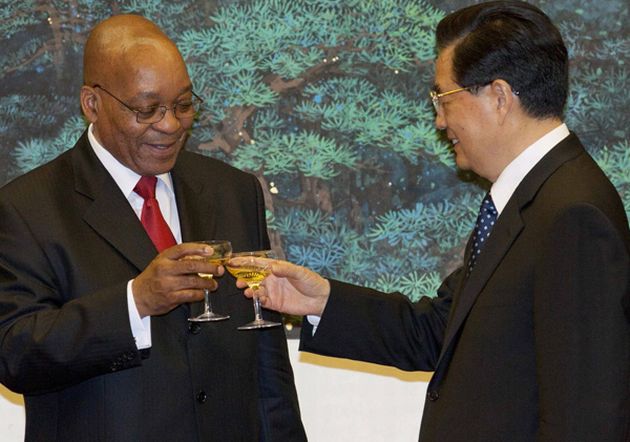 Increasingly, ANC officials — and many officials of other African nations — are being trained and schooled in China, according to the Mail and Guardian.
According to The China – Africa Trade and Economic Relationship Annual Report for 2010; China has moved from a modest partner that gave a grant of 26 million Swiss francs to Egypt in 1956 to a leading trading partner in the entire continent with bilateral trade of over $118 billion.
China, treats Africa as one; a novel approach to the continent different from that of European powers that have sustained mirror images of themselves through Anglophone, Lusophone, francophone and Spanish.
The China – Africa report indicates that between 2002 and 2009, Chinese investment in Africa increased from $220 million to $1.44 billion; curiously, Africa’s investment in China increased from $280 million to $1.31 billion.
The report further states, by the end of 2009, 50 Africa countries had made investments in 4,269 projects in China.
Mauritius is named the biggest Africa investor in China followed by South Africa, Nigeria, Egypt, Namibia, Tunisia and Seychelles.
Of interest to me was the framing of Africa as an investor in China, complete with detailed measurements and specific zones where African investors are located namely; Guangdong, Shanghai, Zhejiang, Jiangsu, Tianjin and Shandong.
Shuttling back and forth in history, the Chinese have avoided the western approach of targeting to “help” Africa and instead focused on Chinese interests coated with friendship instead.
Another curious aspect in the Chinese annual report is the repeated usage of the term, “friendship,” “unity” and more importantly “observe.”
China is making even more effective inroads in authoritarian nations such as Zimbabwe, Angola, Mozambique and Congo. “The Chinese offer attractive solutions out of hand without political demands, and we Europeans just can’t match that,” complains a high-ranking European Union diplomat in Maputo, Mozambique.


![[Most Recent Quotes from www.kitco.com]](https://i0.wp.com/www.kitconet.com/charts/metals/gold/t24_au_en_usoz_2.gif)
![[Most Recent Quotes from www.kitco.com]](https://i0.wp.com/www.kitconet.com/charts/metals/silver/t24_ag_en_usoz_2.gif)

 crisisboom
 CRISISBOOM
You must be logged in to post a comment.