Archive
Nuclear Targets in America
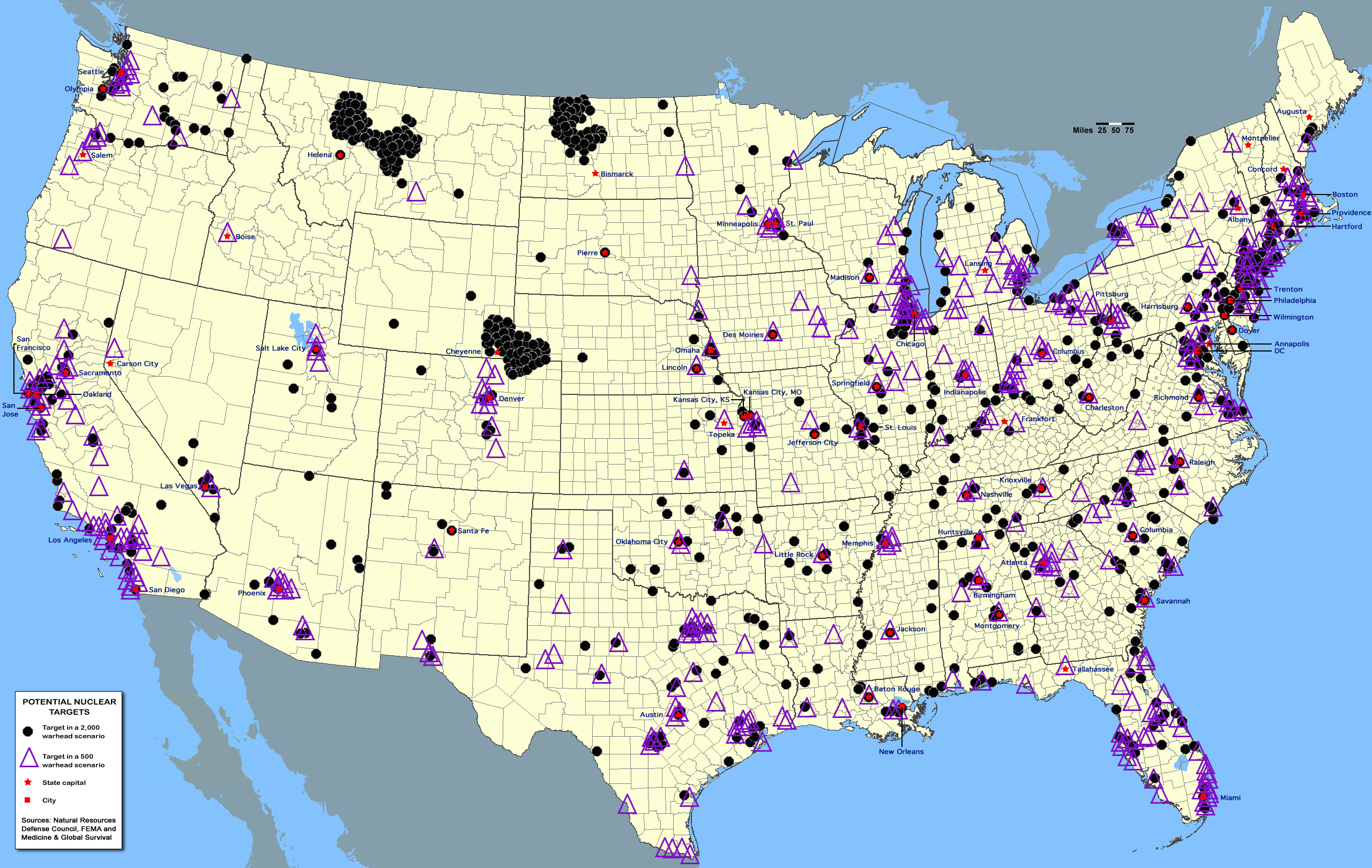
In the event of a nuclear war many of these cities have been mapped as potential Nuclear Targets due to being economic centers, tourism, military, local governments Eco hubs etc.. Click on the map to see your town enlarged. Hard to believe is it not? The town that I reside in is not that large in size however it is marked.
This information and other valuable information regarding the “Safeness” of America can be found at http://www.standeyo-cart.com/ProductDetails.asp?ProductCode=PPUSA
2010 in Review-Commodities affected by World Events
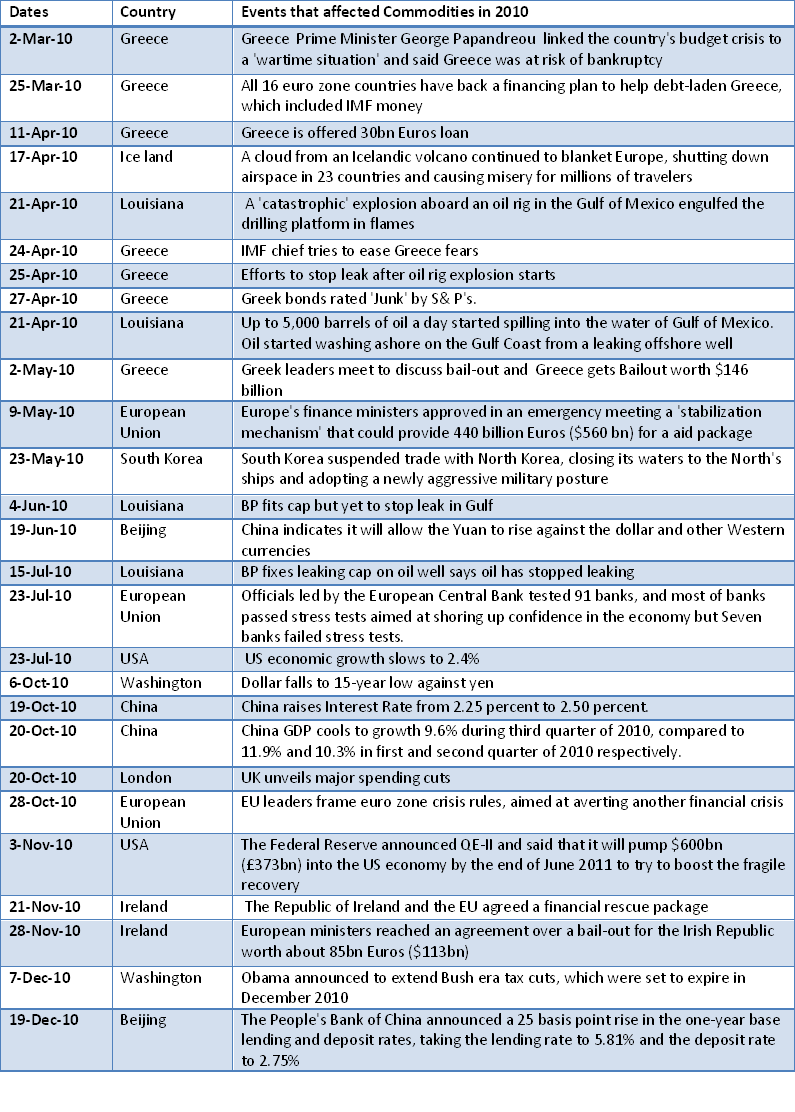 Notable events that affected commodity prices in 2010
Food Crisis of 2011
The Food Crisis of 2011

- Corn: Up 63%
- Wheat: Up 84%
- Soybeans: Up 24%
- Sugar: Up 55%
- Aug. 5: A failed wheat harvest prompted Russia to ban grain exports through the end of the year. Later in August, the ban was extended through the end of 2011. Drought has wrecked the harvest in Russia, Ukraine and Kazakhstan – home to a quarter of world production.
- Oct. 8: For a second month running, the Agriculture Department cut its forecast for US corn production. The USDA predicts a 3.4% decline from last year. Damage done by Midwestern floods in June was made worse by hot, dry weather in August.
Top 10 Survival Downloads
Top 10 Survival Downloads You Should Have

There are tons of good downloads in the Survival Database Download section of this website. For this article – I have selected 10 that everyone should have either printed and put away, or placed on a USB drive – or better yet both.
So – let’s get to it:
#10. FM 4-25-11 First Aid (2002) – Military First Aid Manual. First aid information is a must – get training before you need it – use this manual for reference.
#9. Guide to Canning – Being able to preserve crops to be able to provide for yourself and your family long after the growing season is over is important. This guide will help with that.
#8. Rangers Handbook (2006) – Crammed with info on demolitions, booby traps, communications, patrolling, tactical movement, battle drills, combat intelligence and much more
#7. Where There is No Dentist – The author uses straightforward language and careful instructions to explain how to: examine patients; diagnose common dental problems; make and use dental equipment; use local anesthetics; place fillings; and remove teeth.
#6. NATO Emergency War Surgery – While this is certainly not a manual that would stand alone in most persons emergency/disaster library, it is an absolutely necessary resource if you expect to handle any type of trauma where immediate comprehensive medical care is not available.
#5. A Guide to Raised Bed Gardening – This is not an “all knowing” gardening book – however it provides a lot of information to the “urban gardener” before or after TSHTF. Best to get the experience and knowledge of gardening NOW rather than later.
#4. FM 3-06 Combined Arms Operations in Urban Terrain – Combat techniques covered in the manual which may be very valuable in a “Roadwarrior”-type world.
#3. 1881 Household Cyclopedia – A massive resource of information that much of it has been lost over the past 203 generations. From Angling to Knitting – its here.
#2. FM 21-76-1 Survival-Evasion-Recovery (1999) – Excellent manual geared towards the soldier that finds himself behind enemy lines
#1. FM 21-76 US Army Survival Manual – From Amazon.com: This manual has been written to help you acquire survival skills. It tells you how to travel, find water and food, shelter yourself from the weather and care for yourself if you become sick or injured. This information is first treated generally and then applied specifically to such special areas as the Arctic, the desert, the jungle and the ocean.1970 Military Issue Manual. General Introduction and Individual and Group Survival Orientation Navigation, Finding Water In All Parts of The Globe. How To Obtain Food, Start a Fire and much more!
RELATED ARTICLES:
How to Be a World-Class Survivalist in 5 Simple Steps
10 Skills Needed to Thrive in a Post-Collapse World
IN THE STOCK MARKET, IT’S 1937 ALL OVER AGAIN
One of the most worrisome problems in the stock market right now is that we are basically repeating the exact same situation that occurred from 1937 to 1942.
Most Americans think we’ve had this amazing stock market recovery since the financial crisis of 2008… and we have to a certain extent.
But we are by no means out of the woods.
In fact, during America’s last real economic collapse, in the 1930s and 1940s, we saw a similar drop and recovery… before the markets crashed all over again.
In fact, the situation is eerily similar.
 Look at this chart… it’s one of the scariest I’ve seen in a long time. It shows an overlay of what happened in the stock market in 1937 compared to 2008. In both situations, we saw big crashes, of about the exact same magnitude… then a big recovery, again of about the same size.
But what will happen next?
Well, if history is any guide, we could well have another big leg down in the stock market. That’s exactly what happened 70 years ago.
And with all of the problems left unresolved in our economy today, it could certainly happen again, especially if the U.S. dollar loses its reserve status.
http://www.stansberryresearch.com/pro/1011PSIENDVD/PPSILC42/PR
Normalcy bias-Term of the week
The normalcy bias refers to an extreme mental state people enter when facing a disaster. It causes people to underestimate both the possibility of a disaster occurring and its possible effects. This often results in situations where people fail to adequately prepare for a disaster, and on a larger scale, the failure of the government to include the populace in its disaster preparations. The assumption that is made in the case of the normalcy bias is that since a disaster never has occurred that it never will occur. It also results in the inability of people to cope with a disaster once it occurs. People with a normalcy bias have difficulties reacting to something they have not experienced before. People also tend to interpret warnings in the most optimistic way possible, seizing on any ambiguities to infer a less serious situation.
Hurricane Katrina…
Even as it became clear that the levee system was not going to work, tens of thousands of people stayed in their homes, directly in the line of the oncoming waves of water.
People had never seen things get this bad before… so they simply didn’t believe it could happen. As a result, nearly 2,000 residents died.
Again… it’s the “normalcy bias.”
We simply refuse to see the evidence that’s right in front of our face, because it is unlike anything we have experienced before.
The normalcy bias kicks in… and we continue to go about our lives as if nothing is unusual or out of the ordinary.
Well, we’re seeing the same thing happen in the United States right now.
We have been the world’s most powerful country for nearly 100 years. The U.S. dollar has reigned supreme as the world’s reserve currency for more than 50 years.
Most of us in America simply cannot fathom these things changing. But I promise you this: Things are changing… and faster than most people realize.
For a moment, just look at a tiny fraction of the evidence around us….
** 13% OF POPULATION ON FOODSTAMPS
Did you know that there are now nearly 42 million Americans on food stamps? That’s nearly 13% of the entire population. Those numbers are up 17.5% from last year… and the number of Americans on food stamps has gone up every month for 19 months.
Can a country really be in good shape when 13% of the population can’t even afford to buy food?
Or how about this…
** SHANTY TOWNS COMING TO YOUR NEIGHBORHOOD
Although it’s gone almost completely unreported in the mainstream press, in a dozen or so cities across the nation (like Fresno, Sacramento, and Nashville), there are hundreds of people living in modern-day, Depression-era shanty towns.
The Fresno shanty town has received the most publicity, after a visit by Oprah Winfrey. There, about 2,000 residents are homeless. They even have a security desk at the shelter, because the encampment has gotten so large. City officials say they have three major encampments near downtown, and smaller settlements along two local highways.
Also…
** 43% OF AMERICAN FAMILIES ARE ESSENTIALLY BROKE
According to a recent article on MSN Money, about 43% of the American families spend more than they earn each year.
http://www.stansberryresearch.com/pro/1011PSIENDVD/PPSILC42/PR
Ten Riskiest Places to live In America
Ten Riskiest Places to live In America
NOTE: THESE PAGES HAVE BEEN DRAMATICALLY UPDATED
IN Prudent Places USA — 3rd EDITION
The University of Chicago Press will soon release Mark Monmonier’s new
book, Cartographies of Danger, which looks at how well America maps its natural
and technological hazards as well as social hazards like crime and disease. We
asked Mark to give us a list of the country’s ten most hazardous places. Here is
his top ten (or is that bottom ten?) list:
Hazards of different types affecting areas of varying size are not easily
compared. Even so, the research experience makes it easy to identify ten typical
risky places–areas to which I would be reluctant to move.
Our country has many more hazardous environments: some mapped well,
others poorly or not at all. As “Cartographies of Danger” demonstrates, hazard-
zone maps are a relatively new cartographic product as well as a good indication
of how well we understand hazards and manage risk. In the book I also point out
why a comprehensive atlas of hazards is not yet possible and why place-rating
guides that focus largely on crime present a distorted picture of danger.
Mark Monmonier is a professor of geography at Syracuse University’s
Maxwel School of Citizenship and Public Affairs. He is author of numerous books
on cartography, including How to Lie with Maps (1991, 2nd ed. 1996) and
Drawing the Line: Tales of Maps and Cartocontroversy (1995).
Birds Fish Dead in Arkansas
 On New Years Eve 2010 in Beebe, Arkansas 5,000 blackbirds mysteriously plummeted to their death while in mid-flight. The birds were found in an area that is 1 mile long and 1/2 of a mile wide beginning around 11:30 p.m . No dead birds were found outside of this area. Arkansas’ top veterinarian, Dr. George Stevens, said preliminary autopsies on 17 of the blackbirds, which ruled out poison, indicate they died of blunt trauma and midair. The dead birds were collected from rooftops and streets, but initial tests found no toxins.
 100,000 drum fish were found dead near the town where the 5,000 blackbirds died. It was reported that the fish died Dec. 29, covered about 17 river miles from Ozark Lock and Dam down to river mile 240, directly south of Hartman, Chris Racey, the Game and Fish Commission’s assistant chief of fisheries, said today in a release. The two events happened apparently within a 24 hour time period
Arkansas Game and Fish Commission spokesman Keith Stephens said mass “kills” of fish occur every year but he revealed that the magnitude of the latest one was unusual. “This kill only affected one species,” he said. “If it had been caused by a pollutant it would have affected all kinds, not just drum fish.”
In a seemingly separate incident, some 500 red-winged blackbirds, starlings and grackles were found dead in southern Louisiana in Labarre.Another situation near Little Rock that hasn’t gotten much media attention is the numerous earthquakes that have happened in Guy. According to CNN, there have been 487 “measurable earthquakes” since September 20 of 2010, and the depth of the quakes has been between one-and-a-quarter and five miles below the surface. What’s especially interesting is that Guy is near a major earthquake fault known as the New Madrid.
HAPPY NEW YEAR 2011!

Happy New Year!!!! Many more posts to come for the upcoming year so stay tuned!!
Federal Reserve Banking System Explained
Federal Reserve Banking System Explained


![[Most Recent Quotes from www.kitco.com]](https://i0.wp.com/www.kitconet.com/charts/metals/gold/t24_au_en_usoz_2.gif)
![[Most Recent Quotes from www.kitco.com]](https://i0.wp.com/www.kitconet.com/charts/metals/silver/t24_ag_en_usoz_2.gif)

 crisisboom
 CRISISBOOM
You must be logged in to post a comment.