Analysis: Why Pakistan wants to expand its nuclear arsenal
Rob Crilly, The Daily Telegraph
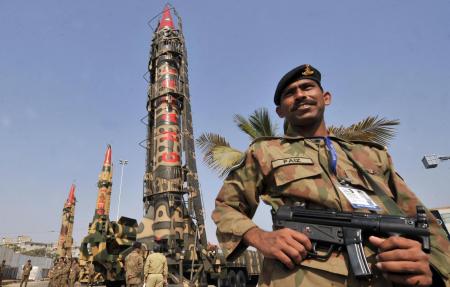
Pakistan is desperate to increase the size of its nuclear arsenal as it eyes India’s rapidly growing economy and population.
Although the numbers of weapons held by either country are small in comparison, the result of the nuclear competition between the two countries is reminiscent of the Cold War arms race between the U.S. and USSR.
In India’s case, the perceived threat is China. For Pakistan, the presumed enemy is India. Paranoia is driving the acceleration of Pakistan’s nuclear arsenal.
The two countries have fought three wars since partition in 1947 and today Islamabad knows that its conventional forces would be swamped by those across the border.
Unable to match India’s defense expenditure, economy and population, Islamabad has, since the 1970s, relied on nuclear technology to provide a deterrent.
The latest escalation in tensions – with Pakistan saying it wants to maintain parity of stocks with India, which recently unveiled a nuclear-powered submarine – will come as no surprise to analysts.
Diplomatic cables released by WikiLeaks have provided snippets of information on Pakistan’s nuclear program.
In a memo dated December 2008, Peter Lavoy, an intelligence officer briefing NATO permanent representatives on Afghanistan and Pakistan, said that despite looming economic meltdown, “Pakistan was producing nuclear weapons at a faster rate than any other country in the world”.
Earlier that year, Indian and U.S. signed a civil nuclear accord, sending shock waves through Pakistan where the deal was seen as allowing Delhi access to international supplies of uranium for civilian projects – freeing domestic reserves for military use.
Other leaked cables also suggest that analysts believe Pakistan is concentrating on developing smaller, mobile nuclear devices to counter India’s conventional battlefield forces, and so need more fissile material.
Since then India has won backing from America to join a series of international nuclear forums, increasing Pakistan’s sense of isolation and nudging it closer to China, which recently announced plans to build a fifth civilian reactor for its ally.
The result is a South Asian nuclear build-up.
The balance of terror
India
Nuclear warheads: 60-80
Defense expenditure (2008): $31.54bn
Military Personnel 4,767,000: (including reservists and paramilitary forces)
Navy: 45 warships, 16 tactical submarines
Air Force: 632 combat aircraft
Pakistan
Nuclear warheads: 70-90
Defense expenditure (2008): $4.42bn
Military Personnel: 1,451,000 (including reservists and paramilitary forces)
Navy 7 warships: 8 tactical submarines
Air Force: 383 combat aircraft


![[Most Recent Quotes from www.kitco.com]](https://i0.wp.com/www.kitconet.com/charts/metals/gold/t24_au_en_usoz_2.gif)
![[Most Recent Quotes from www.kitco.com]](https://i0.wp.com/www.kitconet.com/charts/metals/silver/t24_ag_en_usoz_2.gif)

 crisisboom
 CRISISBOOM
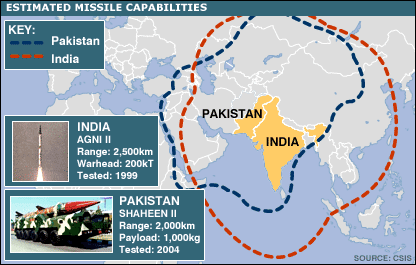
in above diagram the range of pakistani and indian missiles were given wrong…
india have missiles of low range less than 2000 km.and pakistan have missiles of range of approximately 3000 km to 4000 km (shaheen 3) …..so the above data is wrong…..i think this data is given by a indian ……