Archive
Three Cases of Cholera Confirmed by New York City Officials
 The first known cases of cholera in New York since the outbreak of the disease in Haiti last year were confirmed on Saturday by city officials.
A commercial laboratory notified health officials on Friday that three New Yorkers had developed diarrhea and dehydration, classic symptoms of the disease, after returning from a wedding on Jan. 22 and 23 in the Dominican Republic, where the government has been trying to prevent the disease from spreading from neighboring Haiti.
The three who contracted cholera were adults who returned to the city within days of the wedding.
None were hospitalized. Dr. Sharon Balter, a medical epidemiologist for the city Department of Health and Mental Hygiene, said on Saturday that the victims had all recovered.
Officials declined to release the names of the patients or where they lived.
City health officials are now working with the Centers for Disease Control and Prevention in Atlanta to determine what the New York victims ate and to see if the strain of the disease they contracted is linked to the cholera epidemic that has ravaged Haiti, killing thousands since October and infecting many more.
“We’re providing support to the state, with lab testing, in determining which strain” is at issue, said Candice Burns Hoffmann, a spokeswoman for the C.D.C. “And I know there is an Read more…
Red alert in Britain’s forests as Black death sweeps in
Millions of larches have had to be felled to prevent the spread of a lethal virus from Asia. Christopher Middleton reports from the bleak and bare hillsides of South Wales.

Just before Christmas, you could stand at the top of Crynant Forest in South Wales and not have a clue that there was a village in the valley below. Today, the view down to the little white houses is uninterrupted. Where in mid-December there were thousands of larch trees, now there is a mass of stumps and branches.
It looks like a photograph from a First World War battlefield. A featureless no-man’s-land, interrupted by the occasional blasted tree trunk, pointing at an unnatural angle.
And that’s just the start of it. Turn your gaze in any direction, and there is a scene of devastation. Bare hillsides as far as the eye can see; slopes that look as if they’re covered in bracken are in fact coated with fallen trees.
Meanwhile, piles of logs as tall as barns are stacked up neatly by the roadside, like casualties awaiting collection from clearing stations.
The force that swept through here was not a hurricane, but an army of tree-felling engines sent in by the Forestry Commission. Already they’ve cleared 380 acres, but there’s more to be done. Much more.
And they’re in a race against time. Across the country, some 1.4 million larches have been cut down in the Read more…
DEADLY SUPERBUG NDM-1 in BRITAIN
 The bacteria have spread from India and Pakistan and are now being found in hospitals here
Back in 1987 Dr. Robin Cook wrote the medical thriller “Outbreak.” The best-selling novel focused on a team of brilliant medical researchers desperately racing against time to stop a deadly virus from spreading across the United States and potentially killing millions.
Once again fiction becomes reality as England faces its own potentially deadly outbreak with the looming possibility that a superbug from India could bring mass fatalities and spread like wildfire across an unprotected population.
According to the British Health Protection Agency (HPA), a virulent super-bacteria called NDM-1 has invaded the island nation from the Indian sub-continent and Pakistan.
Concerned health professionals have found the bacteria cropping up in hospitals across the country.
Bacteriologists are now burning the midnight oil in a desperate attempt to get a handle on a disease that has the ability to kill thousands.
Superbugs—of which the NDM-1 bacteria is one—are resistant to Read more…
40,000 birds culled in Japan at farm which tested positive for bird flu
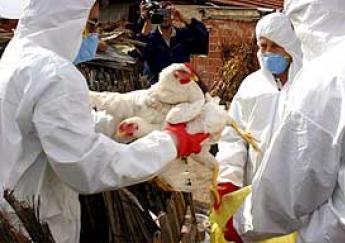 Nearly 40,000 chickens were killed Monday at a poultry farm located in Japan after tests confirmed dead chickens found on Sunday tested positive for bird-flu.
The farm located in the southern region of the country in Miyazaki prefecture on the island of Kyushu was the site of where 90 chickens were found dead.
The incident marked the sixth outbreak of the deadly virus in the region and ninth in the country.
Further tests will be conducted to ascertain whether the virus is the H5N1 strain which has caused the most disease and death in humans or if it was a less virulent strain of the avian flu, such as H5N2.
In November, avian flu was found in the western prefecture of Shimane and also has been confirmed in wild birds across the country.
Over the last few days nearly 600,000 chickens were killed in Miyazaki in government efforts to control the disease.
“It’s spreading quickly,” said Koji Saito a spokesman for the Japanese Agriculture Ministry in charge of sanitation of livestock farming in Miyazaki Prefecture.
Japanese Agriculture Ministry officials are reporting the virus won’t affect humans if meat and eggs consumed from infected birds is fully cooked.
This flu season there haven’t been any human infections according to authorities. Typically bird to human infections is spread largely by direct contact with infected birds.


![[Most Recent Quotes from www.kitco.com]](https://i0.wp.com/www.kitconet.com/charts/metals/gold/t24_au_en_usoz_2.gif)
![[Most Recent Quotes from www.kitco.com]](https://i0.wp.com/www.kitconet.com/charts/metals/silver/t24_ag_en_usoz_2.gif)

 crisisboom
 CRISISBOOM
You must be logged in to post a comment.