Archive
Even Donald Trump Is Warning That An Economic Collapse Is Coming
 In a shocking new interview, Donald Trump has gone farther than he ever has before in discussing a potential economic collapse in America. Using phrases such as “you’re going to pay $25 for a loaf of bread pretty soon” and “we could end up being another Egypt”, Trump explained to Newsmax that he is incredibly concerned about the direction our economy is headed. Whatever you may think of Donald Trump on a personal level, it is undeniable that he has been extremely successful in business. As one of the most prominent businessmen in America, he is absolutely horrified about what is happening to this nation. In fact, he is so disturbed about the direction that this country is heading that he is seriously considering running for president in 2012. But whether he decides to run in 2012 or not, what Trump is now saying about the U.S. economy should be a huge wake up call for all of us.
Trump says that the U.S. government is broke, that all of our jobs are being shipped overseas, that other nations are heavily taking advantage of us and that the value of the U.S. dollar is being destroyed. The following interview with Trump was originally posted on Newsmax and it is really worth watching….
Now, you may or may not think much of Donald Trump as a politician, but when a businessman of his caliber starts using apocalyptic language to describe where the U.S. economy is headed perhaps we should all pay attention.
The following are 12 key quotes that were pulled out of Trump’s new interview along with some facts and statistics that show that what Trump is saying is really happening. Read more…
Egypt’s economy draws parallels to US economy
Economic Warning Signs
 Do you see all of the warning signs that are flashing all around you? These days it seems like there is more bad economic news in a single week than there used to be in an entire month. 2011 is already shaping up to be a very dark year for the world economy. The price of food is shooting through the roof and we have already seen violent food riots in countries like Egypt, Algeria and Tunisia. World financial markets are becoming increasingly unstable as the sovereign debt crisis continues to get worse. Meanwhile, the number of Americans applying for unemployment benefits is up, foreclosures are up and poverty continues to spread like a plague throughout the United States. What we are starting to see around the globe is a lot like the “stagflation” of the 1970s. All of the crazy money printing that has been going on is overheating prices for agricultural commodities and precious metals, but all of this new money is not doing much to help the average man or woman on the street. Read more…
Falling off the American Dream treadmill – Real median U.S. household income falls under $50,000. Poverty rate has grown exponentially since 2000, during the housing bubble.
The U.S. Census Bureau recently released troubling data on the status of American families. The first disturbing point was that 43.6 million Americans now fall under the poverty category. This works out to 1 out of 7 Americans. The growth has come from many people falling off the middle class treadmill. While the echoes of recovery blast through Wall Street the grim reality for most people is that there is a greater and greater divide occurring. The top 1 percent still has significant control over financial resources and wealth disparity is as high as it was during the 1920s. While many American families wait in lines outside of Wal-Marts so their food assistance debit cards refill to buy food, those calling a recovery are usually those who have been protected via bailouts since the recession started.
The data on poverty is grim and disturbing:
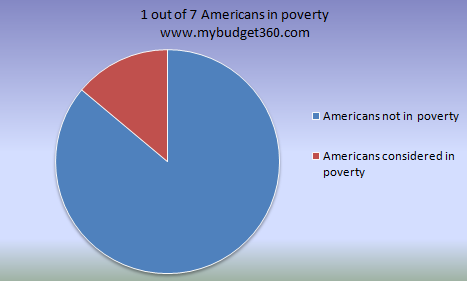
Source: Census
This data takes into full account the deeper blow of the recession. The supposed recovery is nowhere Read more…
Home Construction Declines
By SARA MURRAY
 New-home construction dropped in December to its lowest level in more than a year as the feeble housing sector ended 2010 on a weak note.
Private building of new homes dropped 4.3% in December from a month earlier to a seasonally adjusted annual rate of 529,000—the lowest level of housing starts since October 2009, the Commerce Department said Wednesday. The construction industry continued to stumble last year even as economic growth picked up and private-sector job creation returned. Housing starts ended the year 8.2% below December 2009 and there’s little sign building will pick up early this year.
“From what we’ve heard from builders, they’re not very hopeful for Read more…
World needs $100 trillion more credit, says World Economic Forum
The world’s expected economic growth will have to be supported by an extra $100 trillion (£63 trillion) in credit over the next decade, according to the World Economic Forum.

This doubling of existing credit levels could be achieved without increasing the risk of a major crisis, said the report from the WEF ahead of its high-profile annual meeting in Davos.
But researchers warned that leaders must be wary of new credit “hotspots”, where too much lending takes place, as the world emerges from a financial catastrophe blamed in large part “to the failure of the financial system to detect and constrain” these areas of unsustainable debt.
“Pockets of credit grew rapidly to excess – and brought the entire financial system to the brink of collapse,” said the report, written in conjunction with consulting firm McKinsey. “Yet, credit is the lifeblood of the economy, and much more of it will be needed to sustain the recovery and enable the developing world to achieve its growth potential.”
The global credit stock has already doubled in recent years, from $57 trillion to $109 trillion between 2000 and 2009, according to the report.
The WEF said the continued demand for credit could be met “responsibly, sustainably – and with fewer crises”. However, it cautioned that to achieve this goal, financial institutions, regulators, and policy makers need more robust indicators of unsustainable lending, risk, and credit shortages.
Middle Class Shrinking; Poverty Class Expanding
No Jobs, No Hope, No Future: 27 Signs That America’s Poverty Class Is Rapidly Becoming Larger Than America’s Middle Class
 In the America that most of us grew up in, most Americans considered themselves to be part of the “upper middle class”, the “middle class” or “the lower middle class”. Yes, there have always been poor people and homeless people, but they were thought to be a very small sliver of the population. Well, today all of that is dramatically changing. America’s emerging “poverty class” is exploding in size at the same time that America’s middle class is rapidly disappearing. You won’t hear it on the mainstream news, but the truth is that the United States has lost ten percent of its middle class jobs over the past decade. Only the top 5 percent of income earners in the U.S. has had their incomes increase enough to keep up with the rising cost of living over the past 40 years. The truth is that today there are a whole lot of people aggressively jostling for the small number of good jobs that are actually available and each year millions more Americans are being squeezed out of the middle class. The number of Americans that are financially dependent on the U.S. government continues to set new records month after month. The number of Americans that are participating in the labor force continues to go down. The sad reality is that the “American Dream” that so many Americans used to take for granted is being ripped away from us. If you still believe that the United States is guaranteed to always have a very large, very prosperous middle class then you really need to read the statistics listed below.
If you told most Americans ten years ago that in 2011 over 43 million Americans would be on food stamps hardly anyone would have believed you.
But yet here we are.
The U.S. economy simply is not producing enough good jobs anymore. Most of those that are able to acquire one of these jobs have been able to cling to middle class status, but for millions upon millions of others economic desperation has become “the new normal”.
In fact, more Americans than ever seem to have Read more…
Postal Service Eyes Closing Thousands of Post Offices
HOLMES MILL, Ky.—The U.S. Postal Service plays two roles in America: an agency that keeps rural areas linked to the rest of the nation, and one that loses a lot of money.
 Now, with the red ink showing no sign of stopping, the postal service is hoping to ramp up a cost-cutting program that is already eliciting yelps of pain around the country. Beginning in March, the agency will start the process of closing as many as 2,000 post offices, on top of the 491 it said it would close starting at the end of last year. In addition, it is reviewing another 16,000—half of the nation’s existing post offices—that are operating at a deficit, and lobbying Congress to allow it to change the law so it can close the most unprofitable among them. The law currently allows the postal service to close post offices only for maintenance problems, lease expiration’s or other reasons that don’t include profitability.
The news is crushing in many remote communities where the post office is often the heart of the town and the closest link to the rest of the country. Shuttering them, critics say, also puts an enormous burden on people, particularly on the elderly, who find it difficult to travel out of town.
The postal service argues that its network of some 32,000 brick-and-mortar post offices, many built in the horse-and-buggy days, is outmoded in an era when people are more mobile, often pay bills online and text or email rather than put pen to paper. It also wants post offices to be profitable to help it overcome record $8.5 billion in losses in fiscal year 2010.
A disproportionate number of the thousands of post offices under review are in rural or smaller suburban areas, though the postal service declined to provide any estimate on how many beyond those slated to begin closure in March might ultimately close or which ones are being targeted. “We want to make the smartest decisions possible with the smallest impact on communities,” Dean Granholm, vice president for delivery and post office operations, said in an interview. He said the agency is identifying locations that are operating at a deficit and looking “for the opportunity to start the process of closing.” Read more…
U.S. Treasury Secretary Admits U.S. Default is Imminent
By James West
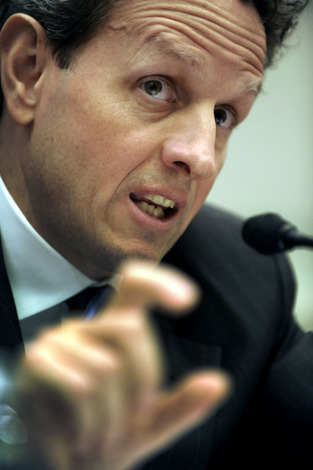 Timothy Geithner, U.S. Treasury Secretary, admitted in a letter to congress dated January 6th, that the United States Treasury would be forced to default on its credit obligations without clearance from congress to raise the amount of money tha the treasury is allowed to borrow.
After citing a list of “extraordinary measures” congress has had to resort to int he past to avoid entering a state of defualt, Geithner stated, “Once these steps have been taken, no remaining legal and prudent measures would be available to create additional headroom under the debt limit, and the United States would begin to default on its obligations. The extraordinary measures include, “suspending sales of State and Local Government Series (SLGS) Treasury securities; suspending reinvestment of the Government Securities Investment Fund (G-Fund); suspending reinvestment of the Exchange Stabilization Fund (ESF); and determining that a “debt issuance suspension period” exists, permitting redemption of existing, and suspension of new, investments of the Civil Service Retirement and Disability Fund (CSRDF).
That the United States has already defaulted on its obligations is beyond dispute, at this point, as its the rate at which its debt service obligations is growing exceeds the rate at which the United States GDP could possibly grow, meaning that, without drastic cuts to governmenbt spending, the debt can only continue to grow.
Before our very eyes, the so-called leadership of the world’s largest economy is intentionally bankrupting the country and devaluing its currency in what can only be a precursor to rampant inflation. Since the integrity necessary to manage this problem does not exist within the United States political system, the rest of the world has no choice but to stand by and watch the value of their United States Treasury Bills diminish incrementally on a daily basis. Selling them will only exacerbate the problem, but the question must be asked, how long until the remedy is preferred over the miserable condition?
Geithner goes on to say, in a remarkable baring of the national soul,
However, if Congress were to fail to act, the specific consequences would be as follows:
The Treasury would be forced to default on legal obligations of the United States, causing catastrophic damage to the economy, potentially much more harmful than the effects of the financial crisis of 2008 and 2009. Read more…
Fed chief expects high unemployment, economic growth in 2011
Vicki Needham
 Unemployment will remain high, the nation’s economy could expand by 4 percent and interest rates may need go up, Federal Reserve Bank of Philadelphia President Charles Plosser said Monday.
“If economic growth in the United States continues to gain traction and the prospects begin to look ever better, it might be time for us to begin thinking about how do we begin to gradually take our foot off the accelerator,” Plosser told reporters after a speech at the Central Bank of Chile in Santiago, according to news reports.
Plosser said he may favor a rate increase if economic growth necessitates a change.
“It might. I’m not going to rule that out,” he said.
The central bank has said that it plans to keep short-term interest rates low for an “extended period.”
During Monday’s speech, Plosser also predicted that the U.S. could grow between 3 percent and 4 percent this year.
The Fed’s plan to purchase $600 billion in government debt will probably continue through June while the nation’s 15 million unemployed look for work, although Plosser didn’t rule out pulling the stimulus funds back earlier.
“It could end earlier if economic conditions call for it, but right now I’m not sure that that’s the most likely outcome,” he told reporters. “It obviously creates challenges for some countries because of appreciating currencies. But I think that will pass. Those are short-run issues.”
Plosser has expressed concern about whether the Fed’s quantitative easing, also known as QE2, will spur economic growth while lowering the jobless rate that has remained above 9 percent for 20 months.
“Monetary policy is not going to be able to speed up the adjustments in labor markets or prevent asset bubbles, and attempts to do so may create more instability, not less,” he said.
“Expecting too much of monetary policy will undermine its ability to achieve the one thing that it is well-designed to do — ensuring long-term price stability.”
QE2 has brought harsh criticism from some lawmakers on Capitol Hill who argue that the plan could devalue the dollar and cause inflation.


![[Most Recent Quotes from www.kitco.com]](https://i0.wp.com/www.kitconet.com/charts/metals/gold/t24_au_en_usoz_2.gif)
![[Most Recent Quotes from www.kitco.com]](https://i0.wp.com/www.kitconet.com/charts/metals/silver/t24_ag_en_usoz_2.gif)

 crisisboom
 CRISISBOOM
You must be logged in to post a comment.