Archive
Russia to accelerate GLONASS navigation satellite launches
 Russia will accelerate the pace of communications satellite launches to give its GLONASS navigation system full global coverage capacity by the end of the year, a senior government official said Wednesday.
Russia’s national space agency is planning to place into orbit six new GLONASS navigation satellites by the end of 2011, said Anatoly Shilov, a spokesman for Russia’s National Space Agency.
GLONASS is a Russia-developed satellite-navigation system similar to the U.S.-developed GPS.
The Russian network currently operates 23 satellites, giving coverage of Russia and the former Soviet Union. It needs between 25 and 30 aloft to provide global coverage, according to news reports.
A top government priority for GLONASS is tracking Read more…
Medvedev Commits Russia’s Support to Africa
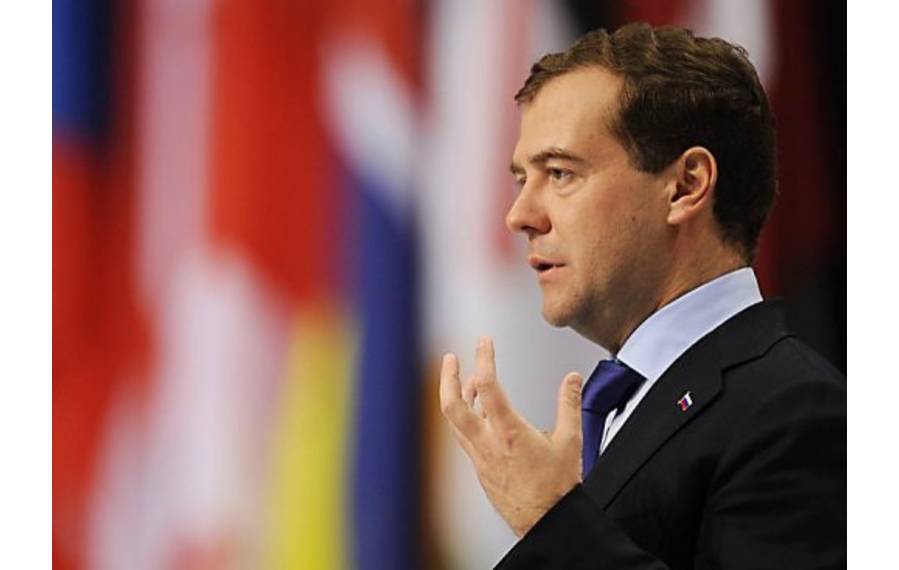 In a congratulatory message to the continent on Africa Day, the Russian President, Dmitry Medvedev, said that his country is ready to continue supporting Rwanda and other African countries in their quest for development.
In his message sent to The New Times, Medvedev said that Africa Day is important for the continent to reflect on its aspirations for freedom, unity, peace, stability and sustainable development.
“In the recent years African countries have been steadily moving on the way of fundamental transformations and modernisation. A lot has been done for acceleration of growth rate, Read more…
Russian resources fuel China’s economic growth
 China has increased high tech exports to Russia 300% in the past five years, while its imports from Russia are dominated by commodities, the Economic Development Ministry said.
China accounted for the bulk of Russia’s bilateral trade, which reached $60 billion in 2010. Russia has increased equipment exports by only 30% since 2005, according to a ministry report on economic relations with China.
No government documents pertaining to Russia’s relations with economic partners are ever published. There is a confidential part to Russia’s foreign economic strategy through 2020, which gives a detailed description of goals and risks related to contacts with each of Russia’s economic partners. Based on this strategy, two years ago the Economic Development Ministry worked out very specific country plans through 2012.
The 2010 report on the China plan progress is addressed to Deputy Prime Minister Alexander Zhukov, who chairs the Russian-Chinese Commission.
In 2009 Zhukov said shortly before Prime Minister Vladimir Putin’s visit to China: “Unfortunately, the share of machinery and equipment in our exports to China is sparse. Our plan is to increase exports of products with a high level of processing.”
However, the ministry report indicates that the progress has been unimpressive so far. Russia’s imports from China are $19bn Read more…
Putin Delivers Big, Mocking Speech Of US Debt, Trade Balance, And Out Of Control Fed
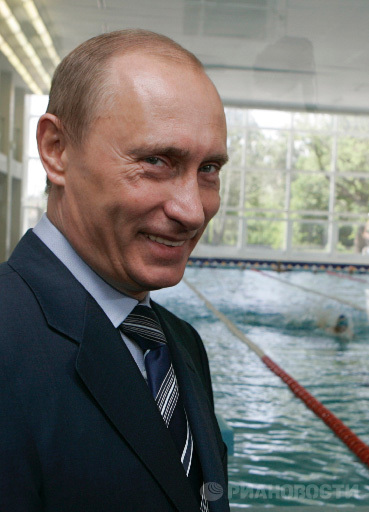 Russian Prime minister Vladimir Putin has called U.S. monetary policy “hooliganism” in a speech before his country’s parliament.
Putin also criticized the U.S. debt situation, and said Russia could not conduct its policy similarly.
“We see that everything is not so good for our friends in the States,” Putin told lawmakers in the lower house of parliament. “Look at their trade balance, their debt, and budget. They turn on the printing press and flood the world with dollars,” he said.
The speech seems pretty typical Putin, applauding himself for recent Russian successes, but it’s made in the context of the 2012 Russian presidential election, in which Putin is expected to run against current president Dmitry Medvedev.
He’s continued to emphasize the fact that Russia Read more…
BRICS demand global monetary shake-up, greater influence

(L-R) India's Prime Minister Manmohan Singh, Russia's President Dmitry Medvedev, China's President Hu Jintao, Brazil's President Dilma Rousseff and South African President Jacob Zuma attend a joint news conference at the BRICS Leaders Meeting in Sanya, Hainan province April 14, 2011. The development banks of the five BRICS nations agreed in principle on Thursday to establish mutual credit lines denominated in their local currencies, not in dollars. REUTERS/How Hwee Young/Pool
SANYA, China (Reuters) – The BRICS group of emerging-market powers kept up the pressure on Thursday for a revamped global monetary system that relies less on the dollar and for a louder voice in international financial institutions.
The leaders of Brazil, Russia, India, China and South Africa also called for stronger regulation of commodity derivatives to dampen excessive volatility in food and energy prices, which they said posed new risks for the recovery of the world economy.
Meeting on the southern Chinese island of Hainan, they said the recent financial crisis had exposed the inadequacies of the current monetary order, which has the dollar as its linchpin.
What was needed, they said in a statement, was “a broad-based international reserve currency system providing stability and certainty” — thinly veiled criticism of what the BRICS see as Washington’s neglect of its global monetary responsibilities.
The BRICS are worried that America’s large trade and budget deficits will eventually debase the dollar. They also begrudge the financial and political privileges that come with being the leading reserve currency.
“The world economy is undergoing profound and complex changes,” Chinese President Hu Jintao said. “The era demands that the BRICS countries strengthen dialogue and cooperation.”
In another dig at the dollar, the development banks of the five BRICS nations agreed to establish mutual credit lines denominated in their local currencies, not the U.S. currency.
The head of China Development Bank (CDB), Chen Yuan, said he was prepared to lend up to 10 billion yuan to fellow BRICS, and his Russian counterpart said he was looking to borrow the yuan equivalent of at least $500 million via CDB.
“We think this will undoubtedly broaden the opportunities for Russian companies to diversify their loans,” Vladimir Dmitriev, the chairman of VEB, Read more…
China-Russia relations and the United States: At a turning point?
 By Dr. Richard Weitz
Since the end of the Cold War, the improved political and economic relationship between Beijing and Moscow has affected a range of international security issues. China and Russia have expanded their bilateral economic and security cooperation. In addition, they have pursued distinct, yet parallel, policies regarding many global and regional issues.
Yet, Chinese and Russian approaches to a range of significant subjects are still largely uncoordinated and at times in conflict. Economic exchanges between China and Russia remain minimal compared to those found between most friendly countries, let alone allies.
Although stronger Chinese-Russian ties could present greater challenges to other countries (e.g., the establishment of a Moscow-Beijing condominium over Central Asia), several factors make it unlikely that the two countries will form such a bloc.
The relationship between the Chinese and Russian governments is perhaps the best it has ever been. The leaders of both countries engage in numerous high-level exchanges, make many mutually supportive statements, and manifest other displays of Russian-Chinese cooperation in what both governments refer to as their developing strategic partnership.
The current benign situation is due less to common values and shared interests than to the fact that Chinese and Russian security concerns are Read more…
Russian Lawmakers to Warn Against Space-Based WMD

The KS battle station. Stripped surplus Buran test articles are docked to the core. They would act as nuclear weapon dispensers.
The lower house of Russia’s parliament was set on Monday to back a decree opposing any deployment of weapons of mass destruction in outer space, Interfax quoted the body’s executive service as saying on Saturday (see GSN, Aug. 11, 2009).
The State Duma decree, titled “In Connection with the 50th Anniversary of the First Manned Space Flight,” was slated for consideration before a Tuesday celebration of the April 12, 1961, flight of cosmonaut Yuri Gagarin.
“Russia takes consistent action to prevent the deployment of offensive armaments and an arms race in space,” though space systems are key to Russia’s defense, the preliminary document says.
“It is impossible to give a modern image to the armed forces of the Russian Federation and achieve high battle readiness and effectiveness for them without space systems of satellite intelligence, communications, targeting, navigation, missile attack warning and means of space missile defense,” the statement says (Interfax, April 9).
U.S. wants to use India in missile shield against Russia, China
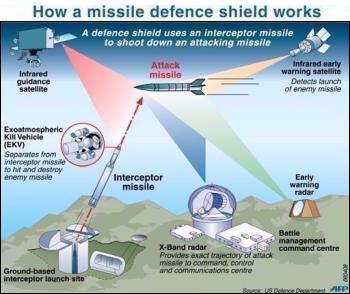 The United States has been trying to rope in India for its plans to build a global missile defence system threatening Russia and China, the Komsomoloskaya Pravda, a popular Russian daily published from Moscow reported on Thursday.
In a story based on the WikiLeaks releases, the report said the U.S. has not only been planning to deploy a missile shield against Russia in Europe, but had also been negotiating with countries along Russia’s borders, such as Japan and India, to jointly build missile defences that would also target Russia.
“The noose [around Russia] is tightening,” the newspaper said. “Thanks to WikiLeaks, it has become known that Washington has been simultaneously conducting talks with countries in other parts of the world for building U.S. missile defences on their territories. Those are different countries, but they form a chain around Russia.”
A 2007 confidential cable from the U.S. embassy in New Delhi carried by the daily refuted media reports that India had abruptly turned its back on a 2005 agreement with the U.S. to cooperate on missile defences. The cable said the Indian media had misinterpreted remarks by External Affairs Minister Pranab Mukherjee after the Russia-India-China trilateral meeting in Harbin, China, on October 24, 2007. Mr. Mukherjee had dismissed as “groundless” the idea that India was going to join a U.S.-led missile defence system.
Misconstrued
“MEA contacts confirm this did not mean India was not interested in continuing to cooperate with the U.S. on missile defence technology and that there has been no change from the current level of bilateral missile defence cooperation,” the U.S. embassy cable said.
The “MEA contacts” explained that Mr. Mukherjee’s comments were “misconstrued” by the Indian press. When Mr. Mukherjee said that “India does not take part in such military arrangements,” the officials said, he had had in mind the U.S. plan to install a missile-detection system in Europe, which his Russian and Chinese counterparts referred to in the same press interaction. Read more…
Why Do These Breathtaking Russian Images of Earth Look So Different from NASA’s?

While this morning’s orbital image of Mercury is historic, these two images are the ones that have truly left me in complete awe today. Even more so than the most accurate, highest resolution view of Earth to date.
But unlike Blue Marble, these images are not by NASA. In fact, they look a lot different from NASA’s Earth imagery. Much better and crisper, some may say. But are they really better? Are they more accurate? NASA has explained to us why they look so different compared to their own.
The russians are back in the space race
It was taken by a Russian spacecraft, a new weather satellite called Elektro-L. It’s now orbiting Earth on a geostationary orbit 36,000 kilometers above the equator, after being launched on January 20 from the Baikonur Cosmodrome, on board a Zenit rocket.
This is the first major spacecraft fully developed in post-Soviet Russia, developed by NPO Lavochkin for the Russian Federal Space Agency. This is a major step in the country’s aerospace industry, after two decades of Read more…
Russia, U.S. begin data exchange under New START

The right to begin conducting on-site inspections officially begins 60 days after the treaty’s entry into force, which is April 6.
The United States and Russia have begun exchanging information on their nuclear stockpiles under a new U.S.-Russian arms reduction treaty, a senior U.S. official said.
“With entry into force of the Treaty, we have begun implementing an extensive regime of mutual monitoring and information exchange,” Rose Gottemoeller, the Assistant Secretary of State for Arms Control, Verification and Compliance, said.
“Our Nuclear Risk Reduction Center transmitted the U.S. database to Russia over this Read more…


![[Most Recent Quotes from www.kitco.com]](https://i0.wp.com/www.kitconet.com/charts/metals/gold/t24_au_en_usoz_2.gif)
![[Most Recent Quotes from www.kitco.com]](https://i0.wp.com/www.kitconet.com/charts/metals/silver/t24_ag_en_usoz_2.gif)

 crisisboom
 CRISISBOOM
You must be logged in to post a comment.