Archive
The What? And Why? Of Rare Earth Metals
Over the past few months, there’s been a buzz surrounding rare earth metals. These are metals such as europium, lanthanum, neodymium and 14 others found in small concentrations attached to other metals and resource deposits. They’re actually not that rare, just expensive and difficult to pull out of the ground.
These naturally occurring elements are essential in everything from wind turbines to lasers to iPads.
Rare earths are a conundrum for the environmentally conscious—they hold the key to green energies but create toxic waste when being separated away from other elements. “Just one wind turbine generating 3 megawatts of electricity requires 600 kilograms of rare earths for its magnets,” a source told the United Kingdom’s Guardian newspaper.
 Electric and hybrid cars can contain more than twice as much rare earth metals as a standard car. This image from the NY Times breaks down how these metals make up critical elements of a Prius.
Currently, China controls 97 percent of the world’s production of rare earth metals. In October 2010, the country cut exports of the metals by 70 percent, disrupting manufacturing in Japan, Europe and the U.S., and sending the prices of these metals up 40 percent.
China currently controls production but the country only has 37 percent of Read more…
Iran to unveil ‘national supercomputer’

The national supercomputer is capable of processing 34 billion operations per second with a speed topping 40 gigabytes within the same time span, Mehr news agency reported on Monday.
Officials at Tehran’s Amirkabir University of Technology (AUT), which will display the computing machine, said that the Iranian supercomputer is capable of processing data and carrying out computations in an array of fields.
High-capacity supercomputers are viewed as strategic products and the Iranian computational device will rank amongst the world’s first 500, the report said.
Supercomputers, primarily introduced in the 1960s, are at the frontline of current processing capacity, particularly speed of calculation.
The machines were introduced in Iran around 10 years by the AUT. Iranian engineers and technicians have been making efforts to increase the computational capacities of the devices ever since.
Supercomputers are used for intensive calculation tasks such as problems involving physics, weather forecast, climate research, molecular modeling, simulations of airplanes in wind tunnels, nuclear research and computations in nanotechnology among others.
Russia Working on Mysterious Space Plane of Its Own

It’s official: the space race is on again.
54 years after the Soviet Union launched its Sputnik I satellite, sparking the original space race — and 20 years after the USSR’s collapse left America as the sole space superpower — the Russians are back on track. The Kremlin’s military space chief Oleg Ostapenko just announced that Russia is developing a small, maneuverable, reusable space plane to match the U.S. Air Force’s mysterious X-37B Orbital Test Vehicle.
Russian industry has already outlined the craft’s design, Ostapenko said. “As to whether we will use it, only time will tell,” he added coyly.
But it seems unlikely Russia would forgo the opportunity to Read more…
Invisibility cloak enters the real world
Scientists are a step closer to creating a Star Trek-style cloaking device after making an object visible to the naked eye disappear for the first time.

In the past researchers have only been able to “cloak” microscopic objects using extremely complicated physics and so-called meta-materials made on a tiny scale.
But a new study at the University of Birmingham has taken a massive step forward by making a paper clip invisible – an object thousands of times bigger than previous experiments.
The research works by using a naturally forming crystal called calcite which has extraordinary light bending abilities.
By placing the crystals over an object it “bounces” light around it rendering it totally invisible to the naked eye.
Dr Shuang Zhang, a physicist and lead investigator from the University of Birmingham, said: ‘‘This is a huge step forward as, for the first time, the cloaking area is rendered at a size that is big enough for the observer to ‘see’ the invisible object with the naked eye.
“By using natural crystals for the first time, rather than artificial meta-materials, we have been able to scale up the size of the cloak and can hide larger objects, thousands of times bigger than the wavelength of the light.”
The new technique is only limited by the size of the naturally formed crystals.
Calcite crystals can be up to 21ft long so it could be used on a car or a military vehicle.
It may also be possible to manufacture crystals with similar qualities.
Dr Zhang said: “Previous cloaks have succeeded at the micron level – much smaller than the thickness of a human hair – using a nano- or micro-fabricated artificial composite material.
“It is a very slow process to make these structures and they also restrict the size of the cloaking area.
“We believe that by using calcite, we can start to develop a cloak of significant size that will open avenues for future applications of cloaking devices.”
The research is published in the journal Nature Communications.
Germany deploys contactless national ID
 Germany began issuing the new contactless national ID to citizens in November. The program is one of the first contactless-only electronic ID programs. It also employs a unique privacy scheme to protect cardholders.
National ID cards aren’t new in the European Union and many countries use smart card technology to power the credentials. But the contactless German ID is a bit of a departure from what other countries have done and thus necessitated a slightly different take on existing contactless smart cards.
The country expects to issue 60 million cards over the next 10 years to replace existing paper documents, says Rudy Stroh, executive vice president of the ID business and country manager for Germany at NXP Semiconductors. NXP is providing the chip–its 128-kilobyte SmartMX secure contactless microcontroller–for the German e-ID.
“The contactless technology used in the e-ID enables strong privacy protection,” Stroh says.
The first difference between the German ID card and other contactless smart cards is that is can only be read from four centimeters, whereas most other cards can be read from Read more…
Get Internet Access When Your Government Shuts It Down
Does your government have and Internet kill-switch? Read our guide to Guerrilla Networking and be prepared on when the lines get cut.
 These days, no popular movement goes without an Internet presence of some kind, whether it’s organizing on Facebook or spreading the word through Twitter. And as we’ve seen in Egypt, that means that your Internet connection can be the first to go. Whether you’re trying to check in with your family, contact your friends, or simply spread the word, here are a few ways to build some basic network connectivity when you can’t rely on your cellular or landline Internet connections.
Do-It-Yourself Internet With Ad-Hoc Wi-Fi
Even if you’ve managed to find an Internet connection for yourself, it won’t be that helpful in reaching out to your fellow locals if they can’t get online to find you. If you’re trying to coordinate a group of people in your area and can’t rely on an Internet connection, cell phones, or Read more…
Technology of the New World
Your cellphone is spying on you…even when its off

Domestic use of aerial drones by law enforcement likely to prompt privacy debate
 AUSTIN – The suspect’s house, just west of this city, sat on a hilltop at the end of a steep, exposed driveway. Agents with the Texas Department of Public Safety believed the man inside had a large stash of drugs and a cache of weapons, including high-caliber rifles.
As dawn broke, a SWAT team waiting to execute a search warrant wanted a last-minute aerial sweep of the property, in part to check for unseen dangers. But there was a problem: The department’s aircraft section feared that if it put up a helicopter, the suspect might try to shoot it down.
So the Texas agents did what no state or local law enforcement agency had done before in a high-risk operation: They launched a drone. A bird-size device called a Wasp floated hundreds of feet into the sky and instantly beamed live video to agents on the ground. The SWAT team stormed the house and arrested the suspect.
“The nice thing is it’s covert,” said Bill C. Nabors Jr., chief pilot with the Texas DPS, who in a recent interview described the 2009 operation for the first time publicly. “You don’t hear it, and unless you know what you’re looking for, you can’t see it.”
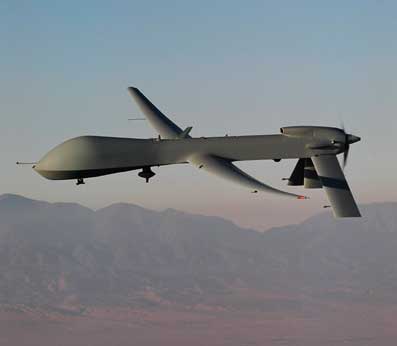
The drone technology that has revolutionized warfare in Iraq, Afghanistan and Pakistan is entering the national airspace: Unmanned aircraft are patrolling the border with Mexico, searching for missing persons over difficult terrain, flying into hurricanes to collect weather data, photographing traffic accident scenes and tracking the spread of forest fires. Read more…
Obama may get power to shut down Internet without court
 A bill giving the president an Internet “kill switch” during times of emergency that failed to pass Congress last year will return this year, but with a revision that has many civil liberties advocates concerned: It will give the president the ability to shut down parts of the Internet without any court oversight.
The Protecting Cyberspace as a National Asset Act was introduced last year by Sens. Joe Lieberman (I-CT) and Susan Collins (R-ME) in an effort to combat cyber-crime and the threat of online warfare and terrorism.
Critics said the bill would allow the president to disconnect Internet networks and force private websites to comply with broad cybersecurity measures. Future US presidents would have those powers renewed indefinitely.
According to a report Monday at CNET News, the bill will be back on the Senate agenda in the new year. But a revision introduced into the bill in December would exempt the law from judicial oversight. According to critics, this change would open the law to politically-motivated abuse by any administration, no matter Read more…


![[Most Recent Quotes from www.kitco.com]](https://i0.wp.com/www.kitconet.com/charts/metals/gold/t24_au_en_usoz_2.gif)
![[Most Recent Quotes from www.kitco.com]](https://i0.wp.com/www.kitconet.com/charts/metals/silver/t24_ag_en_usoz_2.gif)

 crisisboom
 CRISISBOOM
You must be logged in to post a comment.