Archive
JPL: Brown Dwarfs Closer Than First Thought
 Artist’s rendering of size comparisons.
Astronomers have hunted the skies for Y dwarfs, the coldest members of the brown dwarf family, without success until data from NASA’s Wide-field Infrared Survey Explorer revealed the faint glow of six such orbs within a distance of 40 light years from our sun. Unlike stars that burn steadily for billions of years, Y dwarfs fade and cool due to their low mass and inability to fuse atoms at their cores. These dwarfs hold a temperature about the same as a human body.
Astronomers study brown dwarfs in order to Read more…
Strange RF signal is picked up by radio telescopes in California from Elenin.
For several days, has been analyzing radio signals picked up by the USC California Radio Telescope. The signal comes from the transit area of “Elenin” and coincides with the observation G pulse, which also are being analyzed by independent experts. The pulses are equally amazing. In various forums, experts are analyzing the signals…
Closest Supernova in 25 Years Is a ‘Cosmic Classic,’ Astronomers Say
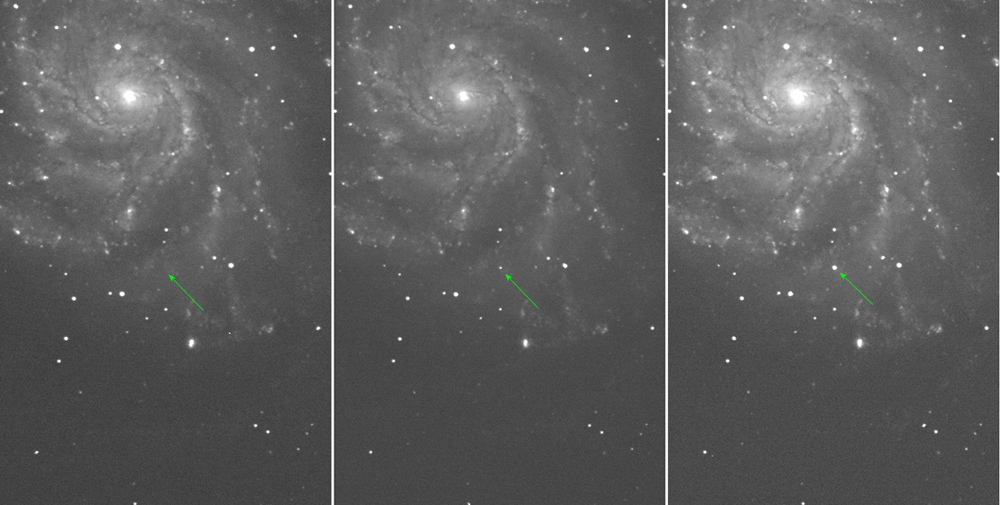
The arrow marks PTF 11kly in images taken on the Palomar 48-inch telescope over the nights of, from left to right, Aug. 22, 23 and 24. The supernova wasn't there Aug. 22, was discovered Aug. 23, and brightened considerably by Aug. 24. CREDIT: Peter Nugent and the Palomar Transient Factory
Astronomers have spotted the closest supernova in a generation — and in a week or so, stargazers with a good pair of binoculars might be able to see it, too.
The supernova, or exploded star, flared up Tuesday night (Aug. 23) in the Pinwheel Galaxy, just 21 million light-years from Earth. It’s the closest star explosion of its type observed since 1986, and astronomers around the world are already scrambling to train their instruments on it.
Researchers said they think they caught the supernova, named PTF 11kly, within Read more…
Supermassive black hole swallows star
 This illustration released by the journal Nature shows an artist’s conception a surge of X-rays from deep space, which resulted after a black hole tore apart a star. (Amadeo Bachar – AFP/Getty Images) For the first time ever, astronomers say they have witnessed a supermassive black hole devouring a star.
In two papers released Wednesday by the journal Nature, scientists described blasts of radiation so bright and powerful they could only be explained by a luckless, sun-sized star being torn apart by the gravitational forces of a “cosmic monster” — the supermassive black hole.
While scientists say this has happened before, this is the first time they have witnessed the event.
On March 28, a detector on the Earth-orbiting Swift observatory picked up a Read more…
Comet Elenin heads towards Earth…
The ancient Mayan calendar predicts that we will be coming to an end of a cycle in the year 2012. The winter solstice is believed to be the date that the world will end. Lately there has been a lot of buzz about the comet Elenin. The comet is set to come close to earth on October 16th of this year and many believe this will have atrocious affects on the planet. Brooks Agnew, author and host of X-squared radio, tells us why we should care.
Two Comets to Pass Close to Earth in Early October
As mentioned before in previous blogs, Comet Elenin will pass close to Earth in six weeks or so. We had previously talked about the theories out there with this comet. To read them, please click here and here.
For even better treat, on Oct. 7, Comet Honda will brighten to a magnitude 5 in the constellation Leo and favor a horizon view before sunrise for Northern sky observers.
That is not all, Comet Honda will join Comet Elenin, and both will be visible on that morning in the same wide field of view in binoculars and camera lenses, a rare treat with two comets at once! You should be able to get some spectacular photos of this event. I will have to remind you as we get closer to the event so that you can post some pictures for me.
Comet Honda is Shown (Bright Object in the Center of the Photo) Read more…
Large Asteroid To Zoom Past Earth In Cosmic Close Call

The third near-earth asteroid of 2011 will pass between the moon and earth later this year, NASA has confirmed.
The 575-foot-wide (175 metres) asteroid, which is more than one and a half times the length of a soccer pitch, will pass within 0.85 lunar distances of the Earth on November 8, 2011.
Discovered on December 28, 2005 by Robert McMillan of the Spacewatch Program near Tucson, Arizona, 2005 YU55 is believed to be a very dark, nearly spherical object.
According to NASA’s Near Earth Object Program: “Although classified as a potentially hazardous object, 2005 YU55 poses no threat of an Earth collision over at least the next 100 years. However, this will be the closest approach to date by an object this large that we know about in advance and an event of this type will not happen again until 2028 when asteroid (153814) 2001 WN5 will pass to within Read more…
Scientists, telescope hunt massive hidden object in space

Some scientists think a brown dwarf or gas giant bigger than Jupiter could be at the outer reaches of the solar system. In this image showing relative size, the white object at the upper left edge represents the sun.
You know how you sometimes can sense that something is present even though you can’t see it? Well, astronomers are getting that feeling about a giant, hidden object in space.
And when we say giant, we mean GIANT.
Evidence is mounting that either a brown dwarf star or a gas giant planet is lurking at the outermost reaches of our solar system, far beyond Pluto. The theoretical object, dubbed Tyche, is estimated to be four times the size of Jupiter and 15,000 times farther from the sun than Earth, according to Read more…
Darkest Planet Found: Coal-Black, It Reflects Almost No Light
Newfound world is off-the-charts dark—and the cause is a mystery, experts say.
 Illustration courtesy David A. Aguilar, CFA
Andrew Fazekas
It may be hard to imagine a planet blacker than coal, but that’s what astronomers say they’ve discovered in our home galaxy with NASA’s Kepler space telescope.
Orbiting only about three million miles out from its star, the Jupiter-size gas giant planet, dubbed TrES-2b, is heated to 1,800 degrees Fahrenheit (980 degrees Celsius). Yet the apparently inky world appears to reflect almost none of the starlight that shines on it, according to a new study.
“Being less reflective than coal or even the blackest acrylic paint—this makes it by far the darkest planet ever discovered,” lead study author David Kipping said.
“If we could see it up close it would look like a near-black ball of gas, with a slight glowing red tinge to it—a true Read more…


![[Most Recent Quotes from www.kitco.com]](https://i0.wp.com/www.kitconet.com/charts/metals/gold/t24_au_en_usoz_2.gif)
![[Most Recent Quotes from www.kitco.com]](https://i0.wp.com/www.kitconet.com/charts/metals/silver/t24_ag_en_usoz_2.gif)

 crisisboom
 CRISISBOOM
You must be logged in to post a comment.