Archive
Chinese Satellites May Aid Strikes on U.S. Warships: Report
New advanced satellites could enable China to direct its ballistic missiles in striking U.S. naval vessels sailing in the region in the event of an outbreak of hostilities, Reuters reported on Monday (see GSN, Jan. 10).

(Jul. 13) - A U.S. guided missile destroyer fires an artillery round during an exercise last month in the South China Sea. China could train its ballistic missiles on nearby U.S. warships using a new generation of reconnaissance satellites, a report warns (U.S. Navy photo).
A soon-to-be-released analysis in the British Journal of Strategic Studies concludes that the fast pace of work on cutting-edge spy orbiters would give China the ability to monitor up-to-the-minute U.S. military movements and to steer its ballistic missiles in strikes on U.S. warships.
“The most immediate and strategically disquieting application (of reconnaissance satellites) is a targeting and tracking capability in support of the antiship ballistic missile, which could hit U.S. carrier groups,” according to the report.
“But China’s growing capability in space is not designed to support any single weapon; instead it is being developed as a dynamic system, applicable to other long-range platforms,” the analysis continues. “With space as the backbone, China will be Read more…
China’s ‘eye-in-the-sky’ nears par with US
 China has launched reconnaissance satellites that can monitor targets up to six hours a day, a think-tanks says
China’s rapidly expanding satellite programme could alter power dynamics in Asia and reduce the US military’s scope for operations in the region, according to new research.
Chinese reconnaissance satellites can now monitor targets for up to six hours a day, the World Security Institute, a Washington think-tank, has concluded in a new report. The People’s Liberation Army, which could only manage three hours of daily coverage just 18 months ago, is now nearly on a par with the US military in its ability to monitor fixed targets, according to the findings.
“Starting from almost no live surveillance capability 10 years ago, today the PLA has likely equalled the US’s ability to observe targets from space for some real-time operations,” two of the institute’s China researchers, Eric Hagt and Matthew Durnin, write in the Journal of Strategic Studies.
China’s Growing Military Muscle: A Looming Threat?
 Stonecutters Island army base in Hong Kong opens to the public once a year as a goodwill gesture. Displays include kung fu demonstrations and shows of knife-fighting skills.
This month, NPR is examining the many ways China is expanding its reach in the world — through investments, infrastructure, military power and more.
At the Stonecutters Island army base in Hong Kong, camouflage-clad Chinese soldiers lunge forward with fierce yells, making stabbing motions with their daggers. There’s a communal shout of admiration from the crowd watching the display on the army’s home territory, which is opened up once a year to the public as a goodwill gesture.
Evolving Military Technology
China is pouring money into its military forces — retrofitting ships, building stealth airplanes and developing advanced weapons technology. Below Read more…
China aircraft carrier confirmed by general
 The 300m (990ft) carrier, under construction in Dalian, is thought to be nearly finished
The head of China’s General Staff of the People’s Liberation Army (PLA) has confirmed that China’s first aircraft carrier is under construction.
Gen Chen Bingde refused to say when the carrier – a remodelled Soviet-era vessel, the Varyag – would be ready.
A member of his staff said the carrier would pose no threat to other nations.
The 300m (990ft) carrier, which is being built in the north-east port of Dalian, has been one of China’s worst-kept secrets, analysts say.
Gen Chen made his comments to the Chinese-language Hong Kong Commercial Daily newspaper.
The PLA – the largest army in the world – is hugely secretive about its defence programme.
The carrier was constructed in the 1980s for the Soviet navy but was Read more…
Iran to Display New Ballistic Missiles
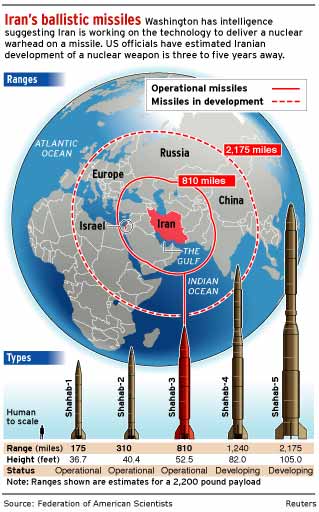 Iran plans next Tuesday to show off a new set of ballistic missiles built recently within its borders, the country’s Fars News Agency reported (see GSN, March 1).
Military equipment “including some vessels, ballistic missiles and new ammunitions will come into use on the occasion of Khorramshahr Liberation Anniversary,” Iranian Defense Minister Ahmad Vahidi said on Wednesday, referring to Iran’s 1982 victory against Iraq in a southern coastal city.
The nation’s military would soon formally receive the new missiles, Vahidi said.
Iran’s missile manufacturing systems have advanced significantly over the past 10 years, according to the media report. The Middle Eastern nation tested an antiship ballistic missile in February (see GSN, Feb. 10).
Iran’s Revolutionary Guard last October received the third variant of the Fateh 110 ballistic missile, and another version of the weapon was due for testing soon, Fars reported. The Fateh 110 is a short-range, solid-fuel weapon suited for firing from a mobile launcher. The missile has sophisticated command and guidance mechanisms, the news report said (see GSN, Sept. 22, 2010; Fars News Agency, May 18).
Iran’s Shahab 3 ballistic missile is the greatest source of worry for Western countries, Deutsche Presse-Agentur reported. The weapon has a 1,240-mile range and could strike any point in Israel (Deutsche Presse-Agentur/Monsters and Critics, May 18).
China-Russia relations and the United States: At a turning point?
 By Dr. Richard Weitz
Since the end of the Cold War, the improved political and economic relationship between Beijing and Moscow has affected a range of international security issues. China and Russia have expanded their bilateral economic and security cooperation. In addition, they have pursued distinct, yet parallel, policies regarding many global and regional issues.
Yet, Chinese and Russian approaches to a range of significant subjects are still largely uncoordinated and at times in conflict. Economic exchanges between China and Russia remain minimal compared to those found between most friendly countries, let alone allies.
Although stronger Chinese-Russian ties could present greater challenges to other countries (e.g., the establishment of a Moscow-Beijing condominium over Central Asia), several factors make it unlikely that the two countries will form such a bloc.
The relationship between the Chinese and Russian governments is perhaps the best it has ever been. The leaders of both countries engage in numerous high-level exchanges, make many mutually supportive statements, and manifest other displays of Russian-Chinese cooperation in what both governments refer to as their developing strategic partnership.
The current benign situation is due less to common values and shared interests than to the fact that Chinese and Russian security concerns are Read more…
Details Emerge on North Korean Missile Launch Site
 North Korea’s second missile launch complex is five times bigger than its first site and seems to be better shielded from a potential attack, the Korea Herald reported on Monday (see GSN, Feb. 18).
In addition to being much larger than the first launch installation at Musudan-ri, the Dongchang-ri complex along the North’s west coast is also closer to China, which is likely to make any attack on the site more complicated for South Korean and U.S. forces, the Chosun Ilbo newspaper reported.
An underground missile fueling center has been constructed at Dongchang-ri in order to escape monitoring by U.S. spy satellites. The facility also has the ability to house liquid fuels for extended periods of time, according to the article.
Work on the facility started in 2002, 10 years after the Musudan-ri site was set up, government sources told the Chosun Ilbo. Recent reports have suggested that construction of the Dongchang-ri site has been completed.
Dongchang-ri is located just 43 miles from the Yongbyon nuclear complex where North Korea has carried out much of its nuclear weapons development efforts. The proximity to Yongbyon would lessen the time and expense of transporting nuclear warheads for attachment to missiles at the new launch site, analysts said.
Pyongyang is not believed to have yet developed the ability to miniaturize nuclear warheads for fielding on long-range ballistic missiles (Song Sang-ho, Korea Herald, April 11).
China blocks coastal waters, enlarges military
Pacific’s chief calls shadowy move ‘troubling’

**file photo **Chinese paramilitary police patrol in Urumqi, western China’s Xinjiang province. (AP Photo/Eugene Hoshiko)
NavyAdm. Robert F. Willard said during a hearing of the Senate Armed Services Committee that China’s intentions behind its decades-long buildup remain hidden and are undermining stability in the Asia-Pacific region.
The four-star admiral said the arms buildup is understandable because of China’s economic rise, but “the scope and pace of its modernization without clarity on China’s ultimate goals remains troubling.”
“For example, China continues to accelerate its offensive air and missile developments without corresponding public clarification about how these forces will be utilized,” he said.
Chinese officials, in meetings with their U.S. counterparts, have refused to explain the pace or goal of the arms buildup, defense Read more…
“Future War with China”?: New US Bomber Aimed at China?

-[General Gary North, commander of the US Pacific Air Force] has hinted at one of the roles the new bombers might play in any future war with China. He said the key to defeating the new J-20 fighter would be to prevent it ever taking off from its mainland bases. Bombers might be used to attack Chinese airfields in the early hours of a conflict.
$3.7 billion. That’s how much the US Air Force proposes to spend over the next five years developing a new, stealthy, long-range, manned bomber likely specifically intended to penetrate Chinese air defences. The plan, included in the Obama administration’ s 2012 budget, could lead to the production of around 100 new bombers by the mid-2020s — and could significantly tip the Pacific balance of power.
Last week’s bomber announcement marked the continued escalation of the arms race between the United States and China. Since early 2010, China has debuted a new stealth fighter prototype (the Chengdu J-20), brought ballistic anti-ship missiles into service and at least temporarily matched the US in Read more…
Russia Fields Ballistic Missiles in South Ossetia, Report Says
 Russia has moved Tochka ballistic missiles to the breakaway Georgian territory of South Ossetia, Interfax reported last week (see GSN, Aug. 26, 2010).
“The Georgian special services have been informed about the presence of the rockets in South Ossetia, which are capable to effectively repel any aggression from Tbilisi,” Georgia, an insider from Russia’s Southern Military District told the news agency.
Also called the SS-21 Scarab, the short-range, single-warhead missile can hit targets within 75 miles, according to Interfax (Interfax, Jan. 24).
Georgia and Russia fought a brief war in summer 2008 after Tbilisi tried to re-exert control over South Ossetia. Since then, Moscow has recognized the independence of Abkhazia and South Ossetia and constructed military facilities in the two areas.
Georgia last week denounced the reported transfer of the Read more…


![[Most Recent Quotes from www.kitco.com]](https://i0.wp.com/www.kitconet.com/charts/metals/gold/t24_au_en_usoz_2.gif)
![[Most Recent Quotes from www.kitco.com]](https://i0.wp.com/www.kitconet.com/charts/metals/silver/t24_ag_en_usoz_2.gif)

 crisisboom
 CRISISBOOM
You must be logged in to post a comment.