Archive
Eyes on the Street: How Traffic Surveillance Invades Your Privacy
 Credit: Dreamstime
Is it cutting-edge, or just downright creepy? Surveillance technology is increasingly being implemented in municipalities across the country. But while such gadgets aim to curtail crime and decrease traffic accidents, some people are wondering about the costs to both town budgets and privacy.
“Overall, we wonder if the costs will outweigh the benefits,” said Jay Stanley, a Washington, D.C.-based senior policy analyst at the American Civil Liberties Union’s Speech, Policy and Technology Project.
Such technology, which includes everything from neighborhood video cameras, red-light cameras and, most recently, parking-space sensors, is popping up faster than mushrooms in a shady forest.
“Over the last several years, traffic-centric surveillance applications Read more…
No Warrant Needed for GPS Monitoring, Judge Rules

A Missouri federal judge ruled the FBI did not need a warrant to secretly attach a GPS monitoring device to a suspect’s car to track his public movements for two months.
The ruling, upholding federal theft and other charges, is one in a string of decisions nationwide supporting warrantless GPS surveillance. Last week’s decision comes as the Supreme Court is expected to rule on the issue within months in an unrelated case.
The ruling from Magistrate David Noce mirrored the Obama administration position before the Supreme Court during oral arguments on the topic in November. In short, defendant Fred Robinson, who was suspected of fudging his time sheets for his treasurer’s office job for the city of St. Louis, had no reasonable expectation of privacy in his public movements, Magistrate Noce said.
Noce ruled: (.pdf)
Here, installation of the GPS tracker device onto defendant Robinson’s Cavalier was not a Read more…
Atlanta video surveillance center to open
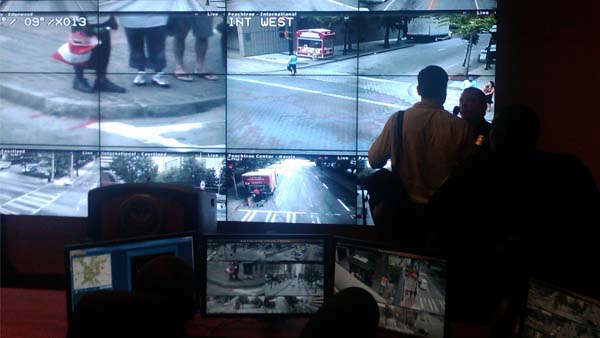 Did you ever get the feeling someone is watching you? If you walk down one of Atlanta’s busy streets, you’re probably right. The police department will keep an even closer eye on the city with a new surveillance camera system they say will help them fight crime.
Monitors stretch from the floor to the ceiling. Police scan every movement on the street in what looks like a scene from a futuristic movie.
It’s the Atlanta Police Department’s new operation shield video integration center, the place where police coordinate and watch more than 100 cameras, mostly downtown, as they keep an eye out for crime.
“When you have an Read more…
We’re Watching You: Surveillance Expansion In the Land of the Free is Unprecedented In Human History

Have you ever heard of a Yottabyte? To put this number into perspective consider the size of a terabyte, which is about the size of a typical modern hard drive. It can hold roughly 100 high definition DVD’s.
A yottabyte is 1,099,511,627,776 terabytes – or over 1 trillion terabytes of information.
This is important because according to a recent report from Politico, the National Security Agency (NSA), which is the security apparatus responsible for monitoring electronic communications across the globe, is building a new data warehousing center in Utah at the cost of $2 billion dollars. It will be housed in a one million square foot complex and be capable of storing at least one yottabyte of data.
We pointed out the various ways that the U.S. government is monitoring Read more…
Wireless Data From Every Light Bulb (Video)
New digital wiretap Bill – why you should be worried

Australia is one step closer to passing the controversial Cybercrime Legislation Amendment Bill 2011. Picture: Thinkstock Source: Supplied
A NEW “digital wiretap” law that would let police force companies like Telstra to store copies of emails and text messages has come under fire from civil rights advocates.
The Cybercrime Legislation Amendment Bill was passed in the House of Representatives this week after being introduced in June. It will now be debated in the Senate.
The Bill would let authorities issue a “preservation notice” to telco companies forcing them to keep copies of a suspect’s digital communications for up to 90 days while police applied for a warrant to access the data.
It would also extend the scope of existing cyber offences and allow for increased information-sharing between Read more…
Future TSA: Track All ‘Daily Travels To Work, Grocery Stores & Social Events’
While the TSA can’t explain why invasive patdowns without probable cause are legal, that isn’t stopping TSA from future plans to track all your daily travels, anywhere you go, from work, to stores, or even when you go out to play.
By Ms. Smith
When the TSA was asked to provide legal reasons that definitely spelled out why physically invasive patdowns are legal, without any probable cause, not one TSA person had an answer. There was no legal documentation for enhanced patdowns other than it serves “the essential administrative purpose.”
Peep show, police state or privacy invasion, patdowns and body scans are not just in airports. EPIC said DHS is refusing to disclose details of mobile body scanner technology. In fact, in answer to EPIC’s FOIA request, DHS handed over “several papers that were completely redacted.”
Meanwhile at airports, the TSA is rolling out “less-invasive gingerbread man” body scanners to a tune of $2.7 million for 240 machines. At this point, I don’t think skinnier versions of the Pillsbury Doughboy via kinder and gentler naked body scans are going to placate people who are secretly Read more…
Airport security: You ain’t seen nothing yet
The Sept. 11, 2001, terrorist attacks forever changed the way Americans fly.

In June, the IATA unveiled a mockup of the "checkpoint of the future" that includes three sensor-lined tunnels that divide passengers into high-, medium- and low-risk threats. Ten years after the 9/11 terror attacks, security experts question whether freedom, speed and personal space -- along with continued safety -- will one day return to air travel.
Gone are the days when friends or family could kiss passengers goodbye at the gate, replaced by X-rayed shoes and confiscated shampoo bottles at security checkpoints.
Air travelers are increasingly subjected to revealing full-body scans or enhanced pat-downs — all in the name of keeping the skies safe.
As America prepares to mark the 10th anniversary of the worst terrorist attacks in the U.S., security experts question whether freedom, speed and personal space — along with continued safety — will one day return to air travel.
Some security analysts foresee a bumper crop of futuristic detection methods — from biometrics to electronic fingerprinting to behavioral analysis — and predict smoother, nimbler and less-intrusive airport walkthroughs in the coming years.
Still others envision Big Brother’s even Bigger Brother: chip-embedded passports that someday tell the federal transportation watchdogs all about your daily commutes to work, the mall — even to parties.
Gazing into the future
And then there are experts like Ed Daly who peer into the next two decades of public travel and forecast two possible scenarios Read more…
In Secret, Senate Panel May Re-Up Vast Surveillance Dragnet
 Most of Congress is busy debating whether to raise the debt ceiling. But starting Thursday, Danger Room is hearing, a group of Senators meeting behind closed doors may consider renewing a controversial law permitting widespread government surveillance of Americans’ communications.
That law would be the FISA Amendments Act of 2008, which gave the cover of law to President George W. Bush’s warrantless surveillance program. Beloved by the Obama administration, the law is set to expire — not this year, but in 2012.
But the Senate Select Committee on Intelligence may not be so keen on waiting, Congressional sources say. When the committee meets to finalize the fiscal 2012 intelligence authorization bill to the full Senate floor — the bill that approves the activities of the 16 U.S. spy agencies – some senators will push to include a measure re-authorizing the surveillance act.
The so-called “mark-up” process begins on Read more…
This Vehicle Registration Plate Surveillance System Is a Warning to Us All
 No CCTV has teamed up with Privacy International and Big Brother Watch to challenge the legality of the Automatic Number Plate Recognition (ANPR) [also known as ALPR in North America] camera network in the UK. A complaint has been sent to the Information Commissioners Office (ICO) against a so-called ANPR “Ring of Steel” that is being constructed around the town of Royston in Hertfordshire — but for Royston read any town in the UK.
Background
The Association of Chief Police Officers (ACPO) has constructed a network of cameras across the country without any public or parliamentary debate. These cameras record the number plate of each and every vehicle that passes, sometimes taking a photograph of the car and its occupants. The number plate is then compared to a “hotlist” of vehicles of interest, and whether or not the plate is on that list (ie a “hit”), all information gathered is stored for between two and five years. A Hertfordshire Police Authority report reveals the details of the data retention periods:
Currently number plate pictures are held for 2 years. Car pictures are held for 90 days. “Hits” information on text and number pictures are held for 5 years and car pictures are held for 2 years.
[‘Final report of the Topic Group on Automatic Number Plate Recognition (ANPR) Technology use within Hertfordshire Constabulary’, p. 9]
The data collected from number plate cameras can be linked to multiple databases such as the Driver and Vehicle Licensing Agency (DVLA) database and the Motor Insurance Database Application System (MIDAS) which in turn can be used to identify the owner of the vehicle. The resulting database of Read more…


![[Most Recent Quotes from www.kitco.com]](https://i0.wp.com/www.kitconet.com/charts/metals/gold/t24_au_en_usoz_2.gif)
![[Most Recent Quotes from www.kitco.com]](https://i0.wp.com/www.kitconet.com/charts/metals/silver/t24_ag_en_usoz_2.gif)

 crisisboom
 CRISISBOOM
You must be logged in to post a comment.