Archive
Banks spying on your bills, rent payments, paychecks: report
This article was published a few months ago, however, it is worth re-posting!
 The age of the plain old credit score is gone, says a report at the Wall Street Journal, and it’s been replaced by ever more intrusive efforts by banks and credit agencies to gauge exactly what you’re worth, and what you can pay.
To that end, financial firms are now tracking their customers’ bank deposits, rent payments or home values, and even utility bills to figure out who may soon become a financial risk, reports WSJ‘s Karen Blumenthal.
So, for example, if your employer pays you through direct deposits and those deposits stop, financial institutions can now have warning that your money situation is likely to tighten, and may deny you credit on that basis.
But the efforts don’t end there. A new area of research, income estimation, “took off earlier this year,” WSJ reports, and involves financial firms collecting information about mortgages, personal loans and credit history to determine how much an individual makes and how much credit they should be given.
In this new era of deep data-mining, even your utility bills and rent Read more…
Chinese Develop Gait-Biometrics Surveillance
Another way to be under surveillance.

A confidential United States embassy dispatch released by Wikileaks provides details about a new technology developed by the Chinese Academy of Science to identify people by their gait.
The technology is designed to be deployed beneath existent flooring. From there it measures pedestrian pace and walking pressure to create a unique biometrics profile which can be used to identify and track the movements of individuals without their knowledge…
According to the dispatch, when questioned about the technology’s potential applications, scientists “stated the device was being used by ‘secret’ customers and was not available on the commercial market.” Officials went on to note the technology was involved with “Program 863.”
Program 863, or the State High Tech Development Plan, is a civil-military program created in 1986, according to Lev Navrozov – a former dissident Soviet writer – for the purpose of developing a “post-nuclear superweapon” possibly incorporating nanotechnology.
ACLU slams Chicago’s pervasive surveillance system
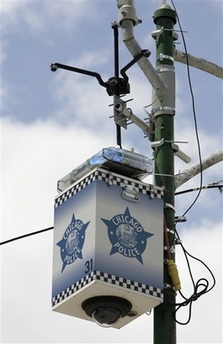 CHICAGO — A vast network of high-tech surveillance cameras that allows Chicago police to zoom in on a crime in progress and track suspects across the city is raising privacy concerns.
Chicago’s path to becoming the most-watched US city began in 2003 when police began installing cameras with flashing blue lights at high-crime intersections.
The city has now linked more than 10,000 public and privately owned surveillance cameras in a system dubbed Operation Virtual Shield, according to a report published Tuesday by the American Civil Liberties Union.
At least 1,250 of them are powerful enough to zoom in and read the text of a book.
The sophisticated system is also capable of automatically tracking people and vehicles out of the range of one camera and into another and searching for images of interest like an unattended package or a particular license plate.
“Given Chicago’s history of unlawful political surveillance, including the notorious ‘Red Squad,’ it is critical that appropriate controls be put in place to rein in these powerful and pervasive surveillance cameras now available to law enforcement throughout the City,” said Harvey Grossman, legal director of the ACLU of Illinois.
The Chicago police “Red Squad” program from the 1920s through the 1970s spied on Read more…
Germany deploys contactless national ID
 Germany began issuing the new contactless national ID to citizens in November. The program is one of the first contactless-only electronic ID programs. It also employs a unique privacy scheme to protect cardholders.
National ID cards aren’t new in the European Union and many countries use smart card technology to power the credentials. But the contactless German ID is a bit of a departure from what other countries have done and thus necessitated a slightly different take on existing contactless smart cards.
The country expects to issue 60 million cards over the next 10 years to replace existing paper documents, says Rudy Stroh, executive vice president of the ID business and country manager for Germany at NXP Semiconductors. NXP is providing the chip–its 128-kilobyte SmartMX secure contactless microcontroller–for the German e-ID.
“The contactless technology used in the e-ID enables strong privacy protection,” Stroh says.
The first difference between the German ID card and other contactless smart cards is that is can only be read from four centimeters, whereas most other cards can be read from Read more…
Technology of the New World
Are You Living In A “Perfect Prison”?
Russia To Adopt Universal ID Card in 2012
 2012 will be the year of universal ID cards in Russia.
For all those conspiracy theorists out there, 2012 just got a little more ominous. As required by legislation passed this last summer, Russia will adopt a universal ID card starting next year. The Universal Electronic Card (UEC) is intended to eventually replace all local, regional, and national forms of ID, providing a central database through which Russians can access everything from medical insurance to ATMs. According to the official website, the UEC will be adopted by around 1000 national and regional services along with about 10,000 commercial enterprises. The mayor of Moscow has already declared it will be able to handle public transportation there, and we can expect similar adoptions throughout the nation. Will all Russians be carrying a single form of ID that is their only passport to all public and private services? Looks like it. A similar project has started in India, and there are experiments for related concepts in Mexico. Universal ID is starting to catch on around the globe. Where will it spread to next?
Ostensibly, the UEC is designed to push the Russian ID Read more…
The State Of Surveillance
 Lost in the recent London bombings, along with innocent lives, was any illusion that today’s surveillance technology can save us from evildoers. Britain has 4 million video cameras monitoring streets, parks, and government buildings, more than any other country. London alone has 500,000 cameras watching for signs of illicit activity. Studying camera footage helped link the July 7 bombings with four men — but only after the fact. The disaster drove home some painful reminders: Fanatics bent on suicide aren’t fazed by cameras. And even if they are known terrorists, most video surveillance software won’t pick them out anyway.
Tomorrow’s surveillance technology may be considerably more effective. But each uptick in protection will typically come at the cost of more intrusion into the privacy of ordinary people. For now, the public seems to find that trade-off acceptable, so scientists around the world have intensified efforts to perfect the art of surveillance, hoping to catch villains before they strike.
Research laboratories envision tools that could identify and track just about every person, anywhere — and sound alarms when the systems encounter hazardous objects or chemical compounds. Many such ideas seem to leap from the pages of science fiction: An artificial nose in doorways and corridors sniffs out faint traces of explosives on someone’s hair. Tiny sensors floating in reservoirs detect a deadly microbe and radio a warning. Smart cameras ID people at a distance by the way they walk or the shape of their ears. And a little chemical lab analyzes the sweat, body odor, and skin flakes in the human thermal plume — the halo of heat that surrounds each person.
All of these projects are on a fast track since September 11. Meanwhile, consumer demand is speeding their development by lowering the cost of the underlying technologies. Camera phones, nanny cams, and even satellite photos are commonplace. Biological sensors are flooding into households in the form of tests for HIV, pregnancy, and diabetes — some of which can relay data to a doctor — and soon there will be far more sensitive DNA-based tests. Next up are radio-frequency identification (RFID) tags. They’re showing up in stores to help track inventory, and 50 people in the U.S. have had them planted under their skin to broadcast their ID and medical data, in case of an emergency. Read more…
Don’t Follow Wikileaks or Big Brother will be following you!
 The Justice Dept. in its ongoing battle to frighten people from sites that might reveal embarassing truths about the U.S. government, issued subpoenas seeking information on Wikileaks associates and people who regularly read their twitter feeds. The move resulted in several thousand Twitter followers dropping out as followers.
It is a bit late of course. The subpoenas would still cover their earlier activity. The Justice Dept. was hoping to obtain not just IP addresses, but mailing addresses and banking information from the people involved. However, Twitter is not likely to have any banking data.
Fortunately Twitter refused to comply with the requests and challenged the act and informed the targets as well. However, Wikileaks lawyer Mark Stephens believe that similar subpoenas may have been sent to other companies such as Skype, and Facebook. THis has yet to be confirmed.
Even though Wikileaks has not any charges against the site, it is being treated not only as a criminal but as some type of terrorist organisation. Certainly the organisation seems to be spreading terror within the U.S. government. The government is pressuring many large corporations to help silence the site and cut off funding and other support.
Big Brother
 When you hear the phrase “Big Brother is watching you,” you probably think of two countries in particular: China and the former Soviet Union. Technology has changed the game. Although the Big Brother approach was effective, due to today’s technology alone privacy is almost nonexistent.
Do you know where your children are? Or your wife who says she has gone shopping or the spouse who claims to be “working late”? How about the whereabouts of your pet? Even in Turkey pet owners are required to make sure their pets have their own microchip. My pets each have a chip in case they go astray. Global Positioning System technology, more commonly known as GPS, is making it easier than ever to find stolen cars or track down missing people or Fido when he gets lost. Who would have ever imagined 50 years ago that you could be found, maybe in some cases somewhere you would not want to be Read more…


![[Most Recent Quotes from www.kitco.com]](https://i0.wp.com/www.kitconet.com/charts/metals/gold/t24_au_en_usoz_2.gif)
![[Most Recent Quotes from www.kitco.com]](https://i0.wp.com/www.kitconet.com/charts/metals/silver/t24_ag_en_usoz_2.gif)

 crisisboom
 CRISISBOOM
You must be logged in to post a comment.