Archive
Cheap food may be a thing of the past

U.S. grain prices should stay unrelentingly high this year, according to a Reuters poll, the latest sign that the era of cheap food has come to an end.
U.S. corn, soybeans and wheat prices — which surged by as much has 50 percent last year and hit their highest levels since mid-2008 — will dip by at most 5 percent by the end of 2011, according to the poll of 16 analysts.
The forecasts suggest no quick relief for nations bedeviled by record high food costs that have stoked civil unrest. It means any extreme weather event in a grains-producing part of the world could send prices soaring further.
The expectations may also strengthen importers’ resolve to build bigger inventories after a year in which stocks of corn and soybeans in the United States — the world’s top exporter — dwindled to their lowest level in decades.
Story: Global food chain stretched to the limit Read more…
When and How Gold Will Begin its Bubble
 The bull market in Gold is in its 12th year (globally it began in 1999) but has yet to exhibit any “bubble-like” conditions. In fact, we still see many people referring to this bull market as “the Gold trade,” as if its an aberration that needs to be reversed or corrected. That aside, we know that Gold is under-owned as an asset class. The very well respected BCA Research estimates that globally only 1% is allocated to Gold and that fits with some of the charts that I’ve shown in the past.
Institutional accumulation began in 2009 (e.g. Paulson, Einhorn) and we know that phase lasts at least a few years before a bull market gives birth to a bubble.
Part of the problem for Gold has been the solid performance of other asset classes through most of the Gold bull market. Stocks performed very well from 2003 to 2007 and from 2009-2010. Commodities performed well from 2001-2002 and in the first half of 2008. If stocks are doing well or if commodities such as oil and agriculture are performing well, it detracts from Gold. Gold performs its absolute best when the other asset classes underperform or don’t perform too well.
Let me explain the conditions and setup that will facilitate the birth of a bubble and Gold going mainstream. Read more…
Could China Be Forced To Bring A New Global Recession by 2015?
By Dian L. Chu, EconForecast
 Bloomberg on Sunday, Jan. 30 cited a 28-page report–The Financial Crisis of 2015: An Avoidable History (pdf file below)–by Barrie Wilkinson, a London-based partner at consulting firm Oliver Wyman.
The report describes a scenario–spanned 2013 to 2015–when Western QE-induced inflation brings down China, creating a debt crisis in the commodity sector–inclusive of resource-dependent countries as well as commodity producers–which eventually plunge the world into another recession, and a new world order by 2015.
“…the dramatic rises in commodities prices resulting from loose Western monetary policies eventually caused rampant inflation in China. China was forced to raise interest rates and appreciate its currency to bring inflation under control.”
Well, I think we are pretty much there already.
“Once the Chinese economy began to slow, investors quickly realized Read more…
Sudanese Student dies in Sudan clash
 |
| Sudanese riot police patrol the streets of Khartoum [AFP] |
A student who was beaten by police during violent anti-government demonstrations in Khartoum, Sudan’s capital, has died of his wounds in Omdurman hospital, protesters have said.
“Mohammed Abdulrahman, from Ahlia University, died last night in Omdurman hospital as a result of his … wounds after he was beaten by police,” said an activist who took part in Sunday’s protests.
“This morning (Monday) both Ahlia University and the Islamic University of Omdurman have been closed by a government decision,” said the activist, speaking on condition of anonymity.
Two other students said Abdulrahman had fallen during the clashes and was taken to the hospital, where medics informed them that he had died early on Monday.
“Medical sources confirmed to us that the student died yesterday from his injuries inflicted by security forces,” said Yasir Arman, the top official in the north of south Sudan’s main party, the Sudan People’s Liberation Movement (SPLM).
Arman condemned the use of force and said the students were trying to hold peaceful demonstrations.
The Omdurman hospital morgue declined to Read more…
Thousands protest in Jordan for third week
Suha Philip Ma’ayeh
 AMMAN // For the third consecutive on Friday, Jordanians poured into the streets after noon prayers to protest against soaring prices and call for a change in government.
The Islamist led opposition, professional associations and leftist activists marched yesterday from Al Huesseini Mosque to the capital’s center. They held banners that read “Corruption and normalisation are two faces of the same coin,” called for a “national unity government” and called for the prime minister Samir Rifai to step down.
Police estimated 3,500 people took part in the protest, one of several demonstrations held this month despite two recent government aid packages to mitigate the impact of soaring prices. The measures included a 20-dinar (Dh100) monthly salary increase for state workers and in pension, while the previous aid package increased subsidies for some commodities, including fuel and food staples such as rice and sugar.
Another 2,500 people also took to the streets in six other cities across the country after the noon prayers yesterday. Those protests also called for Mr Rifai’s ouster. Read more…
Quantitative Easing Causing Food Prices to Skyrocket
 As I’ve previously noted, interest rates have risen both times after the Fed implemented quantitative easing.
Graham Summers points out that food prices have also skyrocketed both times:
In case you’ve missed it, food riots are spreading throughout the developing world Already Tunisia, Algeria, Oman, and even Laos are experiencing riots and protests due to soaring food prices.
As Abdolreza Abbassian, chief economist at the UN’s Food and Agriculture Organization (FAO), put it, “We are entering a danger territory.”
Indeed, these situations left people literally starving… AND dead from the riots.
And why is this happening?
A perfect storm of increased demand, bad harvests from key exporters (Argentina, Russia, Australia and Canada, but most of all, the Fed’s money pumping. If you don’t believe me, have a look at the below chart: Read more…
Jim Rogers Says $200 Oil Will Lead Massive Commodity Surge
When it comes to state visits the devil is in the detail. It’s the nuances of the arrangements that allow you to calibrate just how important a relationship is. That’s why the world has been watching the visit of the Chinese President Hu Jintao with such attention. The state dinner at the White House – described as an “intimate” event – apparently signifies that Washington rates China as pretty much the most important nation, economically, on earth. But the visit has also prompted much speculation in the press about how long the Chinese economic miracle can last and whether it is about to come to a juddering halt. Jim Rogers, the legendary investor who co-founded the Quantum Fund with George Soros, has moved his family to Singapore and is making sure his two young daughters can speak Mandarin. He spoke to the Business Daily’s Justin Rowlatt.
Transcript is below
 Jim Rogers: The largest creditor nations in the world are in Asia now: China, Korea, Japan, Hong Kong. This is where the assets are. You know who the debtors are and where they are.
Justin Rowlatt: But listen, I mean the Chinese economy is still way behind the American economy is and it is about the third the size of the American economy.
Jim Rogers: Yes, of course. They had a disaster for 300 years, but about 30 years ago, they woke up, they changed their minds and they said we got to try something new. They unleashed entrepreneurship and capitalism again, and they have been astonishing for 30 years. It takes a while to go from a disaster to rival the Americans, but they are on their way.
Justin Rowlatt: Do you really believe the Chinese boom can continue, because lots of people are saying there are all sorts of asset price bubbles that are going to trip the Chinese up in the coming years?
Jim Rogers: Well, the only asset bubble I see potentially in China is in urban coastal real estate, but real estate is not nearly the entire Chinese economy as it was in America and the U.K. Sure, they will have setbacks.
Justin, in the 19th Century, America had a horrible civil war. We had 15 depressions with a ‘D.’ We had very few human rights. We had massacres in the streets regularly. We had very little rule of law. You could buy and sell – you can still buy and sell congressmen in America, but in those days they were cheap. America had horrible problems, but they came out of that and had a pretty good 20th Century. Read more…
Why Are Commodity Prices Rising? Let Me Count the Ways
 Our overview of 2011 ‘What Ifs’ concentrated on the concepts of bifurcation and biflation. Those themes are already playing out just a couple of weeks into the New Year. Inflation in all types of commodities has ramped up even further, leaving countries like China, India, Brazil, Thailand and South Korea to deal with more than their fair share of these inflationary forces. Meanwhile, easy monetary policy in the U.S. and Europe just adds fuel to the inflation fire.
The United Nations food agency (FAO) kicked off 2011 by announcing that December of 2010 saw food prices eclipse the record levels hit during the 2008 food crisis, which triggered riots in Egypt, Cameroon, and Haiti at the time. The current spike in food prices has already caused violent food riots in Algeria, Tunisia, Morocco, Yemen, and Jordan.
Food Inflation by the Numbers
Food inflation has already hit double digits in China, India and Brazil. It’s not hard to see why when you look at how some of the major soft commodities have performed over the last 12 months:
- Corn: + 69%
- Wheat: + 47%
- Soy Beans: + 44%
- Sugar: + 15%
- Coffee: + 65%
- Cotton: + 105%
(Trailing 12-month price moves as of January 12, 2011)
While these price spikes are causing food and clothing prices to rise, those effects will undoubtedly be exacerbated by the simultaneous rise in energy and raw materials we have seen:
- Oil: + 15% over 12 months and + 30% since the August, 2010 low
- Copper: + 30%
Overall, you can see the rise in commodity prices in the CRB Index, up about 30% since August of 2010, but well off the parabolic peak of 2008: Read more…
South African Corn Rises as Dry Weather Stresses Argentina Crop
Corn in South Africa advanced as dry weather continues to stress crops in Argentina, the world’s largest shipper of the grain after the U.S., raising concerns that global stockpiles may be depleted.
White corn for March delivery, the most active contract on the South African Futures Exchange, gained 28 rand, or 2.2 percent, to close trade at 1,328 rand ($194) a metric ton. Meal made from the grain is the country’s staple food.
Argentina will continue to have a rainfall deficit in the seven days from yesterday, Telvent DTN Inc. said in a forecast. The lack of rain, combined with above-normal temperatures, will stress pollinating corn and developing soybeans, it said.
Yellow corn for March delivery advanced 36 rand, or 2.6 percent, to 1,442 rand a ton. The grain is used mainly as animal feed in South Africa.
Wheat for March delivery fell 1 rand to 2,888 rand a ton.
Gains or losses for the most active contracts of three additional crops today were as follows. All prices are in rand and the crops are sold per ton:
            Today’s Price   Previous Close   % Change
Sunflowers       4,219           4,186          +0.8
Soybeans         3,320           3,270          +1.5
Sorghum          1,500           1,500           0.0
USDA begins surveying damage to citrus crop
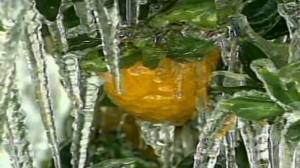 Florida’s freezes wiped out thousands of acres worth of agriculture and millions of cases of food.
Bruce Rottman is picking fruit to get a picture of how bad Florida’s freezes were on citrus.
Rottman works with the USDA, surveying crops to assess damage.
“There’s one right here that’s on the border line,” Rottman said. “It’s got some damage right here where you can see the wavy segment wall there. The fruit is dry right here.”
Nick Faryna, a third generation citrus grower, owns these groves.
He faired surprisingly well, but said the citrus industry will definitely feel the one-two punch from the freezes over the last month.
“Normally we catch the brunt of every system that comes through,” Faryna said. “In this particular event, the air came in so strongly for two days, the air worked its way all the way to South Florida. It was kind of a democratic event. Everyone caught a little bit of it this time.”
Some got hit a lot worse than others.
“There are some areas in Lake County where I have seen some pretty good damage,” Rottman said.
At a grove in Howey-in-the-Hills, most of the leaves are gone and the trees look weathered by winter.
Rottman said this is how it looked after the notorious freezes in the 1980s that wiped out much of the citrus industry here.
“Growers that were in the lower grounds, the sheltered and protected areas really caught the brunt of it this time. And it’s pretty much industry-wide this time,” Faryna said.
Overall, Faryna said about 25 percent of the fruit in his groves suffered some sort of damage from the freezes.
Now, there’s a rush among citrus growers across the state to get that fruit into the orange juice factories before more of it hits the ground.
“It could have been worse,” Faryna said.
Every time there’s a freeze and damage to Florida agriculture, big money is lost here in the state.


![[Most Recent Quotes from www.kitco.com]](https://i0.wp.com/www.kitconet.com/charts/metals/gold/t24_au_en_usoz_2.gif)
![[Most Recent Quotes from www.kitco.com]](https://i0.wp.com/www.kitconet.com/charts/metals/silver/t24_ag_en_usoz_2.gif)

 crisisboom
 CRISISBOOM
You must be logged in to post a comment.