Archive
Bailout plan roils Greece’s leaders
 Greece was wracked by political turmoil yesterday as the embattled prime minister faced down a party revolt over new austerity measures — a bitter dispute that forced the EU to hint at new loans so Greece can fend off a summer default.
Prime Minister George Papandreou has struggled to garner support for a new package of $39.5 billion in spending cuts and tax hikes demanded by the European Union and the International Monetary Fund, which last year granted his debt-ridden nation $155 billion in bailout loans.
But the measures have sparked riots on the streets of Athens and open criticism from his own Socialist lawmakers. Papandreou’s desperate efforts to form a coalition government with the opposition conservatives collapsed Wednesday, and the Read more…
EU ministers scramble to deal with cucumber crisis
 EU agricultural ministers Monday struggled to come to terms with a deadly bacteria outbreak suspected of stemming from contaminated cucumbers that has already killed 12 in Germany.
“One problem with Spanish cucumbers, and all of Europe is trembling,” Belgium’s minister Sabine Laruelle said on the sidelines of an informal meeting in Debrecen, eastern Hungary.
At least 12 people have died in Germany following an outbreak of enterohaemorrhagic E. coli (EHEC) found on imported cucumbers.
And several hundred more are being treated in hospitals for the highly virulent strain of bacteria, which can result in full-blown haemolytic uraemic syndrome (HUS), a disease that causes bloody diarrhoea and serious liver damage and which can result in death.
Around Europe, other cases — real or suspected — have been reported in Denmark, Sweden, Britain, the Netherlands, Austria, France and Switzerland, all of them apparently stemming from Germany.
Dutch agriculture minister Henk Bleker said Read more…
EU Ministers OK $110.8 Billion Portugal Rescue
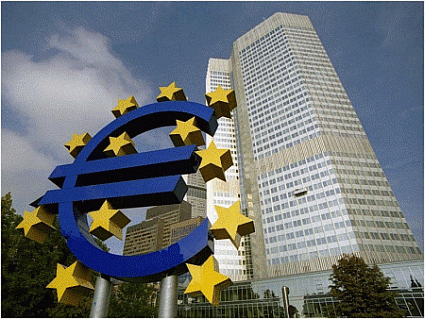 European Union finance ministers cleared the way for Portugal to receive 78 billion euros ($110.8 billion) in aid, making it the third euro-area country to fall back on official loans.
The EU’s two bailout funds, the European Financial Stability Facility and European Financial Stabilization Mechanism, will each provide one-third of the assistance, while the International Monetary Fund will contribute the rest, the EU said in a statement after a unanimous vote in Brussels today.
Finance ministers called Portugal’s planned budget cuts “ambitious but credible,” according to the statement. The aid program will run for three years.
Portugal follows Greece and Ireland in requesting a bailout from the EU and International Monetary Fund. Politicians are struggling to convince investors that 256 billion euros in aid to the three countries will be enough to stamp out Europe’s debt crisis and prevent the euro region’s first restructuring.
Portuguese Finance Minister Fernando Teixeira dos Santos said before the meeting he was confident of approval because “all the issues that we had to clarify were clarified.” German Finance Minister Wolfgang Schaeuble had also been upbeat about Portugal’s aid request.
The meeting was clouded by the May 14 arrest of IMF Managing Director Dominique Strauss-Kahn on Read more…
Signals Spain may seek bailout spelling disaster for eurozone
Violent protests against austerity cuts have broken out in Spain, as the country struggles to deal with record-high unemployment signaling that Madrid could possibly be next in line for an EU bailout.
Across the border, Portugal’s crumbling economy is desperate for a €78 billion rescue package. Read more…
IMF Says Europe’s Debt Woes Could Spread
 The International Monetary Fund is warning that the governmental debt problems in Greece, Ireland and Portugal could spread to other European countries that employ the euro currency and also to the emerging economies in eastern Europe.
In its semi-annual report on the European economy, the IMF said Thursday that officials so far have been able to contain the continent’s debt contagion to the three countries on Europe’s geographic periphery. But the Washington-based financing agency said there “remains a tangible downside risk” of debt problems spreading. It said European nations will have to make “unrelenting” efforts to contain their financial problems.
The IMF said weak banking systems remain a threat to the financial health of the 17 nations where the euro is the common currency. It said the reduction in the number of banks in Europe is proceeding too slowly and that greater financial integration on the continent is needed.
Greece and Ireland reluctantly accepted bailouts from the IMF and their European neighbors last year and now Portugal is Read more…
Timeline: Greece’s debt crisis
 Here is a timeline of economic events in Greece since 2010:
Jan 2010 – Greece unveils stability program on Jan 14, saying it will aim to cut its budget gap to 2.8 percent of GDP in 2012 from 12.7 percent in 2009.
Feb – Greece must refinance 54 billion euros ($66.6 billion) of debt, with a crunch in Q2 as more than 20 billion euros becomes due and market yields for Greek debt soar.
March 5 – Package of public sector pay cuts and tax increases is passed to save an extra 4.8 billion euros. VAT to rise 2 percentage points to 21 percent; state-funded pensions frozen in 2010.
April 11 — Euro zone finance ministers approve 30 billion euros ($40.67 billion) emergency aid mechanism for Greece.
April 15 – Greek parliament passes law that seeks to tackle tax evasion and shift tax burden to higher earners.
April 22 – Eurostat says Greece’s 2009 budget deficit is 13.6 percent of GDP, not 12.7 percent as reported earlier.
April 23 – Prime Minister George Papandreou asks for activation of an EU/IMF aid package. Read more…
Grains Wilt in Dry Europe as England Posts Its Hottest April in 352 Years
Dry, warm weather in Europe may reduce global wheat stockpiles already expected to fall 7.6 percent in the year that ends on May 31, the biggest decline since 2007. Photographer: Simon Dawson/Bloomberg
Dry weather in France and Germany and England’s hottest April in at least 352 years are threatening crops across the European Union, producer of a fifth of the world’s wheat.
About 20 percent of average rain fell in the U.K. in April after a dry March, further reducing soil moisture, the Home- Grown Cereals Authority, an industry group, said in an e-mailed report. European wheat and rapeseed crops are “in jeopardy” after an “incredibly dry” April, according to agricultural weather forecaster Martell Crop Projections.
Dry, warm weather in Europe may reduce global wheat stockpiles already expected to fall 7.6 percent in the year that ends on May 31, the biggest decline since 2007. Food prices reached a record in February, driving 44 million people into poverty, and wheat consumption may rise to an all-time high this year. The world “cannot afford” for Europe’s crop to be diminished, Abdolreza Abbassian, a senior economist at the United Nations’ Food and Agriculture Organization, said last month.
“The world needs a bumper crop in all grains from the U.S. and from Europe and from Canada or we are in trouble,” Dennis Gartman, an economist and author of The Gartman Letter, said today by e-mail. “The winter wheat crop here is in trouble, and the spring wheat crop in the Dakotas and the Canadian prairies may be very badly delayed and therefore in Read more…
Why Is the U.S. Bankrolling IMF’s Bailouts in Europe?
humanevents
 The World Bank and International Monetary Fund held their spring meeting April 14 to 18 in Washington, D.C. Both financial titans were created after World War II to foster economic cooperation and development around the globe. With 16.2% of the International Monetary Fund (IMF) shares, the United States is the largest shareholder among the 187 nations who belong to the fund—even though its managing director has always been a European.
Remote to most Americans, the IMF has been in the headlines recently because of its role as one of the financial rescuers of three European nations whose economies collapsed last year. Under Managing Director Dominique Strauss-Kahn (the former French finance minister, who is considered the leading Socialist candidate for president of France in 2012), the IMF has joined with the European Union to sculpt bailout packages for Greece, Ireland, and Portugal. Coupled with loans from the EU, the price tags on the bailout packages come to $157 billion for Greece, $122 billion for Ireland, and most recently, $116 billion for Portugal.
Obviously, these are quite substantial packages for the three economically devastated countries. They will become very relevant to U.S. taxpayers when they realize that, because we are the largest single contributor to the organization, and with Spain and Italy now Read more…
EU set to unveil neutral net neutrality plans
The European Commission will unveil proposals to foster a neutral and competitive Internet on Tuesday (19 April), drawing praise from big industry for its cautiousness while consumer groups and activists lament its lack of substance. 
Background
Tim Berners Lee, often dubbed ‘the father of the Web’, ranks among the high-profile personalities to have publicly lobbied for regulation to mandate the neutrality of the Internet. However, others have argued that regulation is unnecessary and would threaten innovation.
At the heart of the issue is whether access to Internet services or content should be controlled and filtered rather than left free and provided according to the principle of ‘best effort’.
This principle implies that no provider can prioritise traffic on the Net for economic reasons. Instead, every user should be served with the providers’ ‘best effort’. This criterion has seen derogations in order to allow more professional use of the Internet. Therefore, a business user willing to pay more gets a faster and better connection.
However, extending this concept to many more users would run the risk of the majority getting such a poor service that it will prevent them from using the Internet. The borders between the two needs are currently being defined, and are subject to technological and regulatory developments.
The issue of net neutrality was first debated in the US a while ago, and is now generating intense debate in Brussels. It was also included in the EU’s review of telecoms rules (EurActiv 12/06/09).
While the US has long since passed legislation to ensure an open Internet, the EU has been struggling to catch up.
In a draft proposal seen by EurActiv, the European Commission does its homework on possible infringements of net neutrality but prefers to adopt a Read more…
RSS


Gold
![[Most Recent Quotes from www.kitco.com]](https://i0.wp.com/www.kitconet.com/charts/metals/gold/t24_au_en_usoz_2.gif)
Silver
![[Most Recent Quotes from www.kitco.com]](https://i0.wp.com/www.kitconet.com/charts/metals/silver/t24_ag_en_usoz_2.gif)

 CRISISBOOM
You must be logged in to post a comment.