Archive
Stink bugs hit fruits, vegetables, field crops, also go into houses

A female version of the brown marmorated stink bug.
The Michigan Department of Agriculture (MDA) reported the coming of Asian stink bugs in January, and a report Monday morning said they are confirmed in Ingham, Eaton, Genessee and Berrien counties.
They do not bite or sting, but well, they do stink.
And, as is a big concern to the MDA and producers, they ruin fruit and other crops.
“Exotic pests such as the brown marmorated stink bug pose a serious threat to the economic health of Michigan’s $71.3 billion agri-food industry and our 53,000 farmers,” said Keith Creagh, MDA director. “MDA and Michigan State University researchers will work in concert to both identify control recommendations for our agriculture community, as well as monitor this pest’s spread in the state.”
For those who like to get technical, they are the brown marmorated stink bug (BMSB) or Halyomorpha halys (Stål).
The complete story appears in the Tuesday, April 12, 2011 edition and is available at coldwaterdailyreporter.mi.newsmemory.com.Report Asian stink bugs
BMSB superficially resembles several common species of stink bug native to Michigan. To distinguish them from other stink bugs, look for lighter bands on the antennae and darker bands on the membranous, overlapping part at the rear of the front pair of wings. They have patches of coppery or bluish-metallic colored punctures (small rounded depressions) on the head and pronotum. Those who believe they may have the pest should contact the local Michigan State University Extension office at (517) 279-4311.
For more information on brown marmorated stink bug, one can visit http://www.michigan.gov/mda.
Einstein was right – honey bee collapse threatens global food security
The bee crisis has been treated as a niche concern until now, but as the UN’s index of food prices hits an all time-high, it is becoming urgent to know whether the plight of the honey bee risks further exhausting our food security.

USDA begins surveying damage to citrus crop
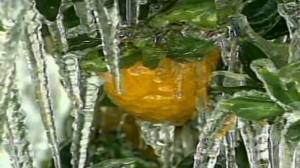 Florida’s freezes wiped out thousands of acres worth of agriculture and millions of cases of food.
Bruce Rottman is picking fruit to get a picture of how bad Florida’s freezes were on citrus.
Rottman works with the USDA, surveying crops to assess damage.
“There’s one right here that’s on the border line,” Rottman said. “It’s got some damage right here where you can see the wavy segment wall there. The fruit is dry right here.”
Nick Faryna, a third generation citrus grower, owns these groves.
He faired surprisingly well, but said the citrus industry will definitely feel the one-two punch from the freezes over the last month.
“Normally we catch the brunt of every system that comes through,” Faryna said. “In this particular event, the air came in so strongly for two days, the air worked its way all the way to South Florida. It was kind of a democratic event. Everyone caught a little bit of it this time.”
Some got hit a lot worse than others.
“There are some areas in Lake County where I have seen some pretty good damage,” Rottman said.
At a grove in Howey-in-the-Hills, most of the leaves are gone and the trees look weathered by winter.
Rottman said this is how it looked after the notorious freezes in the 1980s that wiped out much of the citrus industry here.
“Growers that were in the lower grounds, the sheltered and protected areas really caught the brunt of it this time. And it’s pretty much industry-wide this time,” Faryna said.
Overall, Faryna said about 25 percent of the fruit in his groves suffered some sort of damage from the freezes.
Now, there’s a rush among citrus growers across the state to get that fruit into the orange juice factories before more of it hits the ground.
“It could have been worse,” Faryna said.
Every time there’s a freeze and damage to Florida agriculture, big money is lost here in the state.


![[Most Recent Quotes from www.kitco.com]](https://i0.wp.com/www.kitconet.com/charts/metals/gold/t24_au_en_usoz_2.gif)
![[Most Recent Quotes from www.kitco.com]](https://i0.wp.com/www.kitconet.com/charts/metals/silver/t24_ag_en_usoz_2.gif)

 crisisboom
 CRISISBOOM
You must be logged in to post a comment.