Archive
Chinese Silver Demand Surges Incredible Four Fold in Just One Year
Gold is flat and silver marginally lower despite dollar weakness this morning. Some market participants are blaming the precious metal sell off on speculation that China may take more monetary action to curb surging inflation. This is unlikely to be the reason for the sharp selloff, rather it looks like another paper driven sell off in the futures market by leveraged players on Wall Street with various motives.

The fact that silver is again in backwardation at the front end of the curve suggests that tightness in the physical bullion market continues and may even be deepening. Indeed, the massive increase in silver bullion demand from China (confirmed overnight – see below) suggests that silver’s bull market remains very much intact despite becoming overvalued in the short term towards the end of 2010.

Table Courtesy of Mitsui
Surging inflation in China, India, wider Asia and much of the world is of course positive for gold and silver as it will likely lead to an even greater appetite for the precious metals in order to protect against the ravages of inflation and the further depreciation of paper currencies. Read more…
China buys gold and the world follows
 “We are entering a period of strong seasonal growth in gold demand and Chinese New Year is a big part of that,” said Brien Lundin, editor of Gold Newsletter. “Physical demand has been supporting the gold prices on the downside even during the typical slack periods, and I expect that upcoming increase in demand will also support the price, but at higher levels.”
The Chinese New Year, also known as Lunar New Year, begins on Feb. 3 this year and ends with the Lantern Festival 15 days later.
“Chinese gold and silver demand has been phenomenal ahead of the New Year holiday,” said Adrian Ash, head of research at BullionVault.com, a leading online service for gold bullion trading and ownership, citing comments from dealers among others.
Shipments have been “heavy” and they began very early, in mid-December, he said. Read more…
Jim Rogers Says $200 Oil Will Lead Massive Commodity Surge
When it comes to state visits the devil is in the detail. It’s the nuances of the arrangements that allow you to calibrate just how important a relationship is. That’s why the world has been watching the visit of the Chinese President Hu Jintao with such attention. The state dinner at the White House – described as an “intimate” event – apparently signifies that Washington rates China as pretty much the most important nation, economically, on earth. But the visit has also prompted much speculation in the press about how long the Chinese economic miracle can last and whether it is about to come to a juddering halt. Jim Rogers, the legendary investor who co-founded the Quantum Fund with George Soros, has moved his family to Singapore and is making sure his two young daughters can speak Mandarin. He spoke to the Business Daily’s Justin Rowlatt.
Transcript is below
 Jim Rogers: The largest creditor nations in the world are in Asia now: China, Korea, Japan, Hong Kong. This is where the assets are. You know who the debtors are and where they are.
Justin Rowlatt: But listen, I mean the Chinese economy is still way behind the American economy is and it is about the third the size of the American economy.
Jim Rogers: Yes, of course. They had a disaster for 300 years, but about 30 years ago, they woke up, they changed their minds and they said we got to try something new. They unleashed entrepreneurship and capitalism again, and they have been astonishing for 30 years. It takes a while to go from a disaster to rival the Americans, but they are on their way.
Justin Rowlatt: Do you really believe the Chinese boom can continue, because lots of people are saying there are all sorts of asset price bubbles that are going to trip the Chinese up in the coming years?
Jim Rogers: Well, the only asset bubble I see potentially in China is in urban coastal real estate, but real estate is not nearly the entire Chinese economy as it was in America and the U.K. Sure, they will have setbacks.
Justin, in the 19th Century, America had a horrible civil war. We had 15 depressions with a ‘D.’ We had very few human rights. We had massacres in the streets regularly. We had very little rule of law. You could buy and sell – you can still buy and sell congressmen in America, but in those days they were cheap. America had horrible problems, but they came out of that and had a pretty good 20th Century. Read more…
Pakistan earthquake felt in India and the Middle East


Tremors from a powerful earthquake that rattled many parts of Pakistan early Wednesday were felt as far as New Delhi, 700 miles away.
The 7.2 magnitude quake hit in a sparsely-populated area near the nation’s borders with Iran and Afghanistan, 640 miles west-southwest of Islamabad, according to the U.S. Geological Survey.
No fatalities have been reported.
Officials in Karen, a town in a sparsely populated area close to the epicenter, told the Associated Press that the town suffered no widespread damage.
People came out of their houses in the southern city of Karachi, home to 18 million people, but no major damage was reported there either.
Tremors shook structures in many other parts of the country and were felt as far as Dubai in the Middle East.
The earthquake’s intensity was just below that of another earthquake measuring 7.6 that struck parts of northern Pakistan in 2005 and killed more than 70,000 people.
Government officials warned of the danger of aftershocks in coming days. In some instances such aftershocks have come within a week of previous earthquakes.
“It’s not uncommon for this region to have earthquakes. It is where two tectonic plates come together” CNN quoted Kurt Frankel of the Georgia Institute of Technology.
In Pakistan’s capital Islamabad a Western diplomat quoted by CBS News warned that further damage from the earthquake, notably any of its aftershocks, could seriously undermine Pakistan’s future, right at a time when the United States is urging the country to extend more cooperation in its campaign to fight militants.
“A humanitarian crisis in Pakistan caused by the earthquake will only undermine U.S. interests,” the diplomat said. “As it is, we must all worry about instability in a country armed with nuclear weapons and with political and economic problems,” he added.
South Africa: Another BRIC in China’s Wall
 China’s President Hu Jintao has sent an invitation to South African President Jacob Zuma to attend the third BRICs leaders’ summit to be held in China. Picture: Zuma (center) celebrates the 25th anniversary of the Congress of South African Trade Unions (COSATU) on December 4, 2010 in Johannesburg. (File Photo/CFP)
At China’s invitation, South Africa is set to join the Brazil, Russia, India and China (BRIC) group of emerging nations and will attend the first summit of the leading emerging economies in April this year. The group will thus be renamed the “BRICS,” but doubts remain over the suitability of the African nation to join the exclusive club of the fast-growing economies.
Lauding the Chinese decision to invite her country to the BRIC bloc, South Africa’s Cooperation Minister Maite Nkoana-Mashabane said the invitation was conveyed to her by China’s Foreign Minister Yang Jiechi. She said Chinese President Hu Jintao also sent an invitation to President Jacob Zuma to attend the third BRIC leaders’ summit to be held in China. Read more…
BRIC-The Trillion Dollar World Club
Brazil, Russia, India and China matter individually. But does it make sense to treat the BRICs—or any other combination of emerging powers—as a block?
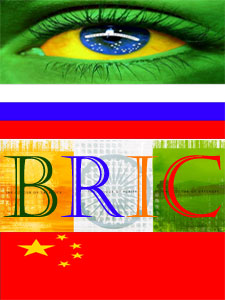 IN ANY global gathering, the American president is usually seen, at a minimum, as primus inter pares: the one who can make or break the final bargain and select his favoured interlocutors. So in Copenhagen last December, as negotiations for a new climate-change
treaty were entering their final hours, a hastily convened meeting between Barack Obama and China’s prime minister, Wen Jiabao, looked as if it would be the critical moment when a deal might be struck. But when the president turned up, he found not only Mr Wen but the heads of government of Brazil, South Africa and India. This was unexpected. The Americans even thought the Indians had already left the summit. What was conceived as a bilateral talk turned instead into a negotiation with an emerging-market block. As an additional sign that things were changing in the world, the president got a finger-wagging from one of Mr Wen’s hangers-on. But at least Mr Obama was in the room; Europeans were shut out while the emerging powers and America put the final touches to their deal.
This week the same developing countries are meeting again, in Brasília. On April 15th Brazil, India and South Africa—rising powers that are also democracies—put their heads together. The next day South Africa will drop out and Russia and China will join the party, to create a meeting of the so-called BRICs.
For this group, it is a second summit; last June their leaders met in Yekaterinburg, in Russia. That inaugural summit, which produced almost nothing concrete, appeared to be Read more…


![[Most Recent Quotes from www.kitco.com]](https://i0.wp.com/www.kitconet.com/charts/metals/gold/t24_au_en_usoz_2.gif)
![[Most Recent Quotes from www.kitco.com]](https://i0.wp.com/www.kitconet.com/charts/metals/silver/t24_ag_en_usoz_2.gif)

 crisisboom
 CRISISBOOM
You must be logged in to post a comment.