Archive
Iran Vows To Unplug The Internet

The leadership in Iran sees the project as a way to end the fight for control of the Internet, according to observers of Iranian policy inside and outside the country. Iran, already among the most sophisticated nations in online censoring, also promotes its national Internet as a cost-saving measure for consumers and as a way to uphold Islamic moral codes.
In February, as pro-democracy protests spread rapidly across the Middle East and Read more…
Escalating violence may push Yemen towards civil war, warns UN human rights office
 Yemenis protesting against the government in Sana’a
27 May 2011 – The United Nations human rights office today voiced alarm at the escalating violence in Yemen, which it said may push the country to the brink of civil war, and called on the Government to stop its deadly crackdown.
The Office of the UN High Commissioner for Human Rights (OHCHR) said it is trying to confirm reports it has received of dozens of civilian casualties, including women and children, in the fighting over the past few days, as well as reports of shelling by Government troops in residential areas.
The death toll has reportedly approached 100 since fighting began Monday after Yemen’s President, Ali Abdullah Saleh, refused for a third time to sign a deal to transfer power amid the pro-democracy protests that began earlier this year.
“The dangerous escalation of violence in Yemen over the past few days is very Read more…
Netanyahu speech eyed for sign of U.S.-Israel rift
President Barack Obama meets with Israel’s Prime Minister Benjamin Netanyahu in the Oval Office at the White House in Washington, May 20, 2011.
WASHINGTON (Reuters) – When Israeli Prime Minister Benjamin Netanyahu addresses Congress on Tuesday, many will be watching to see whether he escalates a war of words with the White House over how to make peace in the Middle East.
Netanyahu has a mostly sympathetic ear in Congress, where few lawmakers in either party speak up for the Palestinians, hewing to decades of Read more…
Why oil prices will spike again soon
How long till the next oil shock?
Energy prices have been coming down this spring as fears of a Middle East blowup fade. But persistent global demand, tepid supply growth and easy money mean it may not be long till the next damaging spike, Goldman Sachs economists say.
 Higher and higher
Oil prices could surge again by the end of 2012, economists Jan Hatzius and Andrew Tilton wrote in a note to clients this past weekend. They say the snail-like pace of global oil supply expansion – which Goldman projects at 1% or so annually – can’t keep a petroleum-addicted world economy rolling without prices rising, perhaps sharply.
So don’t get too used to paying a mere $3 and change for gasoline. Higher prices are on the way soon enough, thanks to stretched supplies and a Federal Reserve spigot that is likely to remain wide open for years to come.
“The fundamental story of increased oil scarcity is unchanged, and our commodity strategists now see distinct upside risks to their current forecast of $120/barrel for Brent crude by late 2012,” Hatzius and Tilton write. “So the impact of scarcer oil and higher oil prices on economic activity remains at the top of our list of worries.”
What makes higher oil prices almost inevitable is the depth of the jobs deficit in the United States. Unemployment is officially 9% but is more like 13% if you consider the low rate of labor force participation, says Bernstein Research strategist Vadim Zlotnikov. That number has fallen this year to levels not seen since 1985.
High joblessness and weak inflation will keep the fed funds rate near zero at least through next year and perhaps longer, Hatzius and Tilton write. That should help keep pushing unemployment slowly toward its long-run average of around 6% — but at the expense of further dollar depreciation, stronger global demand and, ultimately, higher oil prices.
So the selloff that has taken the crude price down to $100 or so in New York and $112 in Europe, where Brent is traded, may persist through much of 2011. But it won’t last Read more…
North Korean Missile Reach Will Extend to U.S.: Senior Intel Official
 WASHINGTON — North Korea’s ballistic missile program would eventually yield systems capable of delivering nuclear weapons to the United States, a senior U.S. intelligence official said on Wednesday (see GSN, April 14).
(May. 19) – A North Korean missile unit, shown in a 1992 military parade in Pyongyang. North Korea is on track to one day produce ballistic missiles suited for carrying nuclear weapons to the United States, a high-level U.S. intelligence official said on Wednesday (Getty Images).
The North Korean missile threat is “very different from what we had 40 years ago with the Soviet Union and the threat of first strikes,” Raymond Colston, the new national intelligence manager for Korea at the National Intelligence Director’s Office, said during a Capitol Hill panel discussion of Korean Peninsula security issues.
“No one is looking at the North Koreans as building these systems to have a first-strike capability or anything like that. That’s not what we’re really concerned about. But they are certainly building missiles that eventually will be capable of targeting the U.S., and these missiles will be capable of having nuclear weapons.”
The North has an aggressive missile development program that has included two apparent test launches of its Taepodong 2 long-range ballistic missile, in 2006 and 2009. The first flight ended in less than a minute, while the second rocket flew farther but apparently crashed down with the second and third stages failing to separate.
Pyongyang is not known to have yet developed nuclear warheads that could be loaded onto missiles. The regime, though, is believed to hold enough plutonium for six weapons and last November unveiled a uranium enrichment plant that could give it a second route for preparing weapons material.
Years of diplomatic activity under the six-party talks process have failed to persuade the regime to accept nuclear disarmament.
North Korea’s proliferation of weapons systems is a “very serious concern,” added the official, who spoke on the third day in his present position at the National Read more…
Iran to Display New Ballistic Missiles
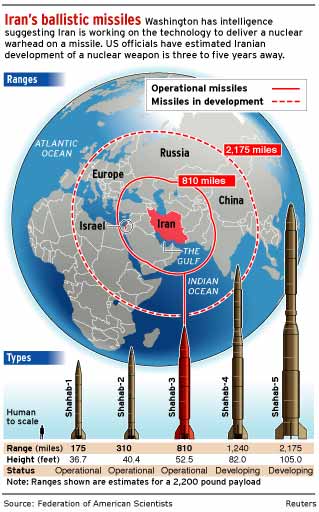 Iran plans next Tuesday to show off a new set of ballistic missiles built recently within its borders, the country’s Fars News Agency reported (see GSN, March 1).
Military equipment “including some vessels, ballistic missiles and new ammunitions will come into use on the occasion of Khorramshahr Liberation Anniversary,” Iranian Defense Minister Ahmad Vahidi said on Wednesday, referring to Iran’s 1982 victory against Iraq in a southern coastal city.
The nation’s military would soon formally receive the new missiles, Vahidi said.
Iran’s missile manufacturing systems have advanced significantly over the past 10 years, according to the media report. The Middle Eastern nation tested an antiship ballistic missile in February (see GSN, Feb. 10).
Iran’s Revolutionary Guard last October received the third variant of the Fateh 110 ballistic missile, and another version of the weapon was due for testing soon, Fars reported. The Fateh 110 is a short-range, solid-fuel weapon suited for firing from a mobile launcher. The missile has sophisticated command and guidance mechanisms, the news report said (see GSN, Sept. 22, 2010; Fars News Agency, May 18).
Iran’s Shahab 3 ballistic missile is the greatest source of worry for Western countries, Deutsche Presse-Agentur reported. The weapon has a 1,240-mile range and could strike any point in Israel (Deutsche Presse-Agentur/Monsters and Critics, May 18).
Grains Wilt in Dry Europe as England Posts Its Hottest April in 352 Years
Dry, warm weather in Europe may reduce global wheat stockpiles already expected to fall 7.6 percent in the year that ends on May 31, the biggest decline since 2007. Photographer: Simon Dawson/Bloomberg
Dry weather in France and Germany and England’s hottest April in at least 352 years are threatening crops across the European Union, producer of a fifth of the world’s wheat.
About 20 percent of average rain fell in the U.K. in April after a dry March, further reducing soil moisture, the Home- Grown Cereals Authority, an industry group, said in an e-mailed report. European wheat and rapeseed crops are “in jeopardy” after an “incredibly dry” April, according to agricultural weather forecaster Martell Crop Projections.
Dry, warm weather in Europe may reduce global wheat stockpiles already expected to fall 7.6 percent in the year that ends on May 31, the biggest decline since 2007. Food prices reached a record in February, driving 44 million people into poverty, and wheat consumption may rise to an all-time high this year. The world “cannot afford” for Europe’s crop to be diminished, Abdolreza Abbassian, a senior economist at the United Nations’ Food and Agriculture Organization, said last month.
“The world needs a bumper crop in all grains from the U.S. and from Europe and from Canada or we are in trouble,” Dennis Gartman, an economist and author of The Gartman Letter, said today by e-mail. “The winter wheat crop here is in trouble, and the spring wheat crop in the Dakotas and the Canadian prairies may be very badly delayed and therefore in Read more…
Yemen crisis: Protesters keep up pressure on Saleh
 Thousands of anti-government protesters are standing their ground in the capital of Yemen, despite a deal that would see the president step down.
Protesters occupying a permanent camp in Sanaa say they don’t trust President Ali Abdullah Saleh to keep his promise to leave office.
Mr Saleh agreed on Saturday to hand over power to his deputy within 30 days in exchange for immunity from prosecution.
Protesters say he must go immediately.
There were fresh demonstrations in Sanaa and in other parts of the country on Sunday.
Witnesses say the protesters in Sanaa are ringed by army units that defected to join and protect them. Uniformed soldiers were seen chanting alongside the demonstrators and flashing victory signs.
At least 130 people have died during two months of protests inspired by uprisings elsewhere in the Arab world.
Despite the protesters concerns, a coalition of seven opposition parties has generally accepted the deal, brokered by the Gulf Read more…
Oil Crisis Just Got Real: Sinopec (Read China) Cuts Off Oil Exports
 As if a dollar in freefall was not enough, surging oil is about to hit the turbo boost, decimating what is left of the US (and global) consumer. Xinhua, via Energy Daily, brings this stunner: ” Chinese oil giant Sinopec has stopped exporting oil products to maintain domestic supplies amid disruption concerns caused by Middle East unrest and Japan’s earthquake, a report said Wednesday. The state-run Xinhua news agency did not say how long the suspension would last but it reported that the firm had said it also would take steps to step up output “to maintain domestic market supplies of refined oil products”. Oh but don’t worry, those good Saudi folks are seeing a massive drop in demand… for their Kool aid perhaps. “Sinopec would ensure supplies met the “basic needs” of the southern Chinese special regions of Hong Kong and Macao, but they also should expect an unspecified drop in supply, Xinhua quoted an unnamed company official as saying.” Now… does anyone remember the 1970s? Read more…
Disease hits wheat crops in Africa, Mideast
 PARIS — Aggressive new strains of wheat rust disease have decimated up to 40 percent of harvests in some regions of north Africa, the Middle East, Central Asia and the Caucasus, researchers said Wednesday.
The countries most affected are Syria and Uzbekistan, with Egypt, Yemen, Turkey, Iran, Morocco, Ethiopia and Kenya also hit hard, they reported at a scientific conference in Aleppo, Syria.
“These epidemics increase the price of food and pose a real threat to rural livelihoods and regional food security,” Mahmoud Solh, director general of the International Center for Agricultural Research in the Dry Areas (ICARDA), said in a statement.
In some nations hit by the blight, wheat accounts for 50 percent of calorie intake, and 20 percent of protein nutrition.
“Wheat is the cornerstone for food security in many of these countries,” said Hans Braun, director of the International Maize and Wheat Improvement Center (CIMMYT), near Mexico City, singling out Syria.
“Looking at the political and social situation, what they don’t need is a food crisis,” he told AFP by phone.
Wheat rust is a fungal disease that attacks the stems, grains and especially the Read more…


![[Most Recent Quotes from www.kitco.com]](https://i0.wp.com/www.kitconet.com/charts/metals/gold/t24_au_en_usoz_2.gif)
![[Most Recent Quotes from www.kitco.com]](https://i0.wp.com/www.kitconet.com/charts/metals/silver/t24_ag_en_usoz_2.gif)

 crisisboom
 CRISISBOOM
You must be logged in to post a comment.