Archive
China Engaging the Arctic
 The United States is shifting its focus from the Atlantic across to the Pacific. However, if an Arctic century is on the horizon, then China is at the forefront of it. While Washington enhances its relationships across the Asia-Pacific basin, Beijing is busy engaging Arctic Ocean coastal states en masse. The Middle Kingdom is apparently interested in the commercial viability of new shipping lanes and developing the resources that lie underneath and along the Arctic seabed. Ostensibly to achieve its objectives, China is engaging the region at an unprecedented pace. Beijing’s comprehensive engagement of Arctic states demonstrates that China’s ambition isn’t just to be a Pacific power, but a global one. Questions that remain are: what is Beijing’s intention in the Arctic, and by extension what type of global power will China be?
China has been in the Arctic since the early 1990s, but only recently began seeking to enhance its engagement there as a permanent observer in the Arctic Council. The Arctic Council is a high-level intergovernmental forum that addresses issues such as the management of resources, climate change, and Arctic environment maintenance. The Council has Full article here
China is flexing its muscles in the Pacific Ocean
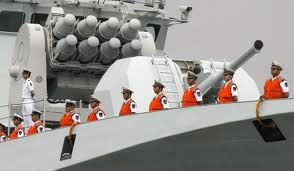
China’s Navy ships moved to the Western part of the Pacific for military exercise. In response Tokyo expressed its concern about the growing naval activity of the Chinese Armed Forces in that region.
According to Japanese mass media, a group consisting of four battle ships (frigates) of the Chinese Navy passed through the waters between the Japanese islands of Okinawa and Miyako. The Chinese Defense Ministry already made a statement that the tour of the ships is connected to the preparation of the annual military exercise of routine nature. In response to the concern of the Japanese side, Beijing stated that China has a free right to pass in those waters. According to the Chinese authorities, that is completely Read more…
Forget the world ending, $5 gas could be the real plague of 2012 according to oil big shot
 For more than two years, former Shell Oil president John Hofmeister has predicted $5-a-gallon gasoline prices by the end of 2012. And as the date that the Mayans coincidentally also think the world will end approaches, Hofmeister is sticking to that.
With 2011 national averages topping $3.50, gas prices have reached record-breaking levels. But, $5 a gallon would still represent an awfully steep climb for 2012.
“Right now, the basic supply and demand balance is at a serious point of escalation,” the straight-talking Hofmeister told CultureMap in a phone interview.
American gas prices are still rising, even in the midst of a sluggish economy.
Fuel prices were once easy to trend, rising with a good United States economy and dropping with a bad one. But in last decade, the conventional wisdom seems somewhat out of step.
American gas prices are still rising, even in the midst of a sluggish economy.
For Hofmeister — who founded the Read more…
Chinese supertankers hired for Iran oil

Clarkson Research Services Ltd., a unit of the world’s largest shipbroker, announced the two supertankers were booked to carry about 2 million barrels of crude from Iran’s Khark Island to China.
Qi Lian San, a large crude carrier anchored near Singapore, was booked to load 270,000 tons of crude at Khark Island from Feb. 3 to Feb. 5 and carry the cargo to China, Clarkson said.
The Chinese oil trader, Zhuhai Zhenrong Co., also booked an unidentified ship owned by the National Iranian Tanker Co. to load 265,000 tons of crude in Khark Island on Jan. 29 and sail to Read more…
With the Keystone Pipeline Stalled, Canada Turns to China
 |
| Canada plans to expand oil shipments from Alberta to British Columbia, in order to increase trade with Asia.(AP Photo) |
On Wednesday, U.S. President Barack Obama’s administration denied the application for the Keystone XL pipeline, running from Canada’s tar sands to the U.S. Gulf coast. The proposed 1,700-mile-long pipeline would cost $7 billion and channel up to 830,000 barrels of crude oil per day from Alberta to Oklahoma and Texas. Environmentalists raised concerns about the route of the pipeline, which would cross the ecologically delicate Sandhills wetland region, and could endanger the water reserve in the Ogallala Aquifer. In a statement, Obama said that the U.S. State Department did not have enough time to consider the application due to a February 21 deadline set by Congress. TransCanada, the company proposing the pipeline, can resubmit an application, with a route that would avoid the environmentally sensitive region. The 2012 U.S. elections also played a role. Nicole Spencer, director of energy policy at Council of the Americas, said: “[It’s] possible that once the (rather unusual) fervor over the pipeline has had a chance to wind down and the elections have passed, cooler heads will prevail.” With Keystone delayed, Canada—the United States’ top energy supplier—could seek a Read more…
Sudan Confiscates Southern Oil, What Will China Do?
 Oil industry in the Sudan (AP)
Sudan’s government announced this weekend that it had confiscated petroleum exports from newly independent South Sudan as compensation for unpaid transit fees but it promised that it would not shut down a pipeline carrying the south’s oil.
The move is likely to exacerbate tension between the two Sudans and could force China, which is major Sudanese oil buyer, to adjust its policy of noninterference if it isn’t to lose access to the region’s oil reserves.
South Sudan declared independence last year after decades of conflict with the north. Despite a 2005 peace deal, many disputes remain unresolved. Among them, possession of oil reserves which are situated close to the border.
Land locked South Sudan has two thirds of the former unified Sudan’s oil output but needs access to northern export infrastructure to sell overseas. South Sudan pumps around 350,000 barrels per day, according to government data. The north needs the entirety of its oil production, some 115,000 barrels per day, to meet domestic demand. The two parties haven’t agreed on transit fees yet but resumed talks sponsored by the African Union on Tuesday.
In the meantime, Khartoum has confiscated Read more…
Our Perspective on the 8 Strategic Factors Shaping Oil Price in 2012
 The price of oil is still one of the most important factors shaping the economy. It can determine not just how much you’ll pay for a gallon of gasoline but also how fast the American and the eurozone economies will recover. It even has a say in who will be the next American president. This is why many people and companies try to predict the price of oil and better understand the events that influence its volatility.
Two people that tried to give it a shot are Gregory Copley and Yossef Bodansky, who are editors at GIS/Defense & Foreign Affairs. They published a list of 8 strategic factors that will likely to influence the price of oil in 2012. This is a very interesting list, although it comes from a business-as-usual perspective, which doesn’t look much beyond the price volatility implications of geo-political events. Adding the green energy market point of view might provide an even more comprehensive picture of the upcoming year, so here’s our take on 2012: Read more…
Iran, Russia Replace Dollar with National Currencies in Trade Exchanges
TEHRAN (FNA)- Iran and Russia have replaced US Dollar with their own currencies in their trade ties, a senior Iranian diplomat announced on Saturday.

Speaking to FNA, Tehran's Ambassador to Moscow Seyed Reza Sajjadi said that the proposal for replacing US Dollar with Ruble and Rial was raised by Russian President Dmitry Medvedev in a meeting with his Iranian counterpart Mahmoud Ahmadinejad in Astana on the sidelines of the Shanghai Cooperation Organization (SCO) meeting.
“Since then, we have acted on this basis and a part of our interactions is done in Ruble now,” Sajjadi stated, adding that many Iranian traders are using Ruble for their trade deals.
“There is a similar interest in the Russian side,” the envoy stated, adding that that Moscow is against unilateral sanctions on Iran outside the UN Security Council, specially the recent sanctions against Iran’s Central Bank (CBI).
“The move (imposing sanction on the CBI) is unacceptable. Russians have clearly announced that they will not accept these sanctions and Iran’s nuclear issue is resolvable just through negotiations.”
Iranian President Mahmoud Ahmadinejad hit back at the US after Washington introduced new sanctions against Iran’s central bank.
President Ahmadinejad told an annual meeting of senior central bank officials that Iran’s central bank would respond with Read more…
Strike call as Nigeria doubles fuel price
 Nigeria’s main trade unions have called for a nationwide strike and mass demonstrations from Monday to protest over the government’s scrapping of fuel subsidies.
Petrol prices have more than doubled since Sunday, when the subsidy was withdrawn. Taxi, bus and motorcycle fares shot up similarly, causing widespread anger and sparking two days of small but vocal protests in the major cities.
Cheap petrol – a litre cost 65 naira ($0.41), before January 1 – has for years been one of the only benefits most Nigerians get from the government. The National Labour Congress and Trades Union Congress said on Wednesday that if the subsidy was not reinstated they would launch “indefinite general strikes, mass rallies and street protests”, starting on January 9.
“All offices, oil production centres, air and sea ports, fuel stations, markets, banks, among others will be Read more…
War Imminent In Straits Of Hormuz? $200 A Barrel Oil?
Submitted by John C.K. Daly of OilPrice.com
 The pieces and policies for potential conflict in the Persian Gulf are seemingly drawing inexorably together.
Since 24 December the Iranian Navy has been holding its ten-day Velayat 90 naval exercises, covering an area in the Arabian Sea stretching from east of the Strait of Hormuz entrance to the Persian Gulf to the Gulf of Aden. The day the maneuvers opened Iranian Navy Commander Rear Admiral Habibollah Sayyari told a press conference that the exercises were intended to show “Iran’s military prowess and defense capabilities in international waters, convey a message of peace and friendship to regional countries, and test the newest military equipment.” The exercise is Iran’s first naval training drill since May 2010, when the country held Read more…


![[Most Recent Quotes from www.kitco.com]](https://i0.wp.com/www.kitconet.com/charts/metals/gold/t24_au_en_usoz_2.gif)
![[Most Recent Quotes from www.kitco.com]](https://i0.wp.com/www.kitconet.com/charts/metals/silver/t24_ag_en_usoz_2.gif)

 crisisboom
 CRISISBOOM
You must be logged in to post a comment.