

 The price of gold reached $1,578.73 an ounce at 1130 GMT on the London Bullion Market (AFP/File, Sebastian Derungs)
 Charles Gave is the French economist whose research firm GaveKal is fairly well known, and read in some hedge fund circles.
 IN GREECE: About 3,000 police officers, coast guard workers and firefighters protest salary and budget cuts on Thursday in Athens. Austerity measures in Greece have fueled disenchantment with the European Union. / DIMITRI MESSINIS/Associated Press
FLENSBURG, Germany — Erik Holm Jensen slips between countries without a thought or a passport.
The 60-year-old business consultant drives from Denmark into northern Germany as smoothly as an American going from Delaware to New Jersey. There’s no hassle at the border, no guards to stop him. If he blinks, he misses the modest sign indicating he’s crossed from one country into another.
Such seamless travel is one of the European Union’s greatest achievements in its pursuit of a stable, prosperous continent built in the lingering aftermath of World War II. The other is the euro, like the wad in Jensen’s wallet that he can use in 17 nations.
But the twin pillars of Europe’s grand project are now Read more…
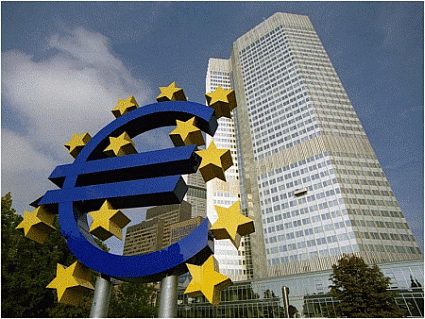

 The World Bank and International Monetary Fund held their spring meeting April 14 to 18 in Washington, D.C. Both financial titans were created after World War II to foster economic cooperation and development around the globe. With 16.2% of the International Monetary Fund (IMF) shares, the United States is the largest shareholder among the 187 nations who belong to the fund—even though its managing director has always been a European.

![[Most Recent Quotes from www.kitco.com]](https://i0.wp.com/www.kitconet.com/charts/metals/gold/t24_au_en_usoz_2.gif)
![[Most Recent Quotes from www.kitco.com]](https://i0.wp.com/www.kitconet.com/charts/metals/silver/t24_ag_en_usoz_2.gif)

 CRISISBOOM
You must be logged in to post a comment.