Archive
Rules eased on snooping by the FBI
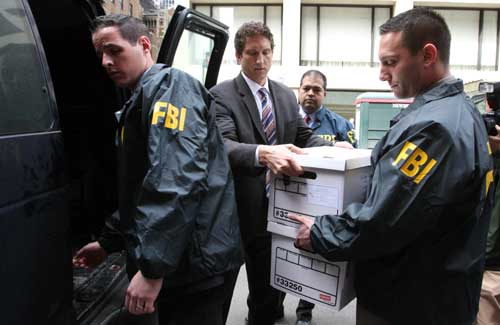 WASHINGTON — The FBI is giving significant new powers to its roughly 14,000 agents, allowing them more leeway to search databases, go through household trash, or use surveillance teams to scrutinize the lives of people who have attracted their attention.
The FBI soon plans to issue a new edition of its manual, called the Domestic Investigations and Operations Guide, according to an official who has worked on the draft document and several others who have been briefed on its contents.
The new rules add to several measures taken over the past decade to give agents more latitude as they search for signs of criminal or terrorist activity.
The FBI recently briefed several privacy advocates about the coming changes. Among them, Michael German, a former FBI agent who is now a lawyer for the American Civil Liberties Union, argued it was unwise to further ease restrictions on agents’ power to use potentially intrusive techniques, especially if they Read more…
US to store passenger data for 15 years

The personal data of millions of passengers who fly between the US and Europe, including credit card details, phone numbers and home addresses, may be stored by the US department of homeland security for 15 years, according to a draft agreement between Washington and Brussels leaked to the Guardian.
The “restricted” draft, which emerged from negotiations between the US and EU, opens the way for passenger data provided to airlines on check-in to be analysed by US automated data-mining and profiling programmes in the name of fighting terrorism, crime and illegal migration. The Americans want to require airlines to supply passenger lists as near complete as possible 96 hours before takeoff, so names can be checked against terrorist and immigration watchlists.
The agreement acknowledges that there will be occasions when people are delayed or prevented from flying because they are wrongly identified as a threat, and gives them the right to petition for judicial review in the US federal court. It also outlines procedures in the event of anticipated data losses or other unauthorised disclosure. The text includes provisions under which “sensitive personal data” – such as ethnic origin, political opinions, and details of health or sex life – can be used in exceptional circumstances where an individual’s life could be imperilled.
The 15-year retention period is likely to prove highly controversial as it is three times the five years allowed for in the EU’s PNR (passenger name record) regime to cover flights into, out of and Read more…
‘Too creepy even for Google’: Search engine boss warns governments against facial recognition technology

Concerns: Google boss Eric Schmidt warned against facial recognition
The executive chairman of Google has warned governments against facial recognition technology – saying it is ‘too creepy’ even for the search engine.
Eric Schmidt said that the technology has advanced rapidly in recent years and that it could be rolled out across the internet.
But the controversial technique has angered privacy campaigners who claim that it would be a further erosion of privacy and civil liberties.
Now Schmidt has dispelled any suggestions that internet giant Google would be the first company to employ the system.
But he warned that there were likely to be other organisations who might ‘cross the line’ and use facial recognition.
Speaking today at Google’s Big Tent conference on internet privacy, technology and society, in Hertfordshire, Schmidt said that the accuracy of such technology was ‘very concerning’.
Facial recognition would work by scanning in a photograph of somebody’s face in order to Read more…
H.J.res. 62. Amending the Constitution to end states rights?
 H. J. Res. 62, Proposing an amendment to the Constitution of the United States to give States the right to repeal Federal laws and regulations when ratified by the Legislatures of two thirds of the several States
Sounds like a great deal..right? Wrong! The states already have the right to repeal Federal laws and regulations. It is called nullification under the 10th Amendment.
Or, states can refuse to contract with the Federal government or any of its privately owned corporate agencies thereby refusing the contract and any of its provisions (regulations or laws).
Secondary to this action, is the refusal to accept any federal funding offered to implement what is usually a series of laws or regulations, (these being written by unelected bureaucrats, lobbyists and other interested stakeholders), meant to deprive you of your rights, intrude on your privacy, interfere with your right to engage in business and otherwise reduce and abrogate your constitutionally protected freedoms.
Article 5
The Congress, whenever two thirds of both Houses shall deem it necessary, shall propose Amendments to this Constitution, or, on the Application of the Legislatures of two thirds of the several States, shall call a Convention for proposing Amendments, which, in either Case, shall be valid to all Intents and Purposes, as part of this Constitution, when ratified by the Legislatures of three fourths of the several States, or by Conventions in three fourths thereof, as the one or the other Mode of Ratification may be proposed by the Congress; Provided that no Amendment which may be made prior to the Year One thousand eight hundred and eight shall in any Manner affect the first and fourth Clauses in the Ninth Section of the first Article; and that no State, without its Consent, shall be deprived of its equal Suffrage in the Senate.
Any amendments to the Constitution must be ratified by the legislatures of three/fourths of the states. Congress, neither House nor Senate, has the authority to alter or amend anything in the Constitution in and of their respective bodies.
So what are they after? Read more…
6 Biggest Tech Security Fails in the Last Year

This is the age of being perpetually connected. If you have a Twitter, Facebook or any other sort of account, your information is out there. The best thing to do is just keep the information you don’t want people to know offline. It’s just safer that way.
Now, let’s take a look at the times that the major companies have failed, big time. There are several of them, here they are.
1) Texas Workforce Commission – Identities Released: Social Security Numbers, Addresses, etc.
My home state (note: everyone on iSmashPhone is from a different part of the world). It was recently found that Social Security numbers, driver’s license numbers and other personal info, according to website ComputerWorld. Two security chiefs were fired over it, and while the Attorney General’s office says that there is no evidence that the exposed data has been misused, they did say that we should be careful about being targets of a new phone scam. Here is that press release. And everyone is worried about Apple? This was personal info for people who truly had no choice in the Read more…
Google CEO: Phone tracking to enrich lives

Google chairman and CEO Eric Schmidt came out to defend tracking technology in smartphones arguing the technology will ultimately enrich and benefit the lives of consumers.
Recent debates regarding privacy have surfaced following the discovery of tracking files native to Apple’s iPhone and Google’s Android mobile operating system.
“Today, you’re phone knows who you are, where you are, where you’re going, to some degree, because it can see your path. And with that and with your permission, it’s possible for software and software developers to predict where you’re going to go, to suggest people you should meet, to suggest activities and so forth,” he said. “So ultimately what happens is the mobile phone does what it does best, which is remember everything and make suggestions.”
Allowing your phone to know you, follow you and help you will allow users to enjoy their social experience more, he contended. The experience of will become increasingly Read more…
Spying on U.S Citizens — Uncle Sam turns his multi-billion dollar espionage network on U.S Citizens

Alexander Higgins, Contributing Writer
Activist Post
A series of previously classified documents obtained by The Federation of American Scientists Project on Government Secrecy reveals that spy operation against U.S citizens here in the homeland have spiked massively over the last year and so has the government’s cost to cover up their plethora of illegal activities.
But first a little background to explain how America has arrived to this point in the first place.
The Executive Branch of the US Government has found a loophole in the legal system that has effectively abolished the Constitution by allowing our entire bill of rights to be suspended at will. This probably best explains it: Read more…
The Strange World of NSA Mind Control

SARTRE, Contributing Writer
“The National Security Agency (NSA) is a combat support agency within the Department of Defense (DOD) established by presidential directive in 1952. NSA has two separate missions: signals intelligence and communications security. For signals intelligence, NSA manages all U.S. signal collection and processing and produces signals intelligence in accordance with DOD and DCI priorities. For communications security, NSA provides leadership, products, and services to U.S. agencies that need to protect their information and communication systems from foreign exploitation. NSA is headed by a three-star flag officer, who reports to the Secretary of Defense. About 80 percent of the NSA workforce is civilian.”
State Dept. wants to make it harder to get a passport
 If you don’t want it to get even harder for a U.S. citizen to get a passport — now required for travel even to Canada or Mexico — you only have until Monday to let the State Department know.
The U.S. Department of State is proposing a new Biographical Questionnaire for some passport applicants: The proposed new Form DS-5513 asks for all addresses since birth; lifetime employment history including employers’ and supervisors names, addresses, and telephone numbers; personal details of all siblings; mother’s address one year prior to your birth; any “religious ceremony” around the time of birth; and a variety of other information. According to the proposed form, “failure to provide the information requested may result in … the denial Read more…


![[Most Recent Quotes from www.kitco.com]](https://i0.wp.com/www.kitconet.com/charts/metals/gold/t24_au_en_usoz_2.gif)
![[Most Recent Quotes from www.kitco.com]](https://i0.wp.com/www.kitconet.com/charts/metals/silver/t24_ag_en_usoz_2.gif)

 crisisboom
 CRISISBOOM
You must be logged in to post a comment.