Archive
Look Out Above for Gold and Silver Prices
 By Greg Hunter’s
Gold hit another all-time high yesterday, closing well over $1,450 per ounce. Silver’s closing price of more than $39 per ounce is the highest it has been in 31 years. Why the big jump in gold and silver prices? The answer is pretty scary because there are many reasons precious metals are heading higher. Let’s start with the most obvious —inflation. Kitco.com reported yesterday, “The precious yellow metal got a fresh influx of investment buying based upon heightened inflationary expectations, safe-haven demand and a weakening U.S. dollar index.” (Click here for the complete Kitco.com story.) You can give the same reasons for rising silver prices.
In the case of silver, many experts say it is way undervalued and will outperform gold as Read more…
True Obama debt bigger than planet’s entire GDP
 President Obama |
As the Obama administration prepares to finance a Fiscal Year 2011 budget deficit expected to top $1.6 trillion, the American public is largely unaware that the true negative net worth of the federal government reached $76.3 trillion last year.
That figure was five times the 2010 gross domestic product of the United States and exceeded the estimated gross domestic product for the world by approximately $14.4 trillion.
According to the U.S. Department of Commerce Bureau of Economic Analysis, U.S. GDP for 2010 was $14.861 trillion. World GDP in 2010, according to the International Monetary Fund, was $61.936 trillion.
“As government obligations continue to spiral out of control and the U.S. government shows no willingness to make the magnitude of spending cuts required to return to fiscal responsible, the U.S. economy is headed to a great collapse coming in the form of a hyper-inflationary great Read more…
Currency Meltdown Coming
 By Greg Hunter’s USAWatchdog.com
The situation in Japan is getting worse, not better. There are shortages in food, fuel and warm dry shelter. To make matters exponentially worse, nuclear power plants there continue to burn out of control and emit high levels of radiation. Japan is a stark reminder of how fast a modern technologically advanced society can be brought to its knees by an unforeseen calamity.
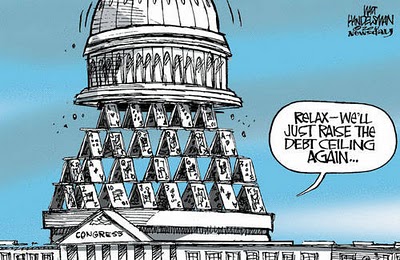
On the other side of the Pacific, the devastating pictures from that island nation are taking the attention away from our own, much more predictable, calamity coming from a tsunami of debt. As the U.S. and other world governments continue to print money to keep the banks and system solvent, a ball of debt is growing. It is on course to Read more…
US Treasurys Dumped, Pimco Sees Value In Emerging-Market Bonds
 NEW YORK (Dow Jones)–The valuations on U.S. Treasurys are not attractive in a historical context and Pacific Investment Management Co. is moving money toward emerging-market debt, said the fund’s founder Bill Gross in an interview on Thursday with CNBC.
Reports came out on Thursday that the bond-fund giant had dumped all of its holdings of U.S. government bonds. Gross said better valuations can be found elsewhere, where yields are not artificially boost by Federal Reserve purchasing.
“The overvaluation [in Treasurys] has been dependent on the purchasing power of the Fed,” said Gross, who does not believe there will be a third round of “quantitative easing.”
Pimco did not participate in Thursday’s 30-year auction nor Wednesday’s 10-year auction, Gross said, though both were considered well-received.
The fund still owns about Read more…
Inflation Group Says U.S. Cities Will Be Like Egypt in Four Years
The National Inflation Association has issued a chilling new advisory in which it warns that the inflationary time bomb being created by the policies of the Federal Reserve will lead to American cities experiencing similar chaos currently unfolding in Egypt by 2015.
Egyptian dictator Hosni Mubarak has been in power for three decades and in that time has managed to handle all manner of threats to the stability of his regime. But it was the huge unrest sparked by soaring food prices that finally led the Egyptian people to launch a revolution which is likely to see Mubarak forced out of office for good.
“Food inflation in Egypt has reached 20% and citizens in the nation already spend about 40% of their monthly expenditures on food. Americans for decades have been Read more…
HOW BANKS AND INVESTORS ARE STARVING THE THIRD WORLD
Ellen Brown
“What for a poor man is a crust, for a rich man is a securitized asset class.”
–Futures trader Ann Berg, quoted in the UK Guardian
 Underlying the sudden, volatile uprising in Egypt and Tunisia is a growing global crisis sparked by soaring food prices and unemployment. The Associated Press reports that roughly 40 percent of Egyptians struggle along at the World Bank-set poverty level of under $2 per day. Analysts estimate that food price inflation in Egypt is currently at an unsustainable 17 percent yearly. In poorer countries, as much as 60 to 80 percent of people’s incomes go for food, compared to just 10 to 20 percent in industrial countries. An increase of a dollar or so in the cost of a gallon of milk or a loaf of bread for Americans can mean starvation for people in Egypt and other poor countries.
Follow the Money
The cause of the recent jump in global food prices remains a matter of debate. Some analysts blame the Federal Reserve’s “quantitative easing” program (increasing the money supply with credit created with accounting entries), which they warn is sparking hyperinflation. Too much money chasing too few goods is the classic explanation for Read more…
Fed chief expects high unemployment, economic growth in 2011
Vicki Needham
 Unemployment will remain high, the nation’s economy could expand by 4 percent and interest rates may need go up, Federal Reserve Bank of Philadelphia President Charles Plosser said Monday.
“If economic growth in the United States continues to gain traction and the prospects begin to look ever better, it might be time for us to begin thinking about how do we begin to gradually take our foot off the accelerator,” Plosser told reporters after a speech at the Central Bank of Chile in Santiago, according to news reports.
Plosser said he may favor a rate increase if economic growth necessitates a change.
“It might. I’m not going to rule that out,” he said.
The central bank has said that it plans to keep short-term interest rates low for an “extended period.”
During Monday’s speech, Plosser also predicted that the U.S. could grow between 3 percent and 4 percent this year.
The Fed’s plan to purchase $600 billion in government debt will probably continue through June while the nation’s 15 million unemployed look for work, although Plosser didn’t rule out pulling the stimulus funds back earlier.
“It could end earlier if economic conditions call for it, but right now I’m not sure that that’s the most likely outcome,” he told reporters. “It obviously creates challenges for some countries because of appreciating currencies. But I think that will pass. Those are short-run issues.”
Plosser has expressed concern about whether the Fed’s quantitative easing, also known as QE2, will spur economic growth while lowering the jobless rate that has remained above 9 percent for 20 months.
“Monetary policy is not going to be able to speed up the adjustments in labor markets or prevent asset bubbles, and attempts to do so may create more instability, not less,” he said.
“Expecting too much of monetary policy will undermine its ability to achieve the one thing that it is well-designed to do — ensuring long-term price stability.”
QE2 has brought harsh criticism from some lawmakers on Capitol Hill who argue that the plan could devalue the dollar and cause inflation.
12 Economic Collapse Scenarios That We Could Potentially See In 2011
 What could cause an economic collapse in 2011? Well, unfortunately there are quite a few “nightmare scenarios” that could plunge the entire globe into another massive financial crisis. The United States, Japan and most of the nations in Europe are absolutely drowning in debt. The Federal Reserve continues to play reckless games with the U.S. dollar. The price of oil is skyrocketing and the global price of food just hit a new record high. Food riots are already breaking out all over the world. Meanwhile, the rampant fraud and corruption going on in world financial markets is starting to be exposed and the whole house of cards could come crashing down at any time. Most Americans have no idea that a horrific economic collapse could happen at literally any time. There is no way that all of this debt and all of this financial corruption is sustainable. At some point we are going to reach a moment of “total system failure”.
So will it be soon? Let’s hope not. Let’s certainly hope that it does not happen in 2011. Many of us need more time to prepare. Most of our families and friends need more time to prepare. Once this thing implodes there isn’t going to be an opportunity to have a “do over”. We simply will not be able to put the toothpaste back into the tube again.
So we had all better be getting prepared for hard times. The following are 12 economic collapse scenarios that we could potentially see in 2011….
#1 U.S. debt could become a massive crisis at any moment. China is saying all of the right things at the moment, but many analysts are openly worried about what could happen if China suddenly decides to start dumping all of the U.S. debt that they have accumulated. Right now about the only thing keeping U.S. government finances going is the ability to borrow gigantic amounts of money at extremely low interest rates. If anything upsets that paradigm, it could potentially have enormous consequences for the entire world financial Read more…


![[Most Recent Quotes from www.kitco.com]](https://i0.wp.com/www.kitconet.com/charts/metals/gold/t24_au_en_usoz_2.gif)
![[Most Recent Quotes from www.kitco.com]](https://i0.wp.com/www.kitconet.com/charts/metals/silver/t24_ag_en_usoz_2.gif)

 crisisboom
 CRISISBOOM
You must be logged in to post a comment.