Archive
Lake Vostok drilling in Antarctic ‘running out of time’

With only about 50m left to drill, time is running out for the Russian scientists hoping to drill into Vostok – the world’s most enigmatic lake.
Vostok is a sub-glacial lake in Antarctica, hidden some 4,000m (13,000ft) beneath the ice sheet.
With the Antarctic summer almost over, temperatures will soon begin to plummet; they can go as low as -80C.
Scientists will leave the remote base on 6 February, when conditions are still mild enough for a plane to land.
The team has been drilling non-stop for weeks. Read more…
Russia threatens NATO with nukes
Press TV
The Russian president has called on NATO to clarify Moscow’s role in a European missile system, warning if no agreement is reached, Russia will be forced to deploy “offensive” nuclear weapons.


“So this is not a joking matter. We expect from our NATO partners a direct and unambiguous answer,” Dmitry Medvedev said during a meeting with Russia’s NATO envoy Dmitry Rogozin.
“In either case, we are either together with NATO, or we separately find an adequate response to the existing problem,” he said.
Under former US President George W. Bush the United States proposed a plan to deploy a missile system in Poland and the Czech Republic — a plan which was fiercely opposed to by Russia. Moscow said it would deem such a deployment a threat to its sovereignty and would properly respond to it.
US President Barack Obama later scrapped the plan proposing Russia to join the missile system.
Russia and NATO agreed to cooperate on a joint missile system plan in Europe during a NATO-Russia Council meeting in Lisbon in November last year.
The parties agreed to formulate terms for cooperation on the missile system by June 2011.
“Either we agree to certain principles with NATO, or we fail to agree, and then in the future we are forced to adopt an entire series of unpleasant decisions concerning the deployment of an offensive nuclear missile group,” Medvedev was quoted by AFP as saying.
Russia To Adopt Universal ID Card in 2012
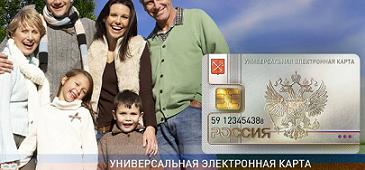 2012 will be the year of universal ID cards in Russia.
For all those conspiracy theorists out there, 2012 just got a little more ominous. As required by legislation passed this last summer, Russia will adopt a universal ID card starting next year. The Universal Electronic Card (UEC) is intended to eventually replace all local, regional, and national forms of ID, providing a central database through which Russians can access everything from medical insurance to ATMs. According to the official website, the UEC will be adopted by around 1000 national and regional services along with about 10,000 commercial enterprises. The mayor of Moscow has already declared it will be able to handle public transportation there, and we can expect similar adoptions throughout the nation. Will all Russians be carrying a single form of ID that is their only passport to all public and private services? Looks like it. A similar project has started in India, and there are experiments for related concepts in Mexico. Universal ID is starting to catch on around the globe. Where will it spread to next?
Ostensibly, the UEC is designed to push the Russian ID Read more…
Alarming NOAA data, Rapid Pole Shift

The NOAA National Geophysical Data Center maintains a data set of annual magnetic north pole coordinates going back to the year 1590, derived from early measurements from ships logs to modern day techniques.
Noting that there has been lots of reporting of pole shift lately, to the point where the phenomenon is actually causing real-world issues such as temporary airport closures, a deeper investigation was in order.
After transferring 420 years of north pole position data from the NOAA Geo Data Center, configuring it to fit in an Excel spreadsheet, adding a complicated formula to determine exact distance between 2 sets of latitude-longitude coordinates, applying the formula to each data point in the series, and then finally plotting it all in a visual graph, it is alarming to discover the amount of pole shift just over the past 10 to 20 years.
Here is one very interesting fact…
Since 1860, the magnetic pole shift has more than doubled every 50 years. That is pretty significant.
Here is another very interesting fact… Read more…
Russian government now largest shareholder in BP
“Will almost certainly complicate the politics of levying and collecting damages” from Gulf oil disaster says Congressman
 BP’s frantic efforts to repair its devastated reputation in the US have been set back by a major new alliance with the Russian government, prompting outraged comments from all sides of the political spectrum.
Amid continuing anger from the American public over the Gulf of Mexico oil spill, politicians are calling for an investigation into BP’s deal to sell a 5 per cent stake in the company to the Russian state-controlled oil giant Rosneft.
That deal, which gives BP access to vast untapped oil reserves in the Arctic, was signed with fanfare in London on Friday night, but across the Atlantic, one Congressman renamed BP “Bolshoi Petroleum”. US critics also suggested BP has now become a national security threat, as well as environmental one.
“The national security implications of BP America being involved with the Russian company – that does require scrutiny by the Committee of Foreign Investment in the US (CFIUS),” Michael Burgess, a Republican from Texas, said in a television interview hours after the deal was signed. Read more…
South Africa: Another BRIC in China’s Wall
 China’s President Hu Jintao has sent an invitation to South African President Jacob Zuma to attend the third BRICs leaders’ summit to be held in China. Picture: Zuma (center) celebrates the 25th anniversary of the Congress of South African Trade Unions (COSATU) on December 4, 2010 in Johannesburg. (File Photo/CFP)
At China’s invitation, South Africa is set to join the Brazil, Russia, India and China (BRIC) group of emerging nations and will attend the first summit of the leading emerging economies in April this year. The group will thus be renamed the “BRICS,” but doubts remain over the suitability of the African nation to join the exclusive club of the fast-growing economies.
Lauding the Chinese decision to invite her country to the BRIC bloc, South Africa’s Cooperation Minister Maite Nkoana-Mashabane said the invitation was conveyed to her by China’s Foreign Minister Yang Jiechi. She said Chinese President Hu Jintao also sent an invitation to President Jacob Zuma to attend the third BRIC leaders’ summit to be held in China. Read more…
Nuclear Targets in America
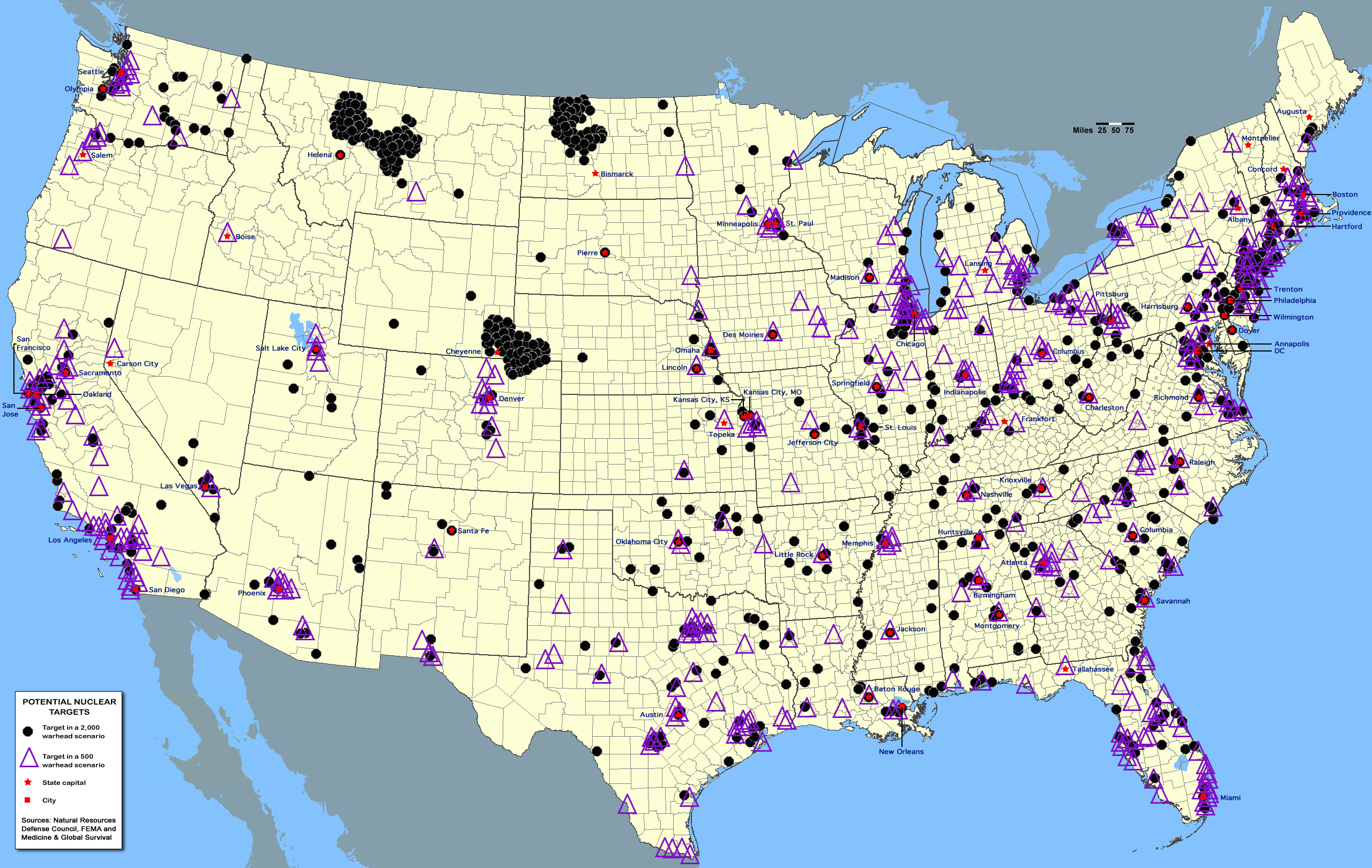
In the event of a nuclear war many of these cities have been mapped as potential Nuclear Targets due to being economic centers, tourism, military, local governments Eco hubs etc.. Click on the map to see your town enlarged. Hard to believe is it not? The town that I reside in is not that large in size however it is marked.
This information and other valuable information regarding the “Safeness” of America can be found at http://www.standeyo-cart.com/ProductDetails.asp?ProductCode=PPUSA
BRIC-The Trillion Dollar World Club
Brazil, Russia, India and China matter individually. But does it make sense to treat the BRICs—or any other combination of emerging powers—as a block?
 IN ANY global gathering, the American president is usually seen, at a minimum, as primus inter pares: the one who can make or break the final bargain and select his favoured interlocutors. So in Copenhagen last December, as negotiations for a new climate-change
treaty were entering their final hours, a hastily convened meeting between Barack Obama and China’s prime minister, Wen Jiabao, looked as if it would be the critical moment when a deal might be struck. But when the president turned up, he found not only Mr Wen but the heads of government of Brazil, South Africa and India. This was unexpected. The Americans even thought the Indians had already left the summit. What was conceived as a bilateral talk turned instead into a negotiation with an emerging-market block. As an additional sign that things were changing in the world, the president got a finger-wagging from one of Mr Wen’s hangers-on. But at least Mr Obama was in the room; Europeans were shut out while the emerging powers and America put the final touches to their deal.
This week the same developing countries are meeting again, in Brasília. On April 15th Brazil, India and South Africa—rising powers that are also democracies—put their heads together. The next day South Africa will drop out and Russia and China will join the party, to create a meeting of the so-called BRICs.
For this group, it is a second summit; last June their leaders met in Yekaterinburg, in Russia. That inaugural summit, which produced almost nothing concrete, appeared to be Read more…


![[Most Recent Quotes from www.kitco.com]](https://i0.wp.com/www.kitconet.com/charts/metals/gold/t24_au_en_usoz_2.gif)
![[Most Recent Quotes from www.kitco.com]](https://i0.wp.com/www.kitconet.com/charts/metals/silver/t24_ag_en_usoz_2.gif)

 crisisboom
 CRISISBOOM
You must be logged in to post a comment.