Archive
Riddle in the sands: Thousands of strange ‘Nazca Lines’ discovered in the Middle East
Peru’s Nazca Lines, the mysterious geoglyphs etched into the desert centuries ago by indigenous groups, are world famous – and now thousands of similar patterns have been found in the Middle East.
Satellite and aerial photography has revealed mysterious stone ‘wheels’ that are more numerous and older than the Nazca Lines in countries such as Syria, Saudi Arabia and Jordan.
The structures are thought to date back 2,000 years, but why they were built is baffling archaeologists and historians.
 Ancient mystery: Read more…
Solar flare could unleash nuclear holocaust across planet Earth, forcing hundreds of nuclear power plants into total meltdowns
 (NaturalNews) Forget about the 2012 Mayan calendar, comet Elenin or the Rapture. The real threat to human civilization is far more mundane, and it’s right in front of our noses. If Fukushima has taught us anything, it’s that just one runaway meltdown of fissionable nuclear material can have wide-ranging and potentially devastating consequences for life on Earth. To date, Fukushima has already released 168 times the total radiation released from the Hiroshima nuclear bomb detonated in 1945, and the Fukushima catastrophe is now undeniably the worst Read more…
China Analyst: U.S. Can’t Win in Space, So Why Bother Racing?
 With access to more than 400 satellites plus at least two tiny, maneuverable robotic shuttles, the U.S. military is the clear leader in military spacecraft. But with 70 orbiters of its own, China is catching up fast. Last year, Beijing matched Washington in space launches for the first time, boosting no fewer than 15 satellites into orbit. It was the first time any nation kept a celestial pace with the U.S. since the height of the Cold War.
The new space race is on. But in the view of one influential analyst, the race isn’t worth the prize. Space “is expensive to enter, hard to sustain assets in, contains no defensive ground, and — barring energy-intensive maneuvering – forces assets into predictable orbits,” Andrew Erickson, a Naval War College professor and editor of the new book Chinese Aerospace Power, told me as part of a longer interview over at AOL Defense.
No one disputes that China is gaining “ground” in space. “The [People’s Liberation Army] is acquiring a range of Read more…
17 Egyptian pyramids found by infra-red satellite images!!
Pakistan successfully launches communication satellite
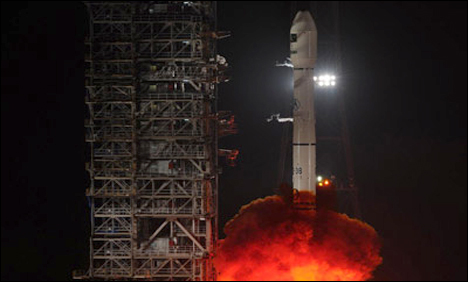 XICHANG: Pakistan successfully launched into space its state-of-the-art PakSat-1R communication satellite here from Xichang Satellite Launch Center in southwest China`s Sichuan Province, late Thursday night.
A select group of senior Pakistani officials witnessed the Long March-3B rocket successfully carrying the communication satellite from the launch pad here with rounds of applause and jubilations visible on their faces.
Prominent among those present included Director General SPD Lt. General (Retd.) Khalid Ahmed Kidwai, Foreign Secretary Salman Bashir, Pakistan`s Ambassador to China Masood Khan, Secretary Defence Lt. General (Retd) Syed Ather Ali and Chairman Space and Upper Atmosphere Research Commission (SUPARCO), Major General Ahmed Bilal, besides senior officials from the Chinese government.
PakSat-1R, a geostationary and advanced communication satellite, has been Read more…
MAJOR SOLAR FLARE: August 9th, 2011.
This morning at 0805 UT, sunspot 1263 produced a powerful X7-class solar flare. NASA’s Solar Dynamics Observatory captured the explosion’s extreme ultraviolet flash.
The solar flare was not Earth directed but a minor proton storm is in progress around our planet, which could affect satellites.
Radiation from the flare also briefly disrupted communications on some VLF and HF radio frequencies.
We may get a glancing blow from the flare. Read more…
Roll to observe Elenin – STEREO BEHIND looks at a hot topic
Story submitted by Robert Bateman

In just a few hours from now, NASA rolls the STEREO BEHIND solar satellite to have a look at Comet Elenin (P/2010 X1), and if you haven’t been paying attention, it is one red hot topic topped with wilder imaginations, dooms, hypotheticals and omens than previously imagined.
From being on a par with/substitute for Read more…
NASA warns of global catastrophe post upcoming ‘huge space storm’
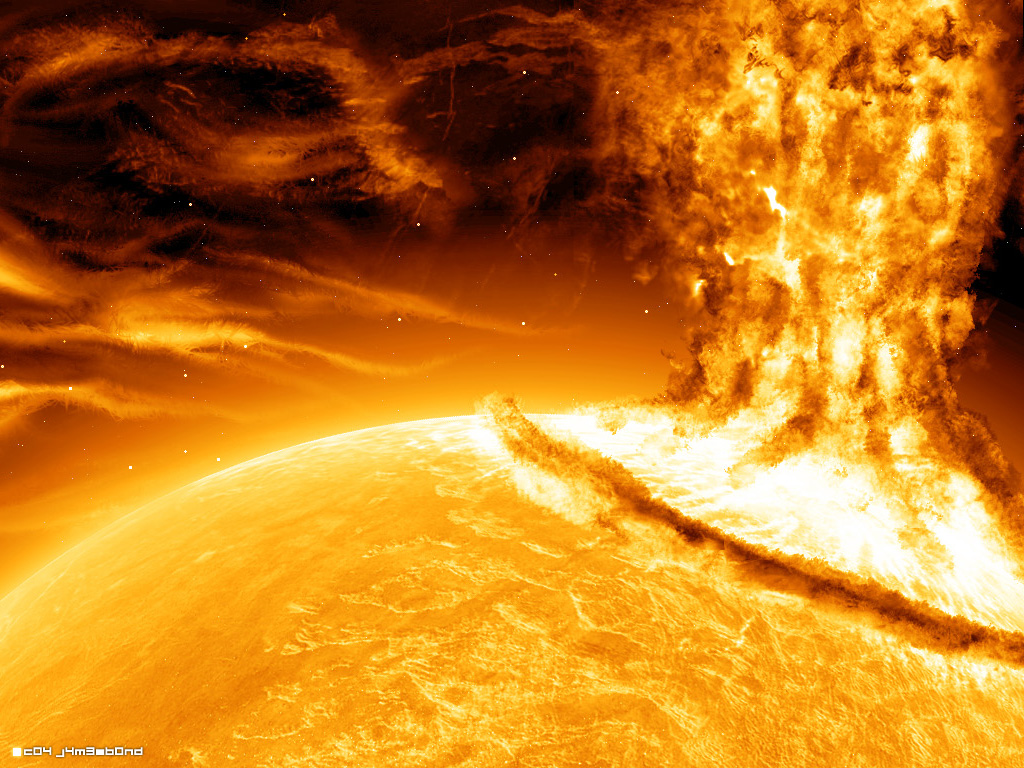 NASA has warned of a once-in-a-lifetime ‘space storm’ after the sun wakes ‘from a deep slumber’ sometime around 2013, causing ‘20 times more economic damage than Hurricane Katrina’.
Senior space agency scientists believe that the super storm would hit like ‘a bolt of lightning’ and damage everything from emergency services’ systems, hospital equipment, banking systems and air traffic control devices, through to “everyday” items such as home computers, iPods and Sat Navs.
And unless precautions are taken, it could cause catastrophic consequences for the world’s health, emergency services and national security.
“We know it is coming but we don’t know how bad it is going to be,” Dr Richard Fisher, the director of NASA’s Heliophysics division, said in an interview with The Daily Telegraph.
He, however, said that preparations were similar to those in a hurricane season, where authorities knew a problem was imminent but did not know how serious it would be.
“I think the issue is now that modern society is so dependant on Read more…
Rapid Greenland Glacial Melt Shown By ESA Satellite
Some of the last images from ESA’s ERS-2 satellite have revealed rapidly changing glacial features in Greenland. In its final days, the veteran satellite gave us frequent views of the Kangerdlugssuaq glacier and its advancing ice stream.

Before it retired on 6 July, ESA’s ERS-2 Earth observation satellite entered an orbit to capture radar images of the same area on the ground every three days, rather than its previous 35-day cycle.
Images of the Kangerdlugssuaq glacier in eastern Greenland taken from March to May 2011 show that the ice stream was Read more…
Russia Launches Long-Delayed Deep Space Radio Telescope
 |
| An artist’s depiction of Russia’s huge Spektr-R radio astronomy satellite in Earth orbit. The satellite launched on July 18, 2011. CREDIT: NPO Lavochkin |
PARIS — Russia’s long-delayed Spektr-R radio telescope successfully launched July 18 aboard a Zenit rocket from the Baikonur Cosmodrome in Kazakhstan, the country’s Federal Space Agency said.
There was no immediate word on the operational status of the new radio observatory beyond the fact that it was placed into the planned elliptical orbit that peaks nearly 207,000 miles (330,000 kilometers) above the Earth, and reaches a low of about 621 miles (1,000 km).
Featuring a giant 30-foot (10-meter) wide antenna, the Spektr-R observatory is Read more…


![[Most Recent Quotes from www.kitco.com]](https://i0.wp.com/www.kitconet.com/charts/metals/gold/t24_au_en_usoz_2.gif)
![[Most Recent Quotes from www.kitco.com]](https://i0.wp.com/www.kitconet.com/charts/metals/silver/t24_ag_en_usoz_2.gif)

 crisisboom
 CRISISBOOM
You must be logged in to post a comment.