Archive
Solar Storms Season Heating Up

Sunspots — cooler regions fraught with intense magnetic fields — now regularly dot the surface of the sun, and the star has unleashed several powerful flares in recent months, including a Feb. 14 blast that was the most powerful outburst in more than four years. All signs suggest that the sun has shaken itself out of its slumber, researchers say. After three years in a deep solar sleep of historic proportions, the sun is starting to wake up.
In 2008, the sun plunged into its least active state in nearly a century. Sunspots all but vanished, solar flares subsided and the star was eerily quiet. Quiet spells on the sun are nothing new. They come along every 11 years or so, as part of the sun’s natural activity cycle. But this latest solar minimum lasted longer than usual, prompting some researchers to wonder if it would ever end.
This year has started off with a bang, as sunspots are crackling with activity. Earth-orbiting satellites have detected Read more…
NAM 12: Scientists see solar outburst in exquisite detail
The largest disturbances to the Earth’s geomagnetic environment occur when it is buffeted by solar material hurled in our direction by explosive changes in the Sun’s atmosphere. These Coronal Mass Ejections or CMEs contain approximately a billion tonnes of ionized gas or plasma and can have a dramatic and damaging impact on everything from satellites to power grids.

Now a team of scientists have used two spacecraft to study these events in unprecedented detail. Graduate student Anthony Williams of the University of Leicester will present their results on Tuesday 19 April at the Royal Astronomical Society’s National Astronomy Meeting in Llandudno, Wales.
Mr Williams and his team used the Heliospheric Imagers (HI) on the Solar TErrestrial RElations Observatory (STEREO) spacecraft to examine the internal structure of an Earth-impacting CME – seen as sunlight scattered from high density blobs of plasma – as it travels outwards from the Sun. They compared this with the internal structure measured in situ by the Read more…
China-Russia relations and the United States: At a turning point?
 By Dr. Richard Weitz
Since the end of the Cold War, the improved political and economic relationship between Beijing and Moscow has affected a range of international security issues. China and Russia have expanded their bilateral economic and security cooperation. In addition, they have pursued distinct, yet parallel, policies regarding many global and regional issues.
Yet, Chinese and Russian approaches to a range of significant subjects are still largely uncoordinated and at times in conflict. Economic exchanges between China and Russia remain minimal compared to those found between most friendly countries, let alone allies.
Although stronger Chinese-Russian ties could present greater challenges to other countries (e.g., the establishment of a Moscow-Beijing condominium over Central Asia), several factors make it unlikely that the two countries will form such a bloc.
The relationship between the Chinese and Russian governments is perhaps the best it has ever been. The leaders of both countries engage in numerous high-level exchanges, make many mutually supportive statements, and manifest other displays of Russian-Chinese cooperation in what both governments refer to as their developing strategic partnership.
The current benign situation is due less to common values and shared interests than to the fact that Chinese and Russian security concerns are Read more…
Details Emerge on North Korean Missile Launch Site
 North Korea’s second missile launch complex is five times bigger than its first site and seems to be better shielded from a potential attack, the Korea Herald reported on Monday (see GSN, Feb. 18).
In addition to being much larger than the first launch installation at Musudan-ri, the Dongchang-ri complex along the North’s west coast is also closer to China, which is likely to make any attack on the site more complicated for South Korean and U.S. forces, the Chosun Ilbo newspaper reported.
An underground missile fueling center has been constructed at Dongchang-ri in order to escape monitoring by U.S. spy satellites. The facility also has the ability to house liquid fuels for extended periods of time, according to the article.
Work on the facility started in 2002, 10 years after the Musudan-ri site was set up, government sources told the Chosun Ilbo. Recent reports have suggested that construction of the Dongchang-ri site has been completed.
Dongchang-ri is located just 43 miles from the Yongbyon nuclear complex where North Korea has carried out much of its nuclear weapons development efforts. The proximity to Yongbyon would lessen the time and expense of transporting nuclear warheads for attachment to missiles at the new launch site, analysts said.
Pyongyang is not believed to have yet developed the ability to miniaturize nuclear warheads for fielding on long-range ballistic missiles (Song Sang-ho, Korea Herald, April 11).
Russia to spend $700 bln on new weapons
(AP)
 MOSCOW (AP) — President Dmitry Medvedev said Friday that Russia will spend the equivalent of $700 billion by 2020 to modernize the military’s aging arsenals, but sternly warned arms industries against jacking up prices.
Medvedev said the new plan should re-equip the armed forces, which have mostly relied on Soviet-built weapons, but some analysts say that the ambitious program that envisages procurement of 600 new warplanes, 100 ships and 1,000 helicopters is unfeasible because of a steady decline of the nation’s once-proud arms industry.
Medvedev, speaking at a meeting with the top military brass, harshly criticized domestic arms makers for failing to meet Russia’s weapons orders last year and said that the culprits will be punished.
Medvedev didn’t give details, but deputy prime minister Sergei Ivanov said Read more…
Get ready for a ‘global Katrina’: Biggest ever solar storm could cause power cuts which last for MONTHS

- Earth is overdue a solar storm as the sun enters its most active period.
The world is overdue a ferocious ‘space storm’ that could knock out communications satellites, ground aircraft and trigger blackouts – causing hundreds of billions of pounds of damage, scientists say.
Astronomers today warned that mankind is now more vulnerable to a major solar storm than at any time in history – and that the planet should prepare for a global Katrina-style disaster.
A massive eruption of the sun would save waves of radiation and charged particles to Earth, damaging the satellite systems used for synchronizing computers, airline navigation and phone networks.
Military Wants More Global Partnerships In Space
US Needs To Better Protect Satellites, Military Says

AP Photo/Department of Defense, Cherie Cullen
|
Posted: 5:02 am EST February 20, 2011Updated: 10:21 am EST February 20, 2011
WASHINGTON — The U.S. military needs to better protect its satellites and strengthen its ability to use them as weapons as the uncharted battlefield of space becomes increasingly crowded and dangerous, Pentagon leaders say. A new military strategy for space, as mapped out by the Pentagon, calls for greater cooperation with other nations on space-based programs to improve America’s ability to deter enemies. “It’s a domain, like air land and sea,” said Gen. Kevin Chilton, who led U.S. Strategic Command until he retired late last month. “Space is not just a Read more…
Spacecraft to be controlled by artificial intelligence
 It is a concept that had fatal consequences for the astronauts in the science fiction movie 2001: A Space Odyssey after their spaceship’s artificially intelligent computer reasoned it had to kill them in order to continue the mission.
Yet despite this warning from Arthur C Clarke and director Stanley Kubrick, The European Space Agency now hopes to use real-life artificial intelligence to control future spacecraft.
British engineers, supported by ESA, are developing control systems that can be used in satellites, robotic exploration vehicles and spacecraft capable of controlling themselves.
The space vehicles will be able to learn, identify problems, adapt during missions, carry out repairs and take their own decisions about how best to carry out a task.
Details of the research have emerged as ESA prepares to launch the second of its Read more…
China’s hostile space capabilities worry US: official
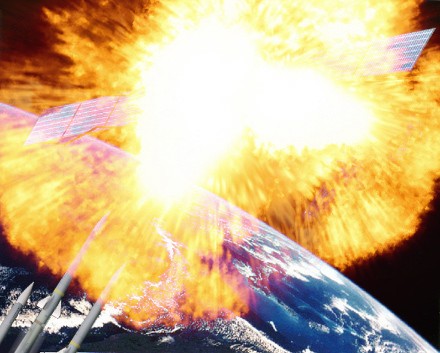 WASHINGTON (AFP) – China is developing “counterspace” weapons that could shoot down satellites or jam signals, a Pentagon official said Friday as the United States unveiled a 10-year strategy for security in space.
“The investment China is putting into counterspace capabilities is a matter of concern to us,” deputy secretary of defense for space policy Gregory Schulte told reporters as the defense and intelligence communities released their 10-year National Security Space Strategy (NSSS).
The NSSS marks a huge shift from past practice, charting a 10-year path in space to make the United States “more resilient” and able to defend its assets in a dramatically more crowded, competitive, challenging and sometimes hostile environment, Schulte said.
“Space is no longer the preserve of the US and the Soviet Union, at the time in which we could operate with impunity,” Schulte said.
“There are more competitors, more countries that are launching satellites… and we increasingly have to Read more…
Iran unveils missiles, satellites as warning to foes
 TEHRAN (Reuters) – Iran showed off new missile and satellite technology on Monday, and told its enemies it had “complete domination” of the entrance to the oil-rich Gulf.
As part of Iran’s annual revolution celebrations, a time traditionally marked by new technological and military advances, President Mahmoud Ahmadinejad unveiled locally-made satellites while a senior commander showed off mass produced missiles.
“We should reach a point where we will be able to provide our knowledge and technology in the aerospace field to other countries,” Ahmadinejad said in a speech, unveiling the satellites he said were for scientific purposes, and showing film of a satellite-carrier rocket.
Although Iran is not engaged in any military conflict, it is on constant alert against possible attacks from the United States and Israel which have not ruled out possible pre-emptive strikes to stop Tehran getting nuclear weapons.
Iran says it has no intention of making nuclear bombs and that its atomic programme, which is the subject of U.S., European and U.N. sanctions, is entirely peaceful.
In 2009, Iran launched a domestically-made satellite into orbit for the first time, a step that increased the Read more…


![[Most Recent Quotes from www.kitco.com]](https://i0.wp.com/www.kitconet.com/charts/metals/gold/t24_au_en_usoz_2.gif)
![[Most Recent Quotes from www.kitco.com]](https://i0.wp.com/www.kitconet.com/charts/metals/silver/t24_ag_en_usoz_2.gif)

 crisisboom
 CRISISBOOM
You must be logged in to post a comment.