Archive
Earth Likely “Unrecognizable” by 2050 Say Experts
In 2011 the Earth’s population will reach 7 billion. The United Nations (UN) reports that the total number of people will climb to 9 billion in 2050, peak at 9.5 billion, stabilize temporarily, and then decline. Despite the confidence with which these projections are presented, in an American Association for the Advancement of Science press briefing and presentation today the Population Council’s John Bongaarts presents evidence that the actual Read more…
Debt now equals total U.S. economy
 President Obama speaks at Parkville Middle School and Center of Technology, in Parkville, Md., Monday, Feb., 14, 2011. At right is Office of Management and Budget Director Jacob Lew. (AP Photo/Carolyn Kaster)
President Obama projects that the gross federal debt will top $15 trillion this year, officially equaling the size of the entire U.S. economy, and will jump to nearly $21 trillion in five years’ time.
Amid the other staggering numbers in the budget Mr. Obama sent to Congress on Monday, the debt stands out — both because Congress will need to vote to raise the debt limit later this year, and because the numbers are so large.
Mr. Obama‘s budget said 2011 will see the biggest one-year jump in debt in history, or nearly $2 trillion in a single year. And the administration says it will reach $15.476 trillion by Sept. 30, the end of the fiscal year, to reach Read more…
Peter Schiff -There Will be Riots in the Streets
Peter Schiff says that ultimately the United States will go the same way as Greece. Before the entire country goes, a state like California may go bankrupt.
The major problem is all of the unfunded liabilities. Social Security is a big problem, but even worse may be all of the guaranteed pensions for government employees.
Of course, one woman on the panel thinks that raising taxes on the rich will solve all of the problems. Peter Schiff explains that he already pays 45% of his income in income taxes. He says that if he is so tired of getting taxed that he would rather work less than to pay more taxes.
The main problem with Europe is that everyone is addicted to their entitlements. Of course, that would also accurately describe a large portion of the American public. If the government defaults on its debt, the people who are hurt the most will be ex-government workers and the elderly who may mostly rely on monthly checks from the federal government.
Social Security financial headwinds, another 395,000 Americans added to food stamp assistance in latest month of data, and manipulating the unemployment rate.
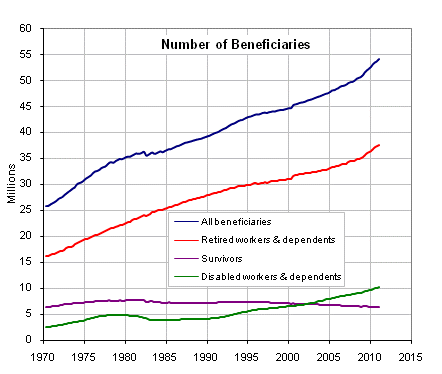
The dichotomous American economy is cracking like old paint into two distinct factions. For a few solid decades after World War II we had a burgeoning middle class, a smaller financial elite, and those who still struggled financially. The main objective however was to get as many people into the secure middle class. Today the middle class, the pinnacle of the American Dream, is significantly shrinking and when this occurs, we pull from the current middle class and put new families into the financially struggling category. The pie is getting smaller for most except for the small elite at the summit. The financial gaming that is occurring is stunning. While the unemployment rate fell largely due to people not being counted in the labor report, the latest month of data showed another 395,000 Americans being added to the nationwide food stamp program. Last year we also crossed a distressing fiscal threshold. In one month we paid out more in Social Security benefits than was collected. Social Security is entering the financial tough days and as we look at the statistics, most retired Americans are using Social Security for their entire monthly budget.
Social Security by the numbers
We should start by looking at the total number of Americans receiving Social Security:
Record U.S. deficit projected this year
 The still-fragile economy and fresh tax cuts approved by Congress last month will drive the federal deficit to nearly $1.5 trillion this year, the biggest budget gap in U.S. history, congressional budget analysts said Wednesday.
The grim forecast from the nonpartisan Congressional Budget Office came hours after President Obama called in his State of the Union address for Republicans and Democrats to work together to rein in record deficits that are pushing the national debt into uncharted territory. At $1.5 trillion, the deficit would equal 9.8 percent of the economy, the CBO said, making it one of the largest by that measure since the end of World War II.
Lawmakers scrambled on Wednesday to respond to the darkening budget picture, with Republicans pressing their call for sharp and immediate cuts in domestic spending. Twenty-one Senate Republicans, meanwhile, unveiled a plan to amend the Constitution to require balanced budgets, a top priority of the tea party movement.
Democrats resisted both initiatives, arguing that amending the Constitution, a lengthy process that requires a vote in all 50 state legislatures, would do little to address the current problem. They dismissed as “drastic” a proposal by House Republicans to slash $100 billion from the current budget, arguing that cuts of that magnitude would endanger a million jobs on public- and private-sector payrolls at a time when the unemployment rate already stands at 9.4 percent.
“We have to cut government, but Republicans are going at this with meat ax when what is needed is a Read more…
U.S. Treasury Secretary Admits U.S. Default is Imminent
By James West
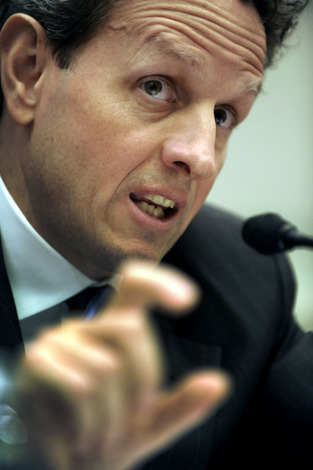 Timothy Geithner, U.S. Treasury Secretary, admitted in a letter to congress dated January 6th, that the United States Treasury would be forced to default on its credit obligations without clearance from congress to raise the amount of money tha the treasury is allowed to borrow.
After citing a list of “extraordinary measures” congress has had to resort to int he past to avoid entering a state of defualt, Geithner stated, “Once these steps have been taken, no remaining legal and prudent measures would be available to create additional headroom under the debt limit, and the United States would begin to default on its obligations. The extraordinary measures include, “suspending sales of State and Local Government Series (SLGS) Treasury securities; suspending reinvestment of the Government Securities Investment Fund (G-Fund); suspending reinvestment of the Exchange Stabilization Fund (ESF); and determining that a “debt issuance suspension period” exists, permitting redemption of existing, and suspension of new, investments of the Civil Service Retirement and Disability Fund (CSRDF).
That the United States has already defaulted on its obligations is beyond dispute, at this point, as its the rate at which its debt service obligations is growing exceeds the rate at which the United States GDP could possibly grow, meaning that, without drastic cuts to governmenbt spending, the debt can only continue to grow.
Before our very eyes, the so-called leadership of the world’s largest economy is intentionally bankrupting the country and devaluing its currency in what can only be a precursor to rampant inflation. Since the integrity necessary to manage this problem does not exist within the United States political system, the rest of the world has no choice but to stand by and watch the value of their United States Treasury Bills diminish incrementally on a daily basis. Selling them will only exacerbate the problem, but the question must be asked, how long until the remedy is preferred over the miserable condition?
Geithner goes on to say, in a remarkable baring of the national soul,
However, if Congress were to fail to act, the specific consequences would be as follows:
The Treasury would be forced to default on legal obligations of the United States, causing catastrophic damage to the economy, potentially much more harmful than the effects of the financial crisis of 2008 and 2009. Read more…
National Debt $200 Trillion Dollars
Dr. Laurence Kotlikoff economics professor at Boston University, discusses the national debt and unfunded liabilities – Aug. 11, 2010
Using CBO data, Kotlikoff says the real national debt is $202 trillion.
Compare the official deficit numbers for July – $165 billion – with the numbers for all of 2002 – where $165 billion covered the deficit for the entire fiscal year.
—
Excerpt:
The Congressional Budget Office whose Long-Term Budget Outlook, released in June, shows an even larger problem.
‘Unofficial’ Liabilities
Based on the CBO’s data, I calculate a fiscal gap of $202 trillion, which is more than 15 times the official debt. This gargantuan discrepancy between our “official” debt and our actual net indebtedness isn’t surprising. It reflects what economists call the labeling problem. Congress has been very careful over the years to label most of its liabilities “unofficial” to keep them off the books and far in the future.


![[Most Recent Quotes from www.kitco.com]](https://i0.wp.com/www.kitconet.com/charts/metals/gold/t24_au_en_usoz_2.gif)
![[Most Recent Quotes from www.kitco.com]](https://i0.wp.com/www.kitconet.com/charts/metals/silver/t24_ag_en_usoz_2.gif)

 crisisboom
 CRISISBOOM
You must be logged in to post a comment.