Archive
Solar Storms Building Toward Peak in 2013, NASA Predicts
 |
| This image from the Solar Dynamics Observatory shows the X6.9 solar flare of Aug. 9, 2011 near the western limb (right edge) of the sun. CREDIT: NASA/SDO/Weather.com |
Solar flares like the huge one that erupted on the sun early today (Aug. 9) will only become more common as our sun nears its maximum level of activity in 2013, scientists say.
Tuesday’s flare was the most powerful sun storm since 2006, and was rated an X6.9 on the three-class scale for solar storms (X-Class is strongest, with M-Class in the middle and C-Class being the weakest).
Flares such as this one could become the norm soon, though, as our sun’s 11-year cycle of magnetic Read more…
Powerful Solar Flare Could Have Caused Serious Damage: Earth ‘Lucked Out’
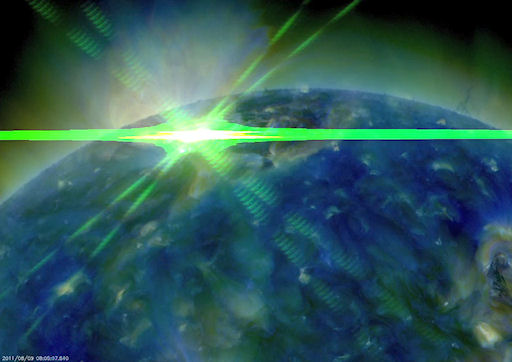 The sun unleashed its most powerful solar flare in four years Tuesday — an eruption that could have had serious consequences on Earth if it had taken place on the side of the sun facing the planet.
“We lucked out because the site of the eruption at the sun was not facing the Earth, so we will probably feel no ill effects,” Joe Kunches, a space scientist with the National Oceanic and Atmospheric Administration’s Space Weather Prediction Center, told MSNBC.
So far, it appears that any consequence felt on the Earth will not cause human injury. A minor proton storm currently on the Earth’s surface could affect satellites in high-altitude orbits, and radiation briefly disrupted Read more…
MAJOR SOLAR FLARE: August 9th, 2011.
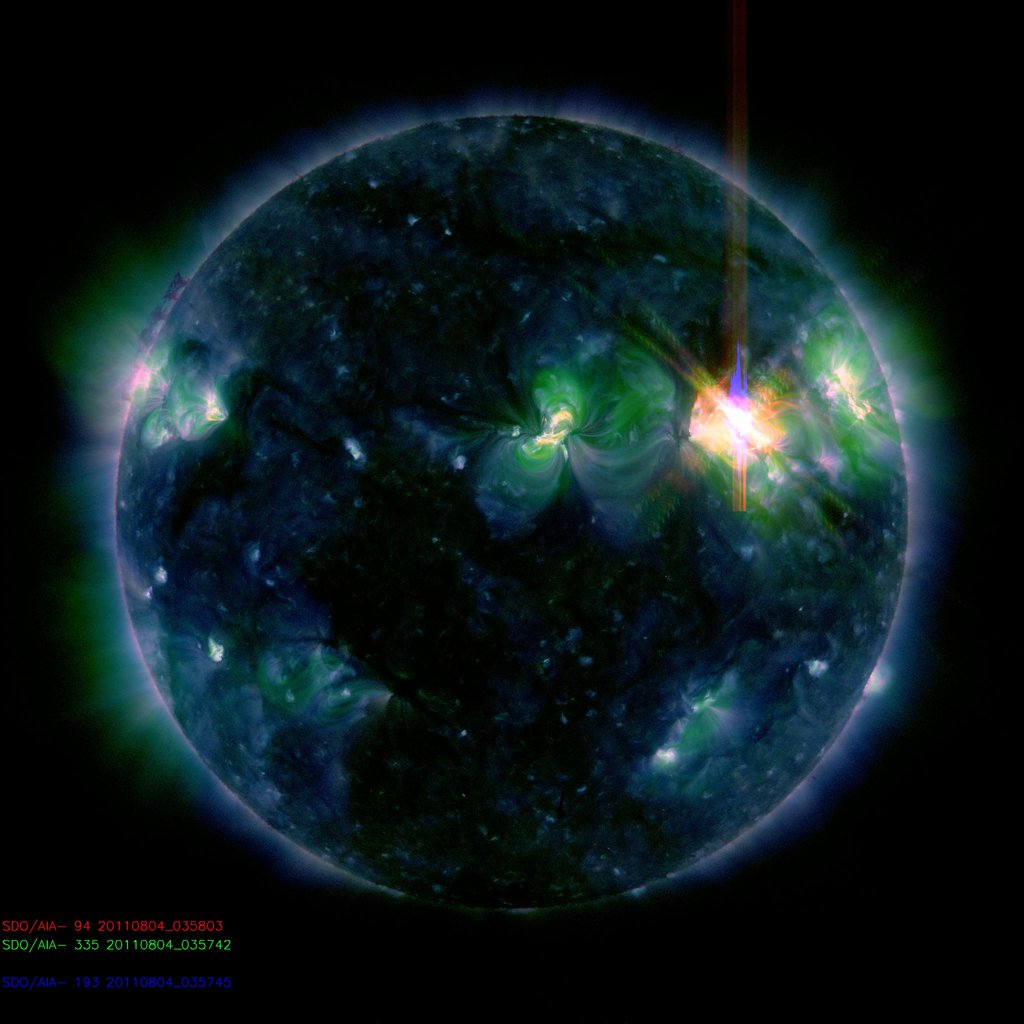
This morning at 0805 UT, sunspot 1263 produced a powerful X7-class solar flare. NASA’s Solar Dynamics Observatory captured the explosion’s extreme ultraviolet flash.
The solar flare was not Earth directed but a minor proton storm is in progress around our planet, which could affect satellites.
Radiation from the flare also briefly disrupted communications on some VLF and HF radio frequencies.
We may get a glancing blow from the flare. Read more…
A Strong M-class solar flare headed for Earth
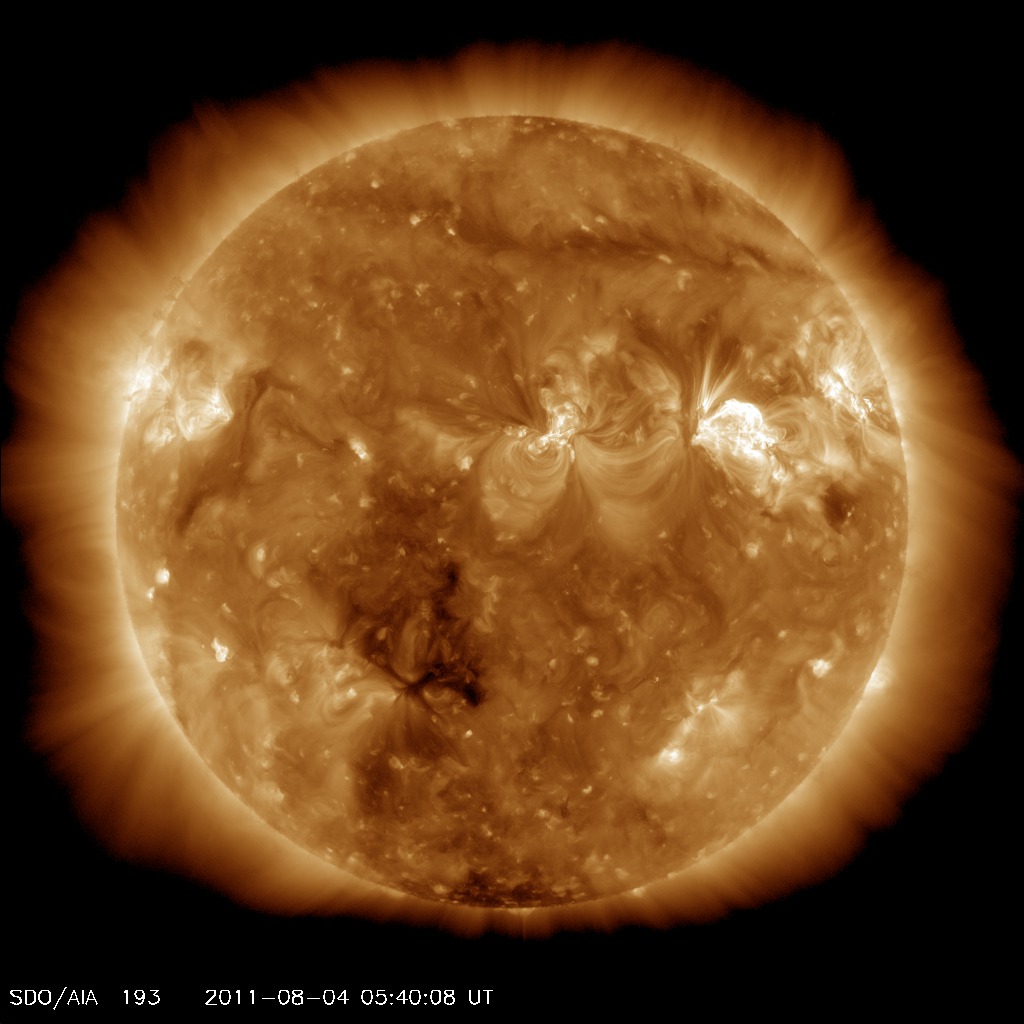
A solar wind stream flowing from the indicated coronal hole should reach Earth on Aug. 7th or 8th. Credit: SDO/AIA.
STRONG SOLAR ACTIVITY: For the third day in a row, active sunspot 1261 has unleashed a strong M-class solar flare. The latest blast at 0357 UT on August 4th registered M9.3 on the Richter Scale of Flares, almost crossing the threshold into X-territory (X-flares are the most powerful kind). The number of energetic protons around Earth has jumped nearly 100-fold as a result of this event. Stay tuned for updates.
INCOMING CLOUDS: At least two coronal mass ejections (CMEs) are now en route to Earth, propelled toward us by eruptions in the magnetic canopy of sunspot 1261 on August 2nd and 3rd. Analysts at the GSFC Space Weather Lab have just produced a new 3-D model of the advancing CMEs. Click on the image to set the clouds in motion below:
Massive Sunspot 1263 Forms-Wider than the Earth!
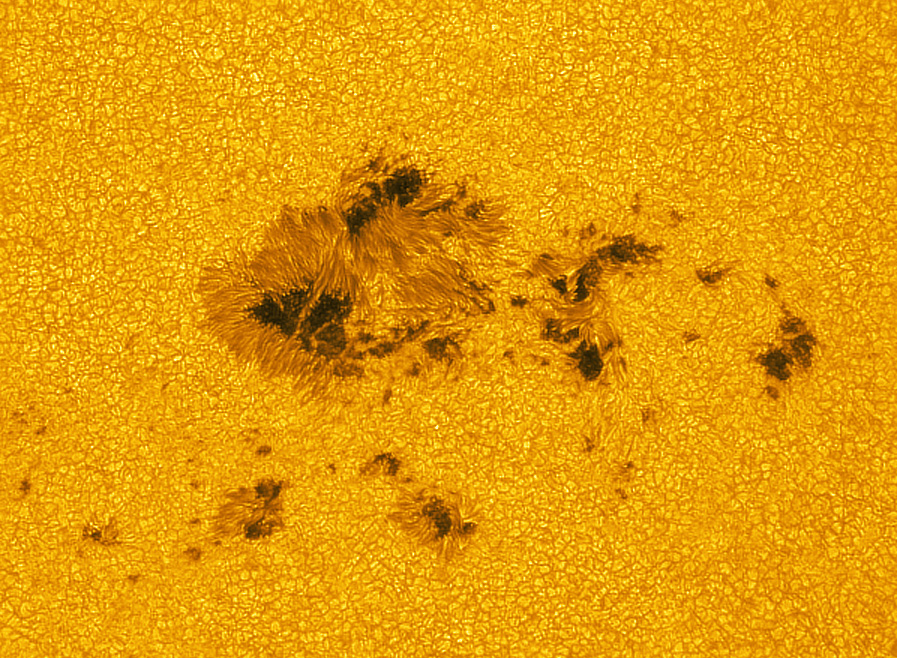
 Double sunspot 1263 is a whopper. Its two dark cores are each wider than Earth, and the entire region stretches more than 65,000 km from end to end. Yesterday in the Netherlands, Emil Kraaikamp took advantage of a break in the clouds and “a few moments of steady air” to capture this magnificent photo:
“To image this monster, I used a 10-inch Newtonian telescope capped by a white light solar filter,” says Kraaikamp. He used the same setup to photograph nearby sunspot 1261. The clarity of both images is impressive. Note the granulation of the stellar surface surrounding the main dark cores. Those are Texas-sized bubbles of plasma rising and falling like water boiling on top of a hot stove.
The magnetic field of sunspot 1263 harbors energy for powerful X-class solar flares. Because the sunspot is turning to face Earth, any such eruptions in the days ahead would likely be geo-effective
Intense Solar Flare Erupts From the Sun
 |
| A powerful M9-class solar flare erupted from the sun at 10:09 p.m. EDT on July 29 (0209 GMT July 30). CREDIT: NASA/SDO |
A powerful flare erupted from the sun this past weekend, but while the storm was not aimed directly at Earth, it was nearly the most powerful type of solar storm there is, scientists say.
The brief but strong solar flare occurred late Friday (July 29) at 10:09 p.m. EDT (0209 GMT July 30), and grew in intensity. The flare was followed by an unrelated geomagnetic storm, which was triggered by fluctuations in the solar wind, according to Spaceweather.com, a website that monitors space weather events.
As a result of the solar storm, skywatchers at high latitudes, particularly in the southern Read more…
Solar Climate Change: Armageddon Ready: Russian solar probe to predict Earthly cataclysms
Some scientists believe bursts of solar activity cause natural disasters on our planet, but until now the Read more…
NASA warns of global catastrophe post upcoming ‘huge space storm’
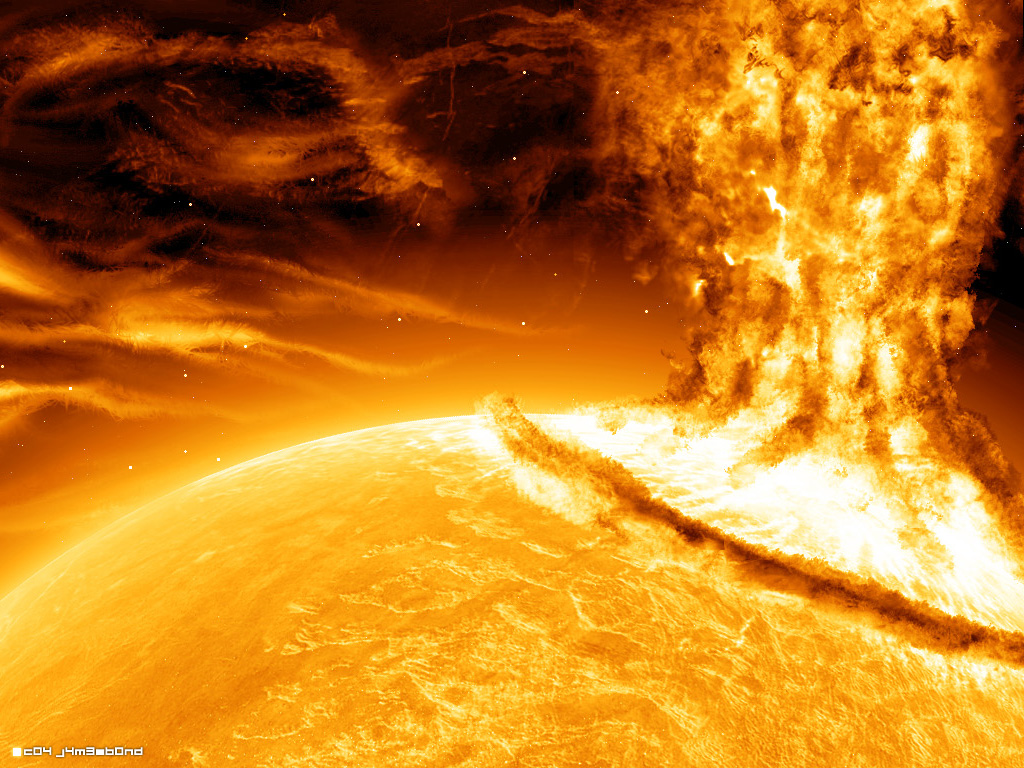 NASA has warned of a once-in-a-lifetime ‘space storm’ after the sun wakes ‘from a deep slumber’ sometime around 2013, causing ‘20 times more economic damage than Hurricane Katrina’.
Senior space agency scientists believe that the super storm would hit like ‘a bolt of lightning’ and damage everything from emergency services’ systems, hospital equipment, banking systems and air traffic control devices, through to “everyday” items such as home computers, iPods and Sat Navs.
And unless precautions are taken, it could cause catastrophic consequences for the world’s health, emergency services and national security.
“We know it is coming but we don’t know how bad it is going to be,” Dr Richard Fisher, the director of NASA’s Heliophysics division, said in an interview with The Daily Telegraph.
He, however, said that preparations were similar to those in a hurricane season, where authorities knew a problem was imminent but did not know how serious it would be.
“I think the issue is now that modern society is so dependant on Read more…
Ring of Fire: Update
Labor market risks of a magnitude 7.8 earthquake in southern California
PDF file of this Regional Report | Other BLS Regional Reports
Authors:
Richard Holden, Amar Mann, and Tian Luo
Bureau of Labor Statistics Read more…
Laws of physics must be rewritten: Mysterious sun particles alter radioactive decay on Earth
 The scientific process, as any experienced researcher can attest, provides a kind of road map through the forest of the natural world. By developing hypotheses and designing methods by which to test them, we use the scientific process to make the abstract world more concrete.
Once we clarify our questions about matter, time, and reality, we can move forward from one conclusion to another in a logical attempt to answer them. But the path in front of us often extends into kind of fog, a compounding cloud of questions, with each conclusion often leading only to additional questions that multiply indefinitely.
And the path behind us can be equally shrouded. Sometimes generations of observations about the Read more…


![[Most Recent Quotes from www.kitco.com]](https://i0.wp.com/www.kitconet.com/charts/metals/gold/t24_au_en_usoz_2.gif)
![[Most Recent Quotes from www.kitco.com]](https://i0.wp.com/www.kitconet.com/charts/metals/silver/t24_ag_en_usoz_2.gif)

 crisisboom
 CRISISBOOM
You must be logged in to post a comment.