Archive
Eyes on the Street: How Traffic Surveillance Invades Your Privacy
 Credit: Dreamstime
Is it cutting-edge, or just downright creepy? Surveillance technology is increasingly being implemented in municipalities across the country. But while such gadgets aim to curtail crime and decrease traffic accidents, some people are wondering about the costs to both town budgets and privacy.
“Overall, we wonder if the costs will outweigh the benefits,” said Jay Stanley, a Washington, D.C.-based senior policy analyst at the American Civil Liberties Union’s Speech, Policy and Technology Project.
Such technology, which includes everything from neighborhood video cameras, red-light cameras and, most recently, parking-space sensors, is popping up faster than mushrooms in a shady forest.
“Over the last several years, traffic-centric surveillance applications Read more…
Atlanta video surveillance center to open
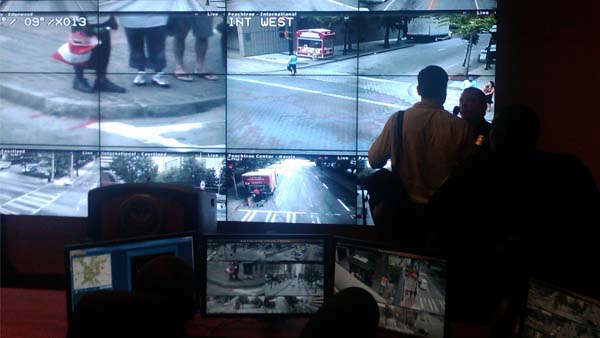 Did you ever get the feeling someone is watching you? If you walk down one of Atlanta’s busy streets, you’re probably right. The police department will keep an even closer eye on the city with a new surveillance camera system they say will help them fight crime.
Monitors stretch from the floor to the ceiling. Police scan every movement on the street in what looks like a scene from a futuristic movie.
It’s the Atlanta Police Department’s new operation shield video integration center, the place where police coordinate and watch more than 100 cameras, mostly downtown, as they keep an eye out for crime.
“When you have an Read more…
We’re Watching You: Surveillance Expansion In the Land of the Free is Unprecedented In Human History

Have you ever heard of a Yottabyte? To put this number into perspective consider the size of a terabyte, which is about the size of a typical modern hard drive. It can hold roughly 100 high definition DVD’s.
A yottabyte is 1,099,511,627,776 terabytes – or over 1 trillion terabytes of information.
This is important because according to a recent report from Politico, the National Security Agency (NSA), which is the security apparatus responsible for monitoring electronic communications across the globe, is building a new data warehousing center in Utah at the cost of $2 billion dollars. It will be housed in a one million square foot complex and be capable of storing at least one yottabyte of data.
We pointed out the various ways that the U.S. government is monitoring Read more…
Police Can Track Your Cell in Real Time
Source: WCTV
 In a case more interesting for its look at the state of modern tracking technology and the brave new world we all live in than for its legal ramifications, a Florida appeals court said Wednesday the police didn’t violate a drug dealer’s rights when they used his cell phone to pinpoint his whereabouts as he drove across the state.
While the legal outcome of the case may catch some people off guard (any idea how close the government can get to your cell phone with GPS?), the legal issue breaks no new ground. The question in the case has already been answered by the U.S. Supreme Court.
The Fourth District Court of Appeal said the Read more…
5 Unexpected Places You Can Be Tracked With Facial Recognition Technology

Once people realized that Facebook was basically harvesting biometric data, the usual uproar over the site’s relentless corrosion of privacy ensued. Germany even threatened to sue Facebook for violating German and EU data protection laws and a few other countries are investigating. But facial recognition technology is hardly confined to Facebook — and unlike the social networking site, there’s no “opt-out” of leaving your house.
Post-9/11, many airports and Read more…
Tiny Military Surveillance Robot
Wireless Data From Every Light Bulb (Video)
New digital wiretap Bill – why you should be worried

Australia is one step closer to passing the controversial Cybercrime Legislation Amendment Bill 2011. Picture: Thinkstock Source: Supplied
A NEW “digital wiretap” law that would let police force companies like Telstra to store copies of emails and text messages has come under fire from civil rights advocates.
The Cybercrime Legislation Amendment Bill was passed in the House of Representatives this week after being introduced in June. It will now be debated in the Senate.
The Bill would let authorities issue a “preservation notice” to telco companies forcing them to keep copies of a suspect’s digital communications for up to 90 days while police applied for a warrant to access the data.
It would also extend the scope of existing cyber offences and allow for increased information-sharing between Read more…
FBI wants businesses watching for customers paying with cash

Just days after the White House announced a community-based approach to combating terrorism in the United States, the FBI and other agencies are asking managers of surplus stores to spy on their customers, watching whether they pay in cash, make “extreme” religious statements or purchase products such as waterproof matches.
And the request from the government also is going to gun shops, fertilizer suppliers, motels and hotels, authorities say.
Earlier this month, the Obama administration announced a new plan titled “Empowering local partners to prevent violent extremism in the United States.” In it, Obama wrote, “Communities – especially Muslim American communities whose children, families and neighbors are being targeted for recruitment by al-Qaida – are often best positioned to take the lead because they know their communities best.”
The report warns that while the Constitution recognizes freedom of expression, “even for individuals who espouse unpopular or even hateful views,” it also is the responsibility of government to Read more…
In Secret, Senate Panel May Re-Up Vast Surveillance Dragnet
 Most of Congress is busy debating whether to raise the debt ceiling. But starting Thursday, Danger Room is hearing, a group of Senators meeting behind closed doors may consider renewing a controversial law permitting widespread government surveillance of Americans’ communications.
That law would be the FISA Amendments Act of 2008, which gave the cover of law to President George W. Bush’s warrantless surveillance program. Beloved by the Obama administration, the law is set to expire — not this year, but in 2012.
But the Senate Select Committee on Intelligence may not be so keen on waiting, Congressional sources say. When the committee meets to finalize the fiscal 2012 intelligence authorization bill to the full Senate floor — the bill that approves the activities of the 16 U.S. spy agencies – some senators will push to include a measure re-authorizing the surveillance act.
The so-called “mark-up” process begins on Read more…


![[Most Recent Quotes from www.kitco.com]](https://i0.wp.com/www.kitconet.com/charts/metals/gold/t24_au_en_usoz_2.gif)
![[Most Recent Quotes from www.kitco.com]](https://i0.wp.com/www.kitconet.com/charts/metals/silver/t24_ag_en_usoz_2.gif)

 crisisboom
 CRISISBOOM
You must be logged in to post a comment.