Archive
PATRIOT Act extension would add judicial oversight
Bill would shift next extension away from election year
 Senate Judiciary Committee Chairman Patrick Leahy (D-VT) introduced legislation to the Senate Wednesday that would extend expiring provisions of the controversial PATRIOT Act.
“Congress now faces a deadline to take action on the expiring provisions of the USA PATRIOT Act,” Sen. Leahy said in a statement. “The USA PATRIOT Act Sunset Extension Act of 2011 will preserve law enforcement and intelligence techniques that are set to expire on February 28, 2011, and extend them to December 2013.”
The legislation, titled “The USA PATRIOT Act Sunset Extension Act of 2011,” would extend the roving wiretap provisions, the “lone wolf” measure and the “library records” provision. The provisions allow authorities to conduct surveillance without identifying the person or location to be wiretapped, permits surveillance of “non-US” persons who are not affiliated with a terrorist group, and lets the government gain access to “any tangible thing” during investigations, respectively.
The bill also increases judicial oversight of government surveillance powers, such as requiring authorities to list the facts that justify obtaining a court order and raising the standards for gaining permission to conduct wiretaps.
“While this bill makes important changes to the Patriot Act to increase oversight of its powers, it unfortunately allows many dangerous provisions to continue,” Michelle Richardson, American Civil Liberties Union legislative counsel, said. Read more…
Domestic use of aerial drones by law enforcement likely to prompt privacy debate
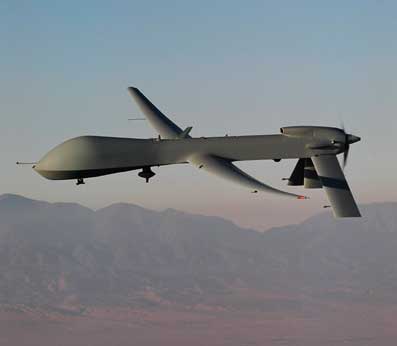 AUSTIN – The suspect’s house, just west of this city, sat on a hilltop at the end of a steep, exposed driveway. Agents with the Texas Department of Public Safety believed the man inside had a large stash of drugs and a cache of weapons, including high-caliber rifles.
As dawn broke, a SWAT team waiting to execute a search warrant wanted a last-minute aerial sweep of the property, in part to check for unseen dangers. But there was a problem: The department’s aircraft section feared that if it put up a helicopter, the suspect might try to shoot it down.
So the Texas agents did what no state or local law enforcement agency had done before in a high-risk operation: They launched a drone. A bird-size device called a Wasp floated hundreds of feet into the sky and instantly beamed live video to agents on the ground. The SWAT team stormed the house and arrested the suspect.
“The nice thing is it’s covert,” said Bill C. Nabors Jr., chief pilot with the Texas DPS, who in a recent interview described the 2009 operation for the first time publicly. “You don’t hear it, and unless you know what you’re looking for, you can’t see it.”
The drone technology that has revolutionized warfare in Iraq, Afghanistan and Pakistan is entering the national airspace: Unmanned aircraft are patrolling the border with Mexico, searching for missing persons over difficult terrain, flying into hurricanes to collect weather data, photographing traffic accident scenes and tracking the spread of forest fires. Read more…
The State Of Surveillance
 Lost in the recent London bombings, along with innocent lives, was any illusion that today’s surveillance technology can save us from evildoers. Britain has 4 million video cameras monitoring streets, parks, and government buildings, more than any other country. London alone has 500,000 cameras watching for signs of illicit activity. Studying camera footage helped link the July 7 bombings with four men — but only after the fact. The disaster drove home some painful reminders: Fanatics bent on suicide aren’t fazed by cameras. And even if they are known terrorists, most video surveillance software won’t pick them out anyway.
Tomorrow’s surveillance technology may be considerably more effective. But each uptick in protection will typically come at the cost of more intrusion into the privacy of ordinary people. For now, the public seems to find that trade-off acceptable, so scientists around the world have intensified efforts to perfect the art of surveillance, hoping to catch villains before they strike.
Research laboratories envision tools that could identify and track just about every person, anywhere — and sound alarms when the systems encounter hazardous objects or chemical compounds. Many such ideas seem to leap from the pages of science fiction: An artificial nose in doorways and corridors sniffs out faint traces of explosives on someone’s hair. Tiny sensors floating in reservoirs detect a deadly microbe and radio a warning. Smart cameras ID people at a distance by the way they walk or the shape of their ears. And a little chemical lab analyzes the sweat, body odor, and skin flakes in the human thermal plume — the halo of heat that surrounds each person.
All of these projects are on a fast track since September 11. Meanwhile, consumer demand is speeding their development by lowering the cost of the underlying technologies. Camera phones, nanny cams, and even satellite photos are commonplace. Biological sensors are flooding into households in the form of tests for HIV, pregnancy, and diabetes — some of which can relay data to a doctor — and soon there will be far more sensitive DNA-based tests. Next up are radio-frequency identification (RFID) tags. They’re showing up in stores to help track inventory, and 50 people in the U.S. have had them planted under their skin to broadcast their ID and medical data, in case of an emergency. Read more…


![[Most Recent Quotes from www.kitco.com]](https://i0.wp.com/www.kitconet.com/charts/metals/gold/t24_au_en_usoz_2.gif)
![[Most Recent Quotes from www.kitco.com]](https://i0.wp.com/www.kitconet.com/charts/metals/silver/t24_ag_en_usoz_2.gif)

 crisisboom
 CRISISBOOM
You must be logged in to post a comment.