Archive
TSA shuts door on private airport screening program

Washington (CNN) — A program that allows airports to replace government screeners with private screeners is being brought to a standstill, just a month after the Transportation Security Administration said it was “neutral” on the program.
TSA chief John Pistole said Friday he has decided not to expand the program beyond the current 16 airports, saying he does not see any advantage to it.
Though little known, the Screening Partnership Program allowed airports to replace government screeners with private contractors who wear TSA-like uniforms, meet TSA standards and work under TSA oversight. Among the airports that have “opted out” of government screening are San Francisco and Kansas City. Read more…
Inventor creates TSA-proof underwear to shield private parts from x-ray machines, prying eyes
Philip Caulfield
 While holiday travelers may not get through this week without a Transportation Security Administration agent touching their junk, a man in Colorado has a new invention he says will prevent anyone from looking at it.
Jeff Buske has created a special kind of underwear with strategically placed fig-leaf designs he says will shield TSA scanners from viewing fliers’ private parts and keep travelers safe from radiation emitted from the notorious “backscatter” x-ray machines.
Buske, an engineer, said his briefs, bras and inserts, which he’s marketing under the name Rocky Top Gear, use a special metal that protects people’s privacy when undergoing medical or security screenings.
“The object is…to protect the public, educate people and ultimately see these X-ray machines put in the Dumpster,” Buske told CBS4 Denver.
The undergarments come in designs featuring a pair of women’s hands modestly clasped together and inserts shaped like shields and stop signs.
The gear is currently for sale online at some ominously cryptic prices.
A pair of fig-leaf themed tighty-whiteys is available for a “special” offer of $19.84, while a women’s bra insert costs $9.11 and women’s briefs costs $17.76.
While the gear won’t protect fliers from a TSA frisking, Buske says his undies should achieve a happy medium between what travelers want to keep hidden and what security officials need to see.
“If someone is trying to hide something large under the thing, it’s going to show up as a bulge, visible to the eye,” Buske told CBS4.
The TSA had no comment about the underwear.
TSA Now Forcing Opt-Outs To Walk Through Body Scanners
Agency claims machines are “switched off,” traveler says policy is part of psychological ploy to coerce subservience from other passengers

Paul Joseph Watson
Prison Planet.com
Tuesday, January 18, 2011
If the experience of a man traveling through Baltimore Washington International Airport last night is anything to go by, the TSA is now forcing people who opt out of the naked body scanner to walk through the machine as part of a psychological ploy to coerce subservience out of other travelers.
Alexander Petersen was passing through security to board a domestic flight to Florida with his wife and three children. After the backscatter x-ray machines were turned on, TSA staff started corralling passengers to go through the naked body scanners. Petersen’s family escaped selection but when he was told to submit to a scan, Peterson declined and opted for the invasive pat down instead.
“They then called for an “opt-out” pat down and still told me I had to go through the machine,” writes Petersen. “I said no, and reiterated that I opt for the pat-down. They said that I just have to walk through the machine and that they won’t turn it on. I said “how do I know it’s not on, just because you say so?” Then, one of the other workers stood inside of the machine where the footprints were and waived for me to go through. With that, I assumed that it was indeed off, and proceeded through the machine for my enhanced pat-down molestation.”
After receiving his advanced grope down, during which a TSA worker felt his crotch and backside, much to the confusion of Peterson’s young son who asked, “what is that man doing to you?,” Petersen reflected on being forced to walk through the machine with assurances that it was “switched off,” even though he had declined to be body scanned.
Court Rules Government Can Keep Naked Body Scanner Images Secret
Admission that images can be stored, transmitted proves TSA lied
Steve Watson
Infowars.net
Friday, Jan 14th, 2011

A federal judge has ruled that the Department of Homeland Security can keep images produced by x-ray body scanners out of the public domain, in a blow to privacy group The Electronic Privacy Information Center’ s (EPIC) efforts to release more than 2000 of the images that show intimate details of airport travelers’ bodies.
Judge Ricardo Urbina ruled that the DHS does not have to comply with the Freedom of Information Act request to disclose the naked images of those who were screened at airport checkpoints, nor does the government have to release any other related materials.
The judge granted the government’s motion to conclude the lawsuit, issuing a 15-page explanation noting Read more…
Airports Consider Using Private Security Screeners
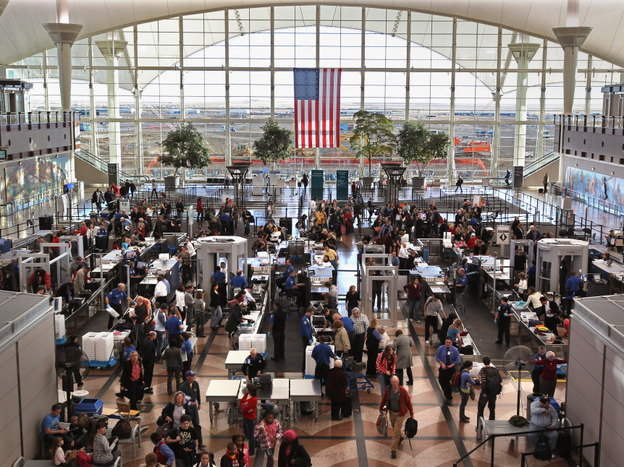 Following the furor over invasive airport security screenings and personal pat-downs, some airports are now considering replacing government security screeners with private companies.
It’s a step the new chairman of the House Transportation Committee has been urging the nation’s airports to take. But it’s not clear travelers would notice much of a difference.
The Kansas City International Airport is one of 17 in the United States where the screeners work for private contractors, not the Transportation Security Administration.
The airport’s director, Mark VanLoh, is expecting to be busy this winter: “I will be giving a lot of tours in the next few months from airports all over the country coming to Kansas City to check us out.”
Using private contractors does make a difference, VanLoh says.
“In my opinion, these contract employees — they’re not federal employees; they’re not guaranteed a job for life,” he says. “If they don’t meet the performance goals or maybe they’re consistently rude, or maybe they miss objects that go through the machine, they are terminated. I can’t remember how easy that would be to do with a federal employee. I don’t think it is.”
Under TSA Supervision
Kansas City was one of the first airports after the Sept. 11 attacks to use screeners hired by private contractors. The Aviation and Transportation Security Act of 2001, which created the TSA, also gave airports the option of using private security screeners. Those that have range in size from San Francisco’s international airport to the regional facility in Tupelo, Miss.
With private screeners, the security line operates the same way it does at airports where TSA handles the screening: Travelers remove their shoes; take out their laptops. They go through the same full-body scanners Read more…
Mobile Body Scanners :Backscatter Vans
 X-Ray “Backscatter Vans” Can See in your Car and Home, Feds are Radiating Americans “And not only are you no longer secure in your home but they can see your hidden guns in the wall or in the floor along with your precious metals. American Science & Engineering, a company based in Billerica, Massachusetts, has sold U.S. and foreign government agencies more than 500 backscatter x-ray scanners mounted in vans that can be driven past neighboring vehicles to see their contents, Joe Reiss, a vice president of marketing at the company told me in an interview. While the biggest buyer of AS&E’s machines over the last seven years has been the Department of Defense operations in Afghanistan and Iraq, Reiss says law enforcement agencies have also deployed the vans to search for vehicle-based bombs in the U.S.
“This product is now the largest selling cargo and vehicle inspection system ever,” says Reiss.
The Z Backscatter Vans, or ZBVs, as the company calls them, bounce a narrow stream of x-rays off and through nearby objects, and read which ones come back. Absorbed rays indicate dense material such as steel. Scattered rays indicate less-dense objects that can include explosives, drugs, or human bodies. That capability makes them powerful tools for security, law enforcement, and border control. Read more…


![[Most Recent Quotes from www.kitco.com]](https://i0.wp.com/www.kitconet.com/charts/metals/gold/t24_au_en_usoz_2.gif)
![[Most Recent Quotes from www.kitco.com]](https://i0.wp.com/www.kitconet.com/charts/metals/silver/t24_ag_en_usoz_2.gif)

 crisisboom
 CRISISBOOM
You must be logged in to post a comment.