Archive
Rising world food prices may soon hit Africa hard, but could be a future boon
 Damaged rice is seen in a paddy field destroyed by flood- waters near a village in Manmunai West in Batticaloa district, about 199 miles east of Colombo, Sri Lanka, on Jan. 26. The floods inundated rice paddies, and according to the UN Food and Agriculture Organization, at least 15.5 percent of the main annual rice harvest could be lost.
Andrew Caballero-Reynolds/Reuters
Johannesburg, South Africa
Global food prices reached a historic high last month, a fact that may cause even the most comfortable of Americans to cinch in their belts and cut back on spending.
But what about the world’s poor?
“Global food prices are rising to dangerous levels and threaten tens of millions of poor people around the world,” World Bank Group President Robert Zoellick said Tuesday as he announced the bank’s findings that about 44 million people in developing countries have been pushed into poverty since Read more…
World Bank: Food prices at “dangerous levels”
 Global food prices have hit “dangerous levels” that could contribute to political instability, push millions of people into poverty and raise the cost of groceries, according to a new report from the World Bank.
The bank released a report Tuesday that said global food prices have jumped 29 percent in the past year, and are just 3 percent below the all-time peak hit in 2008. Bank President Robert Zoellick said the rising prices have hit people hardest in the developing world because they spend as much as half their income on food.
“Food prices are the key and major challenge facing many developing countries today,” Zoellick said. The World Bank estimates higher prices for corn, wheat and oil have pushed 44 million people into extreme poverty since Read more…
Fresh produce prices to double or triple following freak freezes – is Earth in a magnetic pole shift?
In an article posted on January 3 of this year, I predicted a rise in food prices resulting from freak weather events (http://www.naturalnews.com/030903_p…). Here’s what I said in that article:
 By the end of 2012, I predict significant food supply disruptions in North America, brought about either by radical weather affecting crop yields or perhaps the invasion of disease indirectly caused by the over-use of pesticides or GMOs. The number of people in America struggling to feed themselves and their families will rise along with food prices. …Expect to see food prices climb with alarming speed over the next two years. While food won’t disappear, it will become significantly more expensive, causing more people to shift to subsidized foods (corn, sugar, etc.) which also happen to be some of the worst foods for your health.
Now there’s news from Mexico that the fresh produce normally shipped to U.S. grocery stores has been largely destroyed by the freak cold weather snap that struck the continental United States over the past 10 days. As a result, prices on cucumbers, zucchini, peppers, tomatoes and asparagus are set to double or triple starting right now.
Even worse, it looks like the supply of many of these items will be completely wiped out. You won’t be able to buy them, in other words, at any price!
This is the fallout from the worst freeze event recorded in Read more…
The supply of corn keeps getting smaller
 675 million bushels of corn may seem like a lot, but that is only an 18 day supply for the US grain market, and that is the reason corn prices pushed above $7 Wednesday on the CME. March corn did not close above that level, but settled at $6.98 per bushel following USDA’s February Supply and Demand report that indicated the ethanol industry was refining corn faster than previously thought.
Corn, beans and wheat prices have all been rising, but so has the price for ethanol. A year ago, ethanol was in the $1.70 per gallon range, but Wednesday closed at $2.457 per gallon, the highest it has been since the early summer price spike in 2008 when it exceeded $2.80 per gallon.
The result of the ethanol industry’s demand for corn tightens down the supply, says University of Missouri marketing specialist Melvin Brees. In his Crop Report Commentary Brees says USDA economists raised corn use by 70 million bushels and 50 million of that was added to Read more…
The Food Bubble is About to Burst
We’re fast draining the fresh water resources our farms rely on, warns Lester Brown, president of the Earth Policy Institute
What is a food bubble?
 That’s when food production is inflated through the unsustainable use of water and land. It’s the water bubble we need to worry about now. The World Bank says that 15 per cent of Indians (175 million people) are fed by grain produced through over-pumping – when water is pumped out of aquifers faster than they can be replenished. In China, the figure could be 130 million.
Has this bubble already burst anywhere?
Saudi Arabia made itself self-sufficient in wheat by using water from a fossil aquifer, which doesn’t refill. It has harvested close to 3 million tonnes a year, but in Read more…
China spends $1 billion to tackle drought
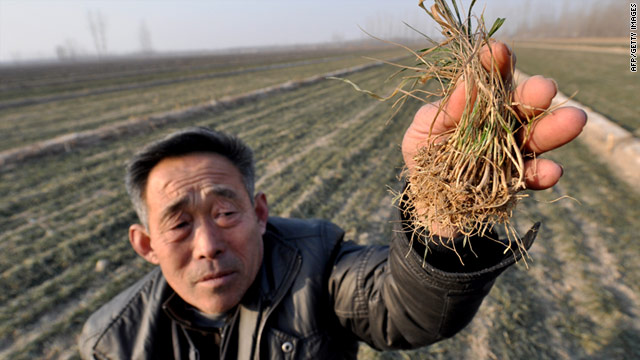
Beijing (CNN) — China’s government will invest $1 billion to combat a three month drought crippling the country’s north.
The worst drought in six decades threatens to ruin China’s winter harvest, the world’s largest producer of wheat.
To combat it, China’s government plans to spend around 6.7 billion yuan ($1.02 billion) to divert water to affected areas and irrigation facilities according to the state news agency, Xinhua.
Some 2.57 million people and 2.79 million livestock are suffering from drinking water shortages, Xinhua said.
The main affected provinces include Shandong, Jiangsu, Henan, Hebei and Shanxi, which together account for about 60% of the wheat planted this winter.
The United Nation’s Food and Agriculture Organization (FAO) issued an alert Tuesday, warning of severe wheat shortages, saying “the ongoing drought is potentially a serious problem.”
According to the FAO the drought is now affecting an area of around 5.16 million hectares, representing two-thirds of China’s wheat production.
Meanwhile the country’s capital Beijing got it first snowfall in more than three months overnight on Wednesday. But the precipitation is unlikely to end the area’s drought, reported Xinhua.
The precipitation followed cloud seeding by the municipal artificial weather intervention office, the agency said.
Einstein was right – honey bee collapse threatens global food security
The bee crisis has been treated as a niche concern until now, but as the UN’s index of food prices hits an all time-high, it is becoming urgent to know whether the plight of the honey bee risks further exhausting our food security.

HOW BANKS AND INVESTORS ARE STARVING THE THIRD WORLD
Ellen Brown
“What for a poor man is a crust, for a rich man is a securitized asset class.”
–Futures trader Ann Berg, quoted in the UK Guardian
 Underlying the sudden, volatile uprising in Egypt and Tunisia is a growing global crisis sparked by soaring food prices and unemployment. The Associated Press reports that roughly 40 percent of Egyptians struggle along at the World Bank-set poverty level of under $2 per day. Analysts estimate that food price inflation in Egypt is currently at an unsustainable 17 percent yearly. In poorer countries, as much as 60 to 80 percent of people’s incomes go for food, compared to just 10 to 20 percent in industrial countries. An increase of a dollar or so in the cost of a gallon of milk or a loaf of bread for Americans can mean starvation for people in Egypt and other poor countries.
Follow the Money
The cause of the recent jump in global food prices remains a matter of debate. Some analysts blame the Federal Reserve’s “quantitative easing” program (increasing the money supply with credit created with accounting entries), which they warn is sparking hyperinflation. Too much money chasing too few goods is the classic explanation for Read more…
Cheap food may be a thing of the past

U.S. grain prices should stay unrelentingly high this year, according to a Reuters poll, the latest sign that the era of cheap food has come to an end.
U.S. corn, soybeans and wheat prices — which surged by as much has 50 percent last year and hit their highest levels since mid-2008 — will dip by at most 5 percent by the end of 2011, according to the poll of 16 analysts.
The forecasts suggest no quick relief for nations bedeviled by record high food costs that have stoked civil unrest. It means any extreme weather event in a grains-producing part of the world could send prices soaring further.
The expectations may also strengthen importers’ resolve to build bigger inventories after a year in which stocks of corn and soybeans in the United States — the world’s top exporter — dwindled to their lowest level in decades.
Story: Global food chain stretched to the limit Read more…
Quantitative Easing Causing Food Prices to Skyrocket
 As I’ve previously noted, interest rates have risen both times after the Fed implemented quantitative easing.
Graham Summers points out that food prices have also skyrocketed both times:
In case you’ve missed it, food riots are spreading throughout the developing world Already Tunisia, Algeria, Oman, and even Laos are experiencing riots and protests due to soaring food prices.
As Abdolreza Abbassian, chief economist at the UN’s Food and Agriculture Organization (FAO), put it, “We are entering a danger territory.”
Indeed, these situations left people literally starving… AND dead from the riots.
And why is this happening?
A perfect storm of increased demand, bad harvests from key exporters (Argentina, Russia, Australia and Canada, but most of all, the Fed’s money pumping. If you don’t believe me, have a look at the below chart: Read more…


![[Most Recent Quotes from www.kitco.com]](https://i0.wp.com/www.kitconet.com/charts/metals/gold/t24_au_en_usoz_2.gif)
![[Most Recent Quotes from www.kitco.com]](https://i0.wp.com/www.kitconet.com/charts/metals/silver/t24_ag_en_usoz_2.gif)

 crisisboom
 CRISISBOOM
You must be logged in to post a comment.