Archive
WikiLeaks: US agrees to tell Russia Britain’s nuclear secrets
The US secretly agreed to give the Russians sensitive information on Britain’s nuclear deterrent to persuade them to sign a key treaty, The Daily Telegraph can disclose.

Information about every Trident missile the US supplies to Britain will be given to Russia as part of an arms control deal signed by President Barack Obama next week.
Defence analysts claim the agreement risks undermining Britain’s policy of refusing to confirm the exact size of its nuclear arsenal.
The fact that the Americans used British nuclear secrets as a bargaining chip also sheds new light on the so-called “special relationship”, which is shown often to be a one-sided affair by US diplomatic communications obtained by the WikiLeaks website.
Details of the behind-the-scenes talks are contained in more than 1,400 US embassy cables published to date by the Telegraph, including almost 800 sent from the London Embassy, which are published online today. The documents also show that: Read more…
WikiLeaks: tension in the Middle East and Asia has ‘direct potential’ to lead to nuclear war
Tension in the Middle East and Asia has given rise to an escalating atomic arms and missiles race which has “the direct potential to lead to nuclear war,” leaked diplomatic documents disclose.
By Heidi Blake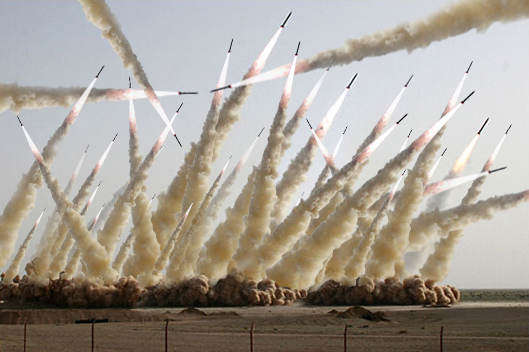 Rogue states are also increasing their efforts to secure chemical and biological weapons, and the means to deploy them, leaving billions in the world’s most densely populated area at risk of a devastating strike, the documents show.
States such as North Korea, Syria and Iran are developing long-range missiles capable of hitting targets outside the region, records of top-level security briefings obtained by WikiLeaks show.
Long-running hostilities between India and Pakistan – which both have nuclear weapons capabilities – are at the root of fears of a nuclear conflict in the region. A classified Pentagon study estimated in 2002 that a nuclear war between the two countries could result in 12 million deaths.
Secret records of a US security briefing at an international non-proliferation summit in 2008 stated that “a nuclear and missile arms race [in South Asia] has the Read more…
Analysis: Why Pakistan wants to expand its nuclear arsenal
Rob Crilly, The Daily Telegraph
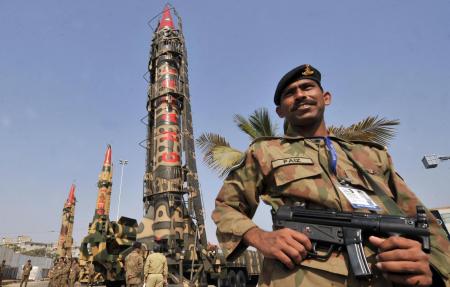
Pakistan is desperate to increase the size of its nuclear arsenal as it eyes India’s rapidly growing economy and population.
Although the numbers of weapons held by either country are small in comparison, the result of the nuclear competition between the two countries is reminiscent of the Cold War arms race between the U.S. and USSR.
In India’s case, the perceived threat is China. For Pakistan, the presumed enemy is India. Paranoia is driving the acceleration of Pakistan’s nuclear arsenal. Read more…
Feds: leaking is worse than spying
 Leaking classified information to the media is a more serious offense than spying, the Justice Department argued in a court filing last week.
The argument came in a motion supporting the detention of Jeffrey Sterling, a former CIA officer indicted for allegedly giving a reporter classified details about a CIA program aimed at interfering with Iran’s nuclear efforts.
“The defendant’s unauthorized disclosures…may be viewed as more pernicious than the typical espionage case where a spy sells classified information for money,” the prosecution team wrote in a brief submitted by attorneys at Justice Department headquarters and the U.S. Attorney’s office in Alexandria, Va.
“Unlike the typical espionage case where a single foreign country or intelligence agency may be the beneficiary of the unauthorized disclosure of classified information, this defendant elected to disclose the classified information publicly through the mass media. Thus, every foreign adversary stood to benefit from the defendant’s unauthorized disclosure of classified information, thus posing an even greater threat to society,” the brief said.
Sterling, who unsuccessfully sued the CIA for racial discrimination, was arrested earlier this month in Missouri on the indictment charging him with unauthorized disclosure of national defense information, mail fraud and obstruction of justice. The indictment doesn’t specify the precise nature of the information leaked, nor does it identify the reporter involved, but the charges contain enough detail to peg Sterling as a source for information contained in a book by New York Times reporter James Risen.
The Justice Department’s brief emphasizing the dangers of leaks could be seen as a preview of arguments the government will make against Wikileaks if authorities proceed with a prosecution of its founder, Julian Assange, or others who are part of the group. A prosecution of Wikileaks would open a significant new front in the Obama Administration’s war on leaks, which has so far targeted only leakers for prosecution and not those who receive the leaks.
China’s covert spy pad technology
 Watch your step — you might just be standing on a spy pad.
Chinese researchers have given new meaning to the term “watch your step” with a so-called “spy pad,” a device that can identify people by their gait, the South China Morning Post reported.
According to a Wikileaks document released in December, the device is able to capture the biometric information of anyone who steps on it, such as the dimension, weight and force applied by a person’s foot when they walk.
Developers believe these statistics are unique to each individual and can be used for identification. The spy pad’s sensors are so sensitive that they are supposedly able to track human targets even if they’ve changed shoes.
You’ve got to wonder why Ian Fleming didn’t think of it when he was writing the James Bond books. Or, for that matter, George Orwell when he was writing “1984.”
Acording to the SCMP report, spy pads were created by scientists at China’s IIM, or Institute of Intelligent Machines, reportedly in collaboration with developers at Nintendo, which may explain the device’s similarities with the Wii Fit Balance Board.
The Ministry for State Security, China’s spy agency, has already jumped on the project and is currently its biggest financier, according to the South China Morning Post.
Zhou Xu, a leading researcher on the project, is quoted by the Post as saying that “the government wants to use this device to track some citizens of concern.”
The gadget piqued the curiosity of U.S. diplomats in Beijing, who wrote in a diplomatic cable in February last year:
“The device can be covertly installed in a floor and is able to collect biometrics data on individuals covertly without their knowledge.
“When questioned about the device’s potential applications, IIM officials stated the device was being used by ‘secret’ customers and was not available on the commercial market.”
The Post reported that the gadget has been tested on the lab’s 100-odd employees and has an accuracy rate of 98 percent.
Giving personal information to websites such as Twitter, Facebook and Gmail is about as secure as putting it on “a postcard”

An Icelandic politician whose Internet records are being targeted by Washington’s WikiLeaks investigation warns that giving personal information to websites such as Twitter, Facebook and Gmail is about as secure as putting it on “a postcard.”
“They are on a fishing expedition,” Birgitta Jonsdottir told The Globe and Mail editorial board, making some of her first public comments since learning that U.S. prosecutors are after her Twitter account. Her private messages, credit-card and telephone numbers are all being sought from the social-networking site – and, almost certainly, from other U.S.-based Internet corporations, too.
The request speaks to how state secrets will be won, lost and protected during the Internet Age, where libraries worth of data can be uploaded onto thumb drives, and where unfathomable amounts of person-to-person correspondence reside on corporate computers inside the United States.
A freedom-of-information advocate, Ms. Jonsdottir, 43, became a crucial WikiLeaks volunteer in 2009, but left last fall amid fallings-out with the leadership of founder Julian Assange. U.S. President Barack Obama’s administration is now under tremendous pressure to charge Mr. Assange amid the deep embarrassment caused by the ongoing disclosure of more than 250,000 diplomatic cables. Read more…
WikiLeaks: Iran developing nuclear bomb with help of more than 30 countries
The Norwegian newspaper Aftenposten quotes U.S. diplomatic cables as saying that Iran is racing to achieve nuclear bomb before its economy collapses due to sanctions.
Iran has been developing contacts in more than 30 countries to acquire technology, equipment and raw materials needed to build a nuclear bomb, a Norwegian newspaper said on Sunday, citing U.S. diplomatic cables.
Aftenposten said that according to the cables, obtained by WikiLeaks, more than 350 Iranian companies and organizations were involved in the pursuit of nuclear and missile technology between 2006 and 2010.
 Technicians measuring parts of Iran's Bushehr nuclear power plant in this undated photo. |
|
| Photo by: AP |
Iran says its nuclear program has purely peaceful aims but the West suspects is designed to develop a weapons capability.
“For years, Iran has been working systematically to acquire the parts, equipment and technology needed for developing such weapons, in violation of UN sanctions against the country Read more…
Don’t Follow Wikileaks or Big Brother will be following you!
 The Justice Dept. in its ongoing battle to frighten people from sites that might reveal embarassing truths about the U.S. government, issued subpoenas seeking information on Wikileaks associates and people who regularly read their twitter feeds. The move resulted in several thousand Twitter followers dropping out as followers.
It is a bit late of course. The subpoenas would still cover their earlier activity. The Justice Dept. was hoping to obtain not just IP addresses, but mailing addresses and banking information from the people involved. However, Twitter is not likely to have any banking data.
Fortunately Twitter refused to comply with the requests and challenged the act and informed the targets as well. However, Wikileaks lawyer Mark Stephens believe that similar subpoenas may have been sent to other companies such as Skype, and Facebook. THis has yet to be confirmed.
Even though Wikileaks has not any charges against the site, it is being treated not only as a criminal but as some type of terrorist organisation. Certainly the organisation seems to be spreading terror within the U.S. government. The government is pressuring many large corporations to help silence the site and cut off funding and other support.
Wikileaks Founder: Our Enemy is China
Wikileaks may have targeted the US with its ongoing releases of sensitive State Department documents, but China is its real “technological enemy,” according to founder Julian Assange.
In an interview with the left-leaning British weekly magazine the New Statesman, Assange called China the “worst offender” for its censorship of information online.

- Associated Press
- Julian Assange, founder of Wikileaks.
“China has aggressive and sophisticated technology that places itself between every reader inside China and every information source outside China,” Assange told the magazine. “We’ve been fighting a running battle to make sure we can get information through.”
The controversial head of Wikileaks is being held in the UK and is awaiting a verdict in extradition hearings over whether he will be turned over to Swedish authorities where he is wanted for questioning over accusations of rape and sexual assault.
The Australian-born hacker has said he is worried that the US may retaliate against him for publishing a series of State Department documents on the Wikileaks site. Since late November 2010 the organization has released Read more…
WikiLeaks to speed release of leaked docs
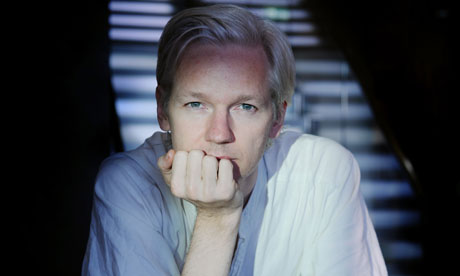
In the event of his untimely death or long-term incarceration, WikiLeaks founder Julian Assange would make public all the leaked documents his group has.
LONDON – WikiLeaks founder Julian Assange vowed Tuesday to step up his site’s release of secret documents while he fights extradition to Sweden, as his lawyers argued that sending him to Stockholm could land him in Guantanamo Bay or even on U.S. death row.
That claim, regarded by many legal experts as extremely unlikely, is part of a preliminary defense argument released by Assange’s attorneys ahead of a court hearing next month.
The Australian computer expert is wanted in Sweden to answer sex-crimes allegations. American officials also are trying to build a criminal case against WikiLeaks, which has published a trove of leaked diplomatic cables and secret U.S. military files on the wars in Iraq and Afghanistan.
Assange’s lawyers are seeking to link the two issues, claiming the Swedish prosecution is politically motivated — an allegation that Sweden strongly denies.
Assange’s defense claims “there is a real risk that, if extradited to Sweden, the U.S. will seek his extradition and/or illegal rendition to the USA, where there will be a real risk of him being detained at Guantanamo Bay or elsewhere.”
The document, prepared by Assange’s lead lawyer, Geoffrey Robertson, adds that “there is a real risk that he could be made subject to the death penalty” if sent to the United States.
Under European law, suspects cannot be extradited to jurisdictions where they may face the death penalty.
It also is not clear what, if any, charges U.S. authorities could bring against Assange, and unclear how he could be classed as an “unlawful enemy combatant,” which could expose him to detention at Guantanamo Bay.
“Mr. Assange would not be sent to Guantanamo,” said John Bellinger, a former legal adviser to the U.S. State Department. “He would be prosecuted in U.S. federal court. He would not be treated as an enemy combatant. Read more…


![[Most Recent Quotes from www.kitco.com]](https://i0.wp.com/www.kitconet.com/charts/metals/gold/t24_au_en_usoz_2.gif)
![[Most Recent Quotes from www.kitco.com]](https://i0.wp.com/www.kitconet.com/charts/metals/silver/t24_ag_en_usoz_2.gif)

 crisisboom
 CRISISBOOM
You must be logged in to post a comment.