Archive
Gold Could Have Seen Its 2011 Low
Gold could have already seen it’s low for the year when it dipped to $1,353/oz Friday, before rebounding after the weaker-than-expected U.S. non-farm payrolls data. “With the U.S. economy recovering slower than expected, and worries over (sovereign debt problems in) the euro-zone back on the front line, it seems that we have seen the year low,” says MKS Finance. Spot gold is at $1,371.20/oz, up $1.40 since Friday’s New York close.
World’s Richest Man Enters the Silver Market
 Here’s some juicy stock market RAW to kick off 2011 – Carlos Slim Helú, the world’s richest man is looking to enter the silver market in a big way.
And that big way, according to KingWorldNews, is a bid for Fresnillo, the Mexican based mining company that is poised to become the world’s biggest silver producer.
Northeast Braces for Powerful Snowstorm That Paralyzed South
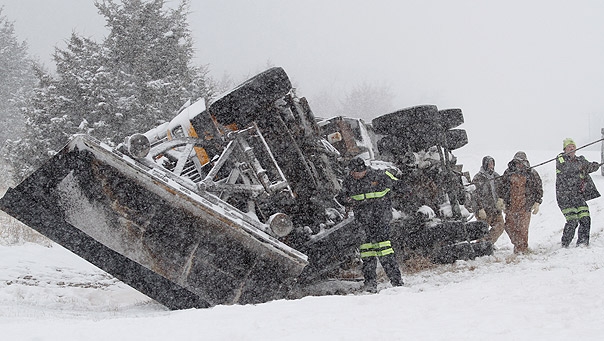 A major snowstorm that paralyzed much of the South is expected to hit the Northeast on Tuesday, possibly dumping more than a foot of snow in regions still digging out from recent storms.
The National Weather Service issued a winter storm watch for New York City from Tuesday evening through Wednesday afternoon, calling for the city and its suburbs to get between 6 and 12 inches. Forecasters also predicted up to 8 inches in Philadelphia, while parts of Massachusetts could see 18 inches.
The storm will produce near-blizzard conditions with frigid temperatures, MyFoxBoston.com reports, and is expected to fall heavily, at a rate of 1 to 3 inches an hour. The Weather Channel also reports that storm systems from the South and Midwest are expected to merge.
The wintry blast, which pounded the South on Sunday and Monday, sent cars sliding off the road, emptied grocery shelves and had officials nervously watching ice-laden powerlines and tree limbs.
Snow ranging from several inches to more than a foot blanketed states from Louisiana to the Carolinas — a region where many cities have only a handful of snowplows, if any. And more misery was on the way: The snow began turning to freezing rain in numerous areas, and low temperatures threatened to turn roads that may have thawed icy overnight.
“I had God with me this morning!” Yolanda Hill, manager of a Shell station north of Columbia, S.C., said of her drive to work. “I drove in the middle of the street, but, hey, I’m here.”
Freezing rain followed the snow in many spots, turning major highways into ice rinks and coating pine trees and power lines.
“If you’re off the main roads, it’s a skating rink, Read more…
The Future of Food Riots

This is a map of the countries in which there have been food riots
If all the food in the world were shared out evenly, there would be enough to go around.
That has been true for centuries now: if food was scarce, the problem was that it wasn’t in the right place, but there was no global shortage. However, that will not be true much longer.
The food riots began in Algeria more than a week ago, and they are going to spread. During the last global food shortage in 2008, there was serious rioting in Mexico, Indonesia, and Egypt. We may expect to see that again this time, only bigger and more widespread.
Most people in these countries live in a cash economy, and a large proportion live in cities. They buy their food, they don’t grow it.
That makes them very vulnerable, because they have to eat almost as much as people in rich countries do, but their incomes are much lower.
The poor, urban multitudes in these countries (including China and India) spend up to half of their income on food, compared to only about 10 percent in the rich countries. When food prices soar, these people quickly find that they simply lack the money to go on feeding themselves and their children properly—and food prices now are at an all-time high.
“We are entering a danger territory,” said Abdolreza Abbassian, chief economist at the Food and Agriculture Organization, on January 5.
The price of a basket of cereals, oils, dairy, meat, and sugar that reflects global consumption patterns has risen steadily for six months. It has just broken through the previous record, set during the last food panic in June 2008.
“There is still room for prices to go up much higher,” Abbassian added, “if, for example, the dry conditions in Read more…
USDA begins surveying damage to citrus crop
 Florida’s freezes wiped out thousands of acres worth of agriculture and millions of cases of food.
Bruce Rottman is picking fruit to get a picture of how bad Florida’s freezes were on citrus.
Rottman works with the USDA, surveying crops to assess damage.
“There’s one right here that’s on the border line,” Rottman said. “It’s got some damage right here where you can see the wavy segment wall there. The fruit is dry right here.”
Nick Faryna, a third generation citrus grower, owns these groves.
He faired surprisingly well, but said the citrus industry will definitely feel the one-two punch from the freezes over the last month.
“Normally we catch the brunt of every system that comes through,” Faryna said. “In this particular event, the air came in so strongly for two days, the air worked its way all the way to South Florida. It was kind of a democratic event. Everyone caught a little bit of it this time.”
Some got hit a lot worse than others.
“There are some areas in Lake County where I have seen some pretty good damage,” Rottman said.
At a grove in Howey-in-the-Hills, most of the leaves are gone and the trees look weathered by winter.
Rottman said this is how it looked after the notorious freezes in the 1980s that wiped out much of the citrus industry here.
“Growers that were in the lower grounds, the sheltered and protected areas really caught the brunt of it this time. And it’s pretty much industry-wide this time,” Faryna said.
Overall, Faryna said about 25 percent of the fruit in his groves suffered some sort of damage from the freezes.
Now, there’s a rush among citrus growers across the state to get that fruit into the orange juice factories before more of it hits the ground.
“It could have been worse,” Faryna said.
Every time there’s a freeze and damage to Florida agriculture, big money is lost here in the state.
Brisbane on edge ahead of catastrophic flood peak
 Authorities are urging people to stay calm as Brisbane and Ipswich prepare for unprecedented flooding over the next two days.
Heavy rain, releases from the giant Wivenhoe Dam and high tides will combine to cause major flood peaks in both cities in the next couple of days, with river levels rising above the historic 1974 floods.
And a four-year-old boy’s death in Ipswich has taken the Queensland floods death toll to 10.
“We are facing one of our toughest ever tests, we will only pass this test if we are calm,” Queensland Premier Anna Bligh said.
“Now is not a time for panic, it is a time for us to stick together.”
Authorities say about 6,500 properties could be flooded as the Bremer and Brisbane rivers hit hits record levels over the next two days.
As panicked residents strip supermarket shelves bare, Police Commissioner Bob Atkinson says people should stay calm.
“Stay calm but act wisely and if you’re in doubt, evacuate to friends or evacuate, don’t take any unnecessary risks,” he said.
The Brisbane River is predicted to rise to 3 metres tonight, 4.5 metres tomorrow and is likely to peak higher than the 1974 floods that reached 5.45 metres.
Large parts of Brisbane are already affected by flooding. A number of shops Read more…
Big Brother
 When you hear the phrase “Big Brother is watching you,” you probably think of two countries in particular: China and the former Soviet Union. Technology has changed the game. Although the Big Brother approach was effective, due to today’s technology alone privacy is almost nonexistent.
Do you know where your children are? Or your wife who says she has gone shopping or the spouse who claims to be “working late”? How about the whereabouts of your pet? Even in Turkey pet owners are required to make sure their pets have their own microchip. My pets each have a chip in case they go astray. Global Positioning System technology, more commonly known as GPS, is making it easier than ever to find stolen cars or track down missing people or Fido when he gets lost. Who would have ever imagined 50 years ago that you could be found, maybe in some cases somewhere you would not want to be Read more…
Soon coupons (or Big Brother) will find you at the store
 Coupons, long the staple of the Sunday paper, are going high tech and with the popularity of smartphones, more young people and men are now using digital coupons. But soon technology will progress further and manufacturers will be able to target shoppers right in the store.
The technology is coming which will pinpoint your exact location in the store. The GPS current phones use doesn’t work indoors, but there are companies hard at work, developing software that will create a detailed map of the store and assign location points throughout the store.
It’s called geotagging.
Companies will be able to geotag consumers with a smartphone. The goal: to send a coupon for an item you wouldn’t normally buy, while you’re near it or standing in front of it in the aisle.
And if you’ve downloaded shopping list apps, or coupon apps, it’s likely the manufacturers or stores will know what kind of items you normally buy, and figure out if they want to offer you a discount to try another brand or an item you might not necessarily buy regularly. Most companies don’t like to give out coupons for items you are going to buy anyway.
The folks I talked to at a grocery store in Metairie say they’d love the savings, but are concerned about having their location pinpointed at all times.
WikiLeaks to speed release of leaked docs

In the event of his untimely death or long-term incarceration, WikiLeaks founder Julian Assange would make public all the leaked documents his group has.
LONDON – WikiLeaks founder Julian Assange vowed Tuesday to step up his site’s release of secret documents while he fights extradition to Sweden, as his lawyers argued that sending him to Stockholm could land him in Guantanamo Bay or even on U.S. death row.
That claim, regarded by many legal experts as extremely unlikely, is part of a preliminary defense argument released by Assange’s attorneys ahead of a court hearing next month.
The Australian computer expert is wanted in Sweden to answer sex-crimes allegations. American officials also are trying to build a criminal case against WikiLeaks, which has published a trove of leaked diplomatic cables and secret U.S. military files on the wars in Iraq and Afghanistan.
Assange’s lawyers are seeking to link the two issues, claiming the Swedish prosecution is politically motivated — an allegation that Sweden strongly denies.
Assange’s defense claims “there is a real risk that, if extradited to Sweden, the U.S. will seek his extradition and/or illegal rendition to the USA, where there will be a real risk of him being detained at Guantanamo Bay or elsewhere.”
The document, prepared by Assange’s lead lawyer, Geoffrey Robertson, adds that “there is a real risk that he could be made subject to the death penalty” if sent to the United States.
Under European law, suspects cannot be extradited to jurisdictions where they may face the death penalty.
It also is not clear what, if any, charges U.S. authorities could bring against Assange, and unclear how he could be classed as an “unlawful enemy combatant,” which could expose him to detention at Guantanamo Bay.
“Mr. Assange would not be sent to Guantanamo,” said John Bellinger, a former legal adviser to the U.S. State Department. “He would be prosecuted in U.S. federal court. He would not be treated as an enemy combatant. Read more…
Could the U.S. central bank go broke?
Reuters
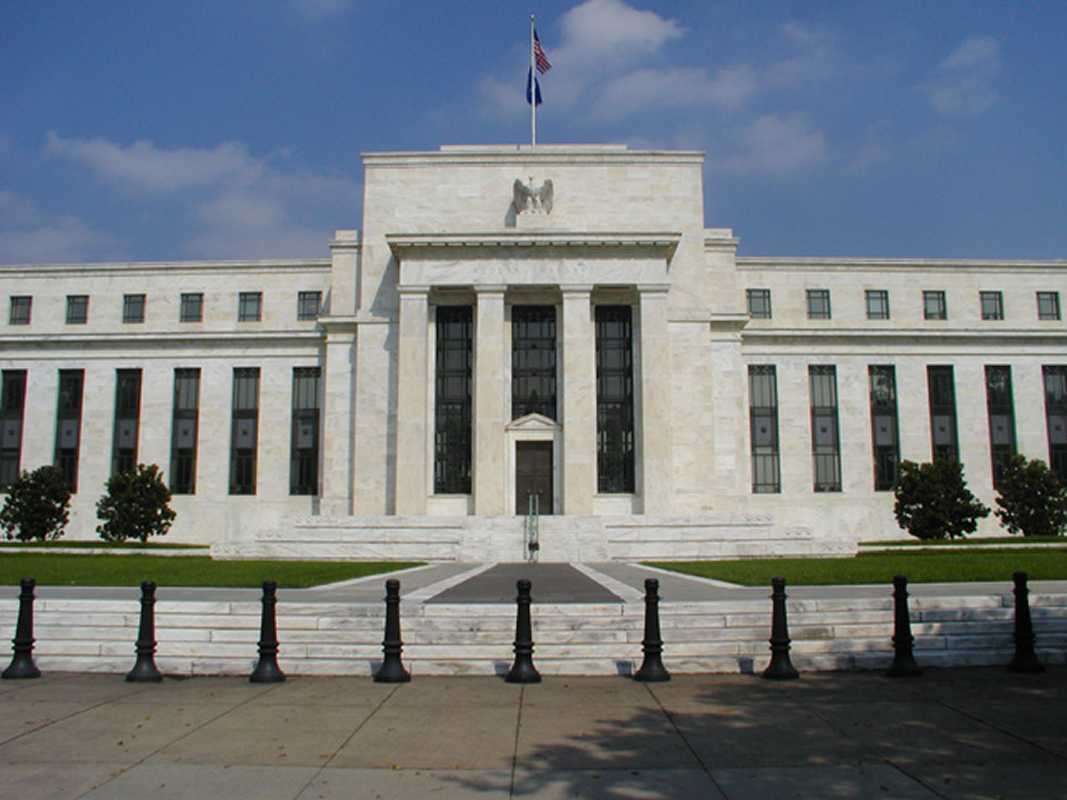 The U.S. Federal Reserve’s journey to the outer limits of monetary policy is raising concerns about how hard it will be to withdraw trillions of dollars in stimulus from the banking system when the time is right.
While that day seems distant now, some economists and market analysts have even begun pondering the unthinkable: could the vaunted Fed, the world’s most powerful central bank, become insolvent?
Almost by definition, the answer is no.
As the monetary authority, the central bank is the master of the printing press. It can literally conjure up money at will, and arguably did exactly that when it bought about $2 trillion of mortgage-backed securities and U.S. Treasuries to push down borrowing costs and boost the economy.
The Fed’s unorthodox steps helped it generate record profits in 2010, allowing it to send $78.4 billion to the U.S. Treasury Department. But its swollen balance sheet leaves the central bank unusually exposed to possible credit losses that could create a major headache at a time of increasing political encroachment on the Fed’s independence. Read more…


![[Most Recent Quotes from www.kitco.com]](https://i0.wp.com/www.kitconet.com/charts/metals/gold/t24_au_en_usoz_2.gif)
![[Most Recent Quotes from www.kitco.com]](https://i0.wp.com/www.kitconet.com/charts/metals/silver/t24_ag_en_usoz_2.gif)

 crisisboom
 CRISISBOOM
You must be logged in to post a comment.