Scientists warn of new Chilean quake
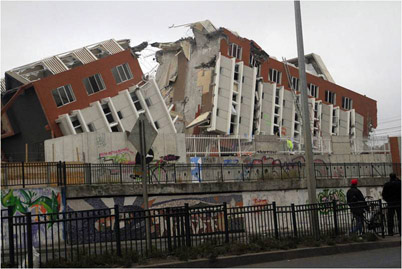
Rescue workers search for victims and survivors after an apartment complex collapsed during an 8.8-magnitude earthquake in Concepcion on February 27, 2010. Scientists say there is a high risk of a new earthquake in an area of Chile's Pacific coast which was hit by a massive quake and tsunamis last year.
Nearly 500 people were killed when an 8.8-magnitude earthquake struck off the coast of central Chile triggering a local tsunami in February 2010.
According to the report published in the journal Nature Geoscience, the previous quake had only partly broken stresses, deep in the Earth’s crust in the Chilean city of Concepcion, that have been building up since an 1835 quake witnessed by British naturalist Charles Darwin.
Darwin documented the 1835 earthquake during a five-year voyage.
“We conclude that increased stress on the unbroken patch may in turn have increased the probability of another major to great earthquake there in the near future,” the report read.
Chile’s February quake was the most powerful since the one in 2004 which caused a devastating tsunami in the Indian Ocean.
“It’s impossible to predict exactly when a new quake might happen,” Stefano Lorito of Italy’s Istituto Nazionale di Geofisica e Vulcanologia told Reuters.
Scientists examined data from tsunamis, satellites and other sources to calculate the risks in an area called the “Darwin gap” near Concepcion.
They found that a continental plate beneath the Pacific Ocean was sliding under the South American mainland at a rate of about 6.8 centimeters a year, therefore a total of almost 12 meters of stresses had built up since 1835.
Quakes happen due to pressure build up and eventually snap. Despite the “Darwin gap,” which barely moved in the 2010 earthquake, some areas, deep below the ground to the north of Concepcion slipped almost 20 meters.
The region was also hit by earthquakes in 1928, 1939, 1960 and 1985.


![[Most Recent Quotes from www.kitco.com]](https://i0.wp.com/www.kitconet.com/charts/metals/gold/t24_au_en_usoz_2.gif)
![[Most Recent Quotes from www.kitco.com]](https://i0.wp.com/www.kitconet.com/charts/metals/silver/t24_ag_en_usoz_2.gif)

 crisisboom
 CRISISBOOM
You must be logged in to post a comment.