Archive

Archive for the ‘age of rage’ Category

Hundreds of Libyans demand the government’s ouster

February 16, 2011 Comments off
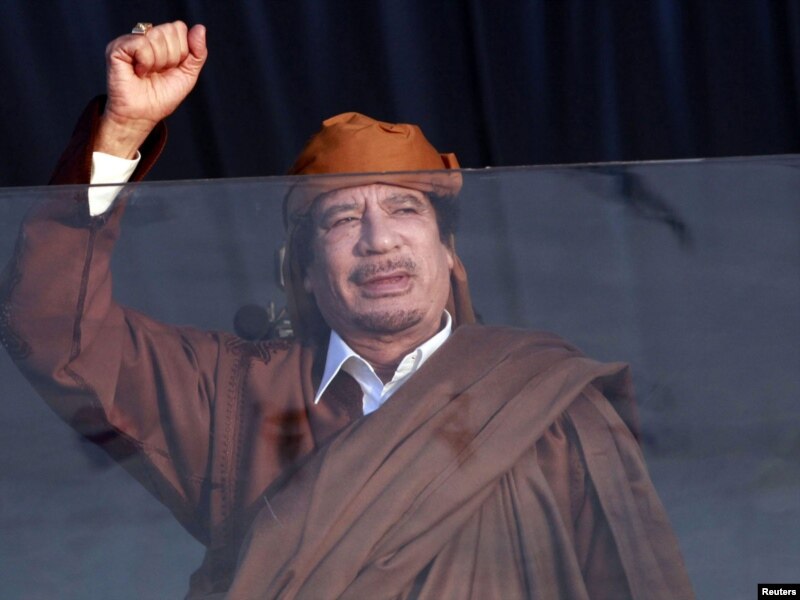
Muammar Ghadafi
TRIPOLI, Libya —

Hundreds of Libyans calling for the government’s ouster took to the streets Wednesday in the country’s second-largest city as Egypt-inspired unrest spread to the country long ruled by Moammar Kadafi.

Ashur Shamis, a Libyan opposition activist in London, said the protests began Tuesday in the port city of Benghazi, with demonstrators chanting, “No God but Allah, Moammar is the enemy of Allah” and “Down, down to corruption and to the corrupt.”

But police and armed government backers quickly clamped down on the protesters, firing rubber bullets, he said.

Witnesses and videos posted on the Internet showed protesters calling for a Libyan uprising and chanting slogans against Kadafi, who has held virtually unchecked power for more than four decades, as well as Read more…

Iranian MPs call for execution of opposition leaders

February 16, 2011 Comments off

Moussavi and Karroubi under house arrest

222 members of Iran’s 290-seat Parliament calling for the execution of opposition leaders Mir Hossein Moussavi and Mehdi Karroubi, who remain under house arrest after being detained from attending anti-government protests in Read more…

Tens of thousands march against Yemen’s president

February 16, 2011 Comments off

By AHMED AL-HAJ
Associated Press

SANAA, Yemen (AP) – Thousands of people marching for the ouster of Yemen’s U.S.-allied president clashed Tuesday with police and government supporters, and at least three demonstrators were injured in a fifth straight day of Egypt-inspired protests.

Police tried to disperse the demonstrators using tear gas, batons and stun guns, but about 3,000 protesters defiantly continued their march from Sanaa University toward the city center, chanting slogans against President Ali Abdullah Saleh, including “Down with the president’s thugs!”

The procession gained momentum with hundreds of students and rights activists joining along the way.

The unrest comes as ties between the U.S. and Saleh have been Read more…

Riots Break Out in Bahrain

February 15, 2011 2 comments
Bloomberg
By Glen Carey – Mon Feb 14 15:04:21 GMT 2011
Bahrain Deploys Police as Demonstrators Demand Freedom, Jobs

Police fired tear gas into a crowd of protesters in the Diraz area today. Photographer: -/AFP/Getty Images

Bahraini riot police were deployed to break up protests across the island nation as demonstrators, inspired by revolts in Egypt and Tunisia, demanded more political freedom and jobs.

Police fired tear gas into crowds in the areas of Diraz and Bani Jamrah. Earlier, residents of the Shiite Muslim village of Nuweidrat said clashes broke out between activists and police after morning prayers. Police were present on the outskirts of Nuweidrat, where Shiite flags adorned buildings along alleyways.

”We were starting our peaceful protests when riot police attacked us with tear gas,” Nabeel Rajab, head of the Bahrain Center for Human Rights, said in an interview after the protest in Bani Jamrah was dispersed. “We will continue Read more…

Algeria shuts down internet and Facebook as protest mounts

February 13, 2011 1 comment

Internet providers were shut down and Facebook accounts deleted across Algeria on Saturday as thousands of pro-democracy demonstrators were arrested in violent street demonstrations.

Internet providers were shut down and Facebook accounts deleted across Algeria on Saturday as thousands of pro-democracy demonstrators were arrested in violent street demonstrations.
Algerian protesters chant slogans during a demonstration in Algiers Photo: EPA
By Nabila Ramdani 7:25PM GMT 12 Feb 2011

Plastic bullets and tear gas were used to try and disperse large crowds in major cities and towns, with 30,000 riot police taking to the streets in Algiers alone.

There were also reports of journalists being targeted by state-sponsored thugs to stop reports of the disturbances being broadcast to the outside world.

But it was the government attack on the internet which was of particular significance to those calling for an end to President Abdelaziz Boutifleka’s repressive regime.

Protesters mobilising through the internet were largely credited with bringing Read more…

Hosni Mubarak steps down

February 11, 2011 Comments off

Omar Suleiman said Mr Mubarak, who earlier left Cairo for Sharm el-Sheikh, has handed control to the military.

Car horns were heard around the capital in celebration following the announcement.

Crowds in Cairo’s Tahrir Square chanted: “The people have brought down the regime.”

“In these grave circumstances that the country is passing through, President Hosni Mubarak has decided to leave his position as president of the republic,” Mr Suleiman said. “He has mandated the Armed Forces Supreme Council to run the state. God is our protector and succor.”

Mohammed ElBaradei, one of Egypt’s key opposition leaders, said: Read more…

Hosni Mubarak gives authority to VP Omar Suleiman

February 10, 2011 Comments off

Egyptian Presidential Palace

On October 14, 1981 Muhammad Hosni Sayyid Mubarak assumed the Presidency of Egypt following the assassination of President Anwar El Sadat. He is the longest-serving Egyptian ruler since Muhammad Ali Pasha.  He announced today that he will not resign but will handover power to Vice President Omar Suleiman ,however, he will no longer run for office.

He quotes “Will work for a peaceful transition of power; says he wants honesty and transparency…I will not run for next presidential election; wants smooth transfer of power…Praises youth and sacrifices; says he will punish those responsible for attacks”

On Feb 4, 2011 there was a failed assassination attempt on Egypt’s vice president left two of his bodyguards dead.

Since January 25, 2011, for a total of 17 days, a popular uprising from the people of Egypt called for his resignation as president of Egypt due to corruptness and illegal activities that the government was associated with.  Because of inflation, many Egyptians are currently struggling to feed themselves as the country’s food crisis is beginning to spiral out of control utilizing anywhere between 40 to 60 percent of their wages going to food.

With this announcement brings many questions to mind. Who will lead Egypt?  What will the future of Egypt bring to the world?  How will this affect the relationship with Israel and the United States?  Is this just a preview of what is to come in other Middle East/ North Africa countries whom are in an eerily similar format?  What will happen with crude oil prices?  As of now all we can do is watch and see history unfold before our eyes.  September awaits…

Days of Rage, Oil Prices, and the Suez Canal

February 4, 2011 Comments off

Kurt Nimmo
Infowars.com

Bloomberg warns today that an act of sabotage or a decision by a new regime – possibly headed up by the Muslim Brotherhood – to close the canal and its oil pipeline to punish supporters of Egyptian dictator Hosni Mubarak could send oil prices through the stratosphere.

Egyptian troops currently guard the canal and its adjacent Suez-Mediterranean oil pipeline but that does not mean the flow of oil – more than 1.7 millions barrels per day – cannot be shut down.

About 2.5 percent of global oil production moves through Egypt via the Suez Canal and the Suez-Mediterranean Pipeline, according to Goldman Sachs.

From 1967 until 1975, Egypt kept the canal closed in response to Israel’s seizure of Arab territory, forcing tankers to travel around the Cape of Good Hope.

Earlier today, investors increased bets that oil prices will likely increase as much as $250 a barrel on concern the unrest in Egypt will shut down the flow of oil through the Suez Canal and spread to Saudi Arabia.
Lindsey Williams and Bob Chapman on the Alex Jones Show, January 28, 2011.

On January 28, Lindsey Williams told Alex Jones the situation unfolding in Egypt is a carefully engineered event instigated by the global elite as part of a plan to bankrupt the United States and send shock waves through the global economy.

In December, Williams told Jones that his insider connections said the price of oil will soon skyrocket to between $150-200 per barrel and this price increase will result in gasoline in the range of $4-5 per gallon.

Williams became a friend and trusted confidant of oil industry executives while serving as chaplain for them and their construction crews building the Alaska pipeline in the 1970s.

Market analysts are unsure how the current crisis will Read more…

Study: Coup possible in Morocco, Saudi Arabia too

February 4, 2011 Comments off

Tomer Velmer

The first signs for the governmental instability in Egypt were detected as early as two years ago, according to a new study conducted by political scientists from Hebrew University.

The study, which will be published soon by the Journal of Conflict Resolution, was conducted by Prof. Tamir Sheafer and Dr. Shaul Shenhav. The researchers measured the “democratic gap” in about 90 democratic and non-democratic countries.

“The democratic gap is the difference between the democratic aspirations of a country’s citizens and the level of democracy given to them by the state’s institutions,” explains Prof. Sheafer.

According to the study’s findings, political stability will be in danger only in the case of a “negative democratic gap”. In other words, when the citizens’ expectations for democracy are unfulfilled, there is a higher chance that the citizens will Read more…

Tens of thousands turn out for rival rallies in Yemen

February 4, 2011 Comments off
By Borzou Daragahi and Noah Browning, Los Angeles Times

Yemeni protesters shout slogans during their "day of rage" rally against President Ali Abdullah Saleh. (Gamal Noman, AFP/Getty Images / February 3, 2011)

Large competing rallies for and against the longtime leader of Yemen unfolded Thursday without incident in one of the Arab world’s poorest, most volatile and violent nations.

The Arabian Peninsula nation’s opposition, inspired by the revolt in Tunisia and the ongoing uprising against President Hosni Mubarak in Egypt, had called for a “day of rage” against the rule of President Ali Abdullah Saleh, who has held his title since 1978 and has been accused of corruption and mismanagement. Saleh and his supporters sought to upstage the protesters by holding a simultaneous counter-demonstration across town.

The two rallies drew tens of thousands of people and, unlike in Egypt or Tunisia, unfolded largely peacefully with no major arrests or clashes, according to a Yemeni official. The day’s relative calm suggested that the political passions unleashed by the uprisings in Egypt and Tunisia will play out in different countries in different ways

In the North African nation of Read more…