Archive
‘Ice Wars’ heating up the Arctic


Editor’s note: CNN correspondent Kaj Larsen recently visited the Arctic to observe the U.S. naval exercise known as ICEX. His experience is part of the CNN documentary “Ice Wars,” which will air at 8 p.m. ET Sunday on CNN Presents.
(CNN) — On a small, floating piece of ice in the Beaufort Sea, several hundred miles north of Alaska, a group of scientists are documenting what some dub an “Arctic meltdown.”
According to climate scientists, the warming of the region is shrinking the polar ice cap at an alarming rate, reducing the permafrost layer and wreaking havoc on polar bears, arctic foxes and other indigenous wildlife in the region.
What is bad for the animals, though, has been good for commerce.
The recession of the sea ice and the reduction in permafrost — combined with advances in technology — have allowed access to oil, mineral and natural gas deposits that were previously trapped in the ice.
The abundance of these valuable resources and the opportunity to exploit them has created a Read more…
Melting Arctic Ice Marks Possible Sea Change in Marine Ecosystems
 |
| Arctic sea ice reached an abnormal low in summer 2010. Declines like this have made it possible for a long-lost species of plankton to return to the North Atlantic. CREDIT: National Oceanic and Atmospheric Administration (NOAA) |
A single-celled alga that went extinct in the North Atlantic Ocean about 800,000 years ago has returned after drifting from the Pacific through the Arctic thanks to melting polar ice. And while its appearance marks the first trans-Arctic migration in modern times, scientists say it signals something potentially bigger.
“It is an indicator of rapid change and what might come if the Arctic continues to melt,” said Chris Reid, a professor of oceanography at the Sir Alister Hardy Foundation for Ocean Science in the United Kingdom.
Arctic sea ice has been in decline for roughly three decades, and in several more recent summers, a passage has opened up between the Pacific and Atlantic. In as little as 30 years, Arctic summers are projected to Read more…
Arctic meltwater could lower temperatures at home, study warns

The pool, which has grown by more than a fifth over the last decade, could interrupt the flow of the Gulf Stream which brings warm water from the tropics, raising average European temperatures by between five and ten degrees Celsius.
Scientists are monitoring the large area of cold water amid fears that changing wind patterns could move it south towards the North Atlantic.
A study by 17 institutes from ten European countries warned that the effects of the melted ice could be abrupt in altering the balance of the Thermohaline Circulation, which keeps warmer waters flowing across the Atlantic.
One theory is that the circulation could slow down dramatically within two decades sending average temperatures plummeting.
The possibility echoes the plot of the 2004 disaster movie The Day After Tomorrow, which depicted the catastrophic effects on world climates when the delicate balance maintained by ocean circulation is suddenly lost.
Scientists have also expressed concern on the environment should the pool of largely fresh water enter the Atlantic altering its salinity levels.
Laura de Steur, an oceanographer at the Royal Netherlands Institute for Sea Research, who helped lead the study told The Times: “Large regional changes could be in store if the ocean circulation changes.”
But researchers have been unable to accurately predict if or when the pool with move southwards.
Polar bear’s long swim illustrates ice melt
Searching for food, one female bear was tracked as she swam for 9 days across the Beaufort Sea before reaching an ice floe. Litigation continues over protection of bear habitat.
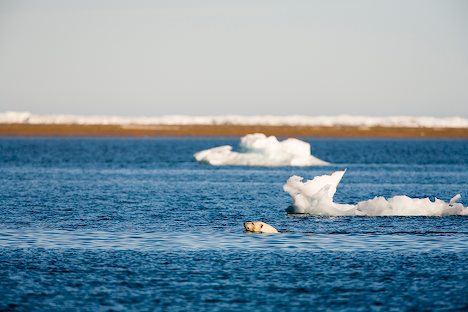 In one of the most dramatic signs ever documented of how shrinking Arctic sea ice impacts polar bears, researchers at the U.S. Geological Survey in Alaska have tracked a female bear that swam nine days across the deep, frigid Beaufort Sea before reaching an ice floe 426 miles offshore.
The marathon swim came at a cost: With little food likely available once she arrived, the bear lost 22% of her body weight and her year-old female cub, who set off on the journey but did not survive, the researchers said.
“Our activity data suggests that she swam constantly for nine days, without any rest. Which is pretty incredible,” said George M. Durner, a USGS zoologist and a lead author of the study, published last month in the journal Polar Biology.
“We have observed other long-distance swimming events. I don’t believe any of them have been Read more…


![[Most Recent Quotes from www.kitco.com]](https://i0.wp.com/www.kitconet.com/charts/metals/gold/t24_au_en_usoz_2.gif)
![[Most Recent Quotes from www.kitco.com]](https://i0.wp.com/www.kitconet.com/charts/metals/silver/t24_ag_en_usoz_2.gif)

 crisisboom
 CRISISBOOM
You must be logged in to post a comment.