Archive
Considering the recent Meteorite that struck Russia…could this be somehow related to the undiscovered Comet?
Considering the recent Meteorite that struck Russia…could this be somehow related to the undiscovered Comet?

 |
| This February eta Draconid was filmed by Peter Jenniskens with one of the low-light-level video cameras of the Cameras for Allsky Meteor Surveillance (CAMS) station in Mountain View, California, at 07:59:24 UT on February 4, 2011. CREDIT: All Sky Cameras/Peter Jenniskens |
A surprise meteor shower spotted in February was likely caused by cosmic “bread crumbs” dropped by an undiscovered comet that could potentially pose a threat to Earth, astronomers announced today (July 27).
The tiny meteoroids that streaked through Earth’s atmosphere for a few hours on Feb. 4 represent a previously unknown meteor shower, researchers said. The “shooting stars” arrived from the direction of the star Eta Draconis, so the shower is called the February Eta Draconids, or FEDs for short.
The bits of debris appear to have been shed by a long-period comet. Long-period comets whiz by the sun very infrequently, so it’s tough to
View original post 578 more words
Crash Site of the Meteorite that hit Russia 2/15/13
It was reported that this meteorite was about the size of a kitchen table!!
Russian Meteor Shower Linked to DA14 Asteroid?
“It was like a scene from the Armageddon movie”
Paul Joseph Watson
Infowars.com
February 15, 2013
Experts are pondering whether a meteorite shower which caused panic in Russia, injuring over 500 people, devastating buildings and wiping out the cell phone network, is linked to today’s fly-by of DA14, the “city killer” asteroid that NASA has assured will not hit the earth.
The meteor shower, which was dramatically captured by numerous people on cell phone videos, was described by some as “like a scene from the Armageddon movie,” with YouTube clips showing a Read more…
Earth Collided Head-On With Comet In January
nanopatentsandinnovations.blogspot.com
Night turned briefly into day over a wide area in California and Nevada at 5:21:44 a.m. PST on Thursday morning January 17th, creating hopes of another extraterrestrial surprise delivery of meteorites, but this bright fireball did not drop meteorites on the ground. This was a head-on collision with a small perhaps 1-meter sized comet, rather than the glancing blow of a stronger asteroid. The comet matter was almost instantly turned into dust and gas.
Sunnyvale record of the January 17 fireball. The beginning of the meteor trajectory is visible right of the bright flash that originated well below the field of view.

Credit: SETI
The fireball that lit up the predawn Northern California sky in late January was a small comet that hit Earth head-on when Read more…
Asteroid to come close to Earth on Febuary 15
An asteroid will come close to the earth on February 15, according to Birla Science Centre here.
“This is the first near-earth asteroid to pass so close to the earth”, said B M Birla Science Centre Director Dr B G Sidharth said in a release here.
The asteroid ‘2012 DA 14’ measures about 50 metres and would swoop to about 27,000 km near earth or roughly about one tenth the distance to moon, he said.
Kansan discovers asteroid that may come near Earth
 For the second time in less than four months, amateur astronomer Gary Hug, of Scranton, has discovered an asteroid that could one day pass close to Earth. The asteroid was found on the evening of Jan. 6 as Hug was searching for another object listed on the NEOCP (Near Earth Object Confirmation Page).
The asteroid discovered by Hug was first noticed on the west edge of the field of vision provided by the camera he had attached to his telescope.
“It was traveling too slow for most satellites but moving about 10 times faster than main belt asteroids,” he explained, noting that main belt asteroids were those found between Mars and Jupiter.
After determining that the asteroid he found wasn’t one that had been seen before, he ran a brief analysis of it and then reported his find to the Minor Planet Center.
“Within 15 minutes, this asteroid was listed on the NEOCP at the Minor Planet Center,” Hug said. “A few hours later, another Read more…
Star Betelgeuse to Crash within 5,000 Years

As per a new image provided by the Herschel Space Observatory, it has been revealed that Betelgeuse, one of the star’s in Orion constellation is going to crash in 5,000 years. The information about the same has been provided by the NASA, which has also unveiled that the star is the going to crash with a cosmic wall.
Experts said that the orange-red star is quite a bright star and its collision will definitely prove costly. It has been said so as the star is already started shedding a large amount of its exterior most layer. The shedding was visible in the Hershel’s picture as well.
The picture has also showed the effect of star’s fierce winds. It has been found that the winds have been causing whipping around the nearby space. It has also been seen that the dusty debris lies around the star.
Experts have predicted that it will take 5,000 years for the outer arc of the star to crash. If to talk about the whole star, then it will take approximately 12,500 years. Astronomers said that the star has swelled up and has been shedding a lot of fraction of its outermost layer. This has made sure that its collision will be a supernova explosion. Read more…
Asteroid Apophis Passing Us Jan.10th 2013 !! Much Larger than they Thought ~ By 75 Percent
Rogue Planet Like Nibiru Found By Hubble Space Telescope
This diagram shows the orbit of the exoplanet Fomalhaut b as calculated from recent Hubble Space Telescope observations. The planet follows a highly elliptical orbit that carries it across a wide belt of debris encircling the bright star Fomalhaut. 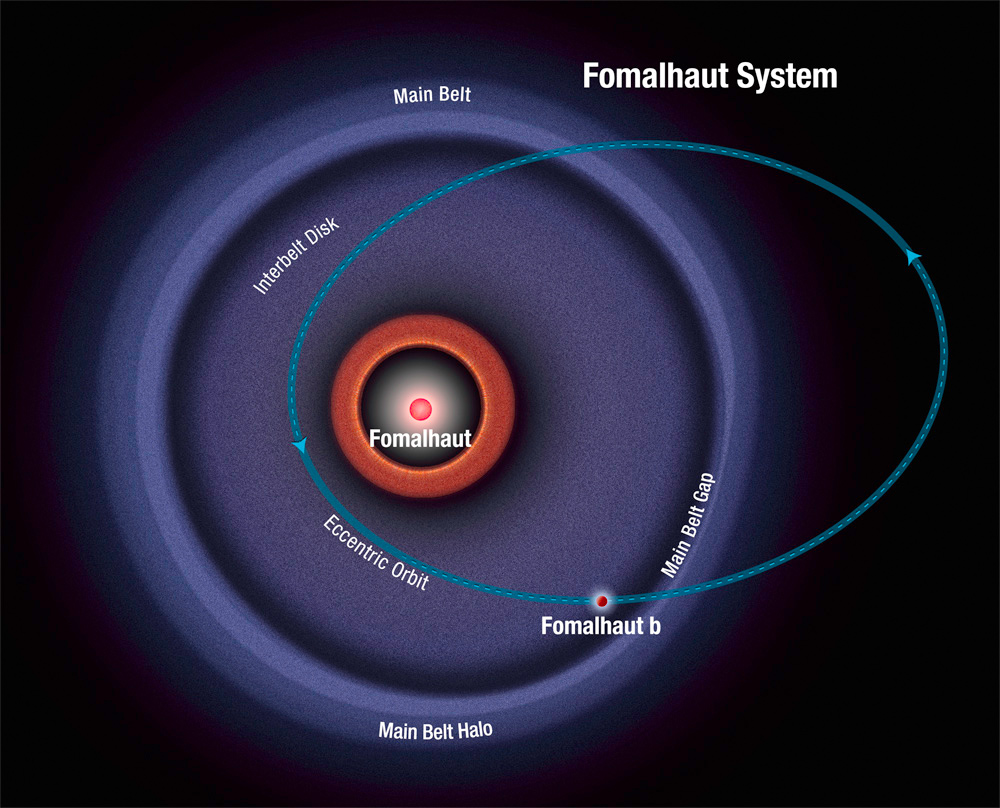 The planet swings as close to its star as 4.6 billion miles, and the outermost point of its orbit is 27 billion miles away from the star. The orbital period is approximately 2,000 years.
Illustration Credit: NASA, ESA, and A. Feild (STScI)
Newly released NASA Hubble Space Telescope images of a vast debris disk encircling the nearby star Fomalhaut and a mysterious planet circling it may provide forensic evidence of a titanic planetary disruption in the system.
Astronomers are surprised to find the debris belt is wider than previously known, spanning a Read more…
SOFIA Spots Recent Starburst in the Milky Way Galaxy’s Center

Researchers using the Stratospheric Observatory for Infrared Astronomy (SOFIA) have captured new images of a ring of gas and dust seven light-years in diameter surrounding the supermassive black hole at the center of the Milky Way, and of a neighboring cluster of extremely luminous young stars embedded in dust cocoons.
The images of our galaxy’s circumnuclear ring (CNR) and its neighboring quintuplet cluster (QC) are the subjects of two posters presented this week during the American Astronomical Society’s meeting in Long Beach, Calif. Ryan Lau of Cornell University and his collaborators studied the CNR. Matt Hankins of the University of Central Arkansas in Conway is lead author of the other paper, regarding the QC.


![[Most Recent Quotes from www.kitco.com]](https://i0.wp.com/www.kitconet.com/charts/metals/gold/t24_au_en_usoz_2.gif)
![[Most Recent Quotes from www.kitco.com]](https://i0.wp.com/www.kitconet.com/charts/metals/silver/t24_ag_en_usoz_2.gif)

 crisisboom
 CRISISBOOM
You must be logged in to post a comment.