
Russian amateur astronomer discovers new comet
If you can recall as many mainstream news articles have reported about it, Venus has been unusually bright during that time span…
view this on the SECCHI-B HI-1: what looks like a large impact on the planet Venus. Just as comet Lovejoy passes nearby. The SECCHI website was “out of service” for the past several days — now I think I may understand why.
A possibly large planetary collision occurred.
search the dates starting on 12/24/2011 – through today 1/6/2012 (several recent days not yet available).
here is the link to the blog post on this with screenshots and the direct link to SECCHI:
http://sincedutch.wordpress.com/2012/01/06/162012-planet-venus-has-been-hit-b… Read more…
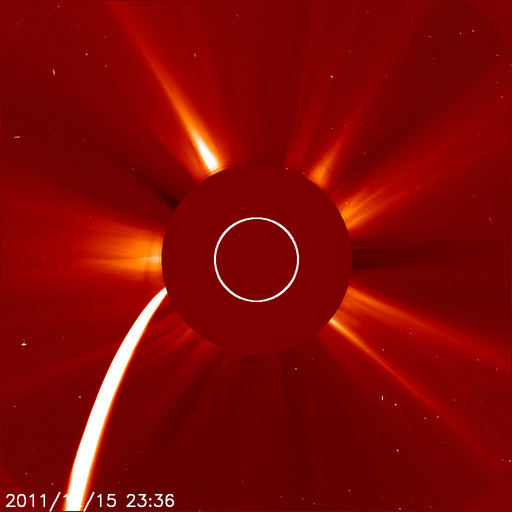
Comet Lovejoy hurtled towards the sun on December 15, 2011, as seen by the SOHO spacecraft. CREDIT: SOHO
Comet Lovejoy plunged through the sun’s corona at about 7 p.m. EST today (midnight GMT on Dec. 16), coming within 87,000 miles (140,000 kilometers) of our star’s surface. Temperatures in the corona can reach 2 million degrees Fahrenheit (1.1 million degrees Celsius), so most researchers expected the icy wanderer to be completely destroyed.But Lovejoy proved to be made of tough stuff. A video taken by NASA’s Solar Dynamics Observatory (SDO) spacecraft showed the icy object emerging from behind the sun and zipping back off into space.
“Breaking News! Lovejoy lives! The comet Lovejoy has survived its journey around the sun to reemerge on the other side,” SDO researchers tweeted today.
SDO is one of many instruments that scientists — eager to record and study the comet’s presumed demise — trained on Lovejoy as it streaked toward the sun.
“We have here an exceptionally rare opportunity to observe the complete vaporization of a relatively large comet, and we have approximately 18 instruments on five different Read more…
 CNN says;
“There is a huge hidden heavenly body right here in our solar system.”
This information does co-inside with our sources except for the distance — according to Read more…
Russian amateur astronomer Artyom Novichonok, a student of Petrozavodsk University, made a discovery of a new comet, Russian astronomy website Astronet said on Sunday.
The comet is the first comet discovered from Russian territory since 1989.
Novichonok’s discovery was confirmed by the International Astronomical Union, the comet being designated P/2011 R3 (Novichonok), the Ka-Dar Observatory, where Novichonok made his discovery, said on its website.
Novichonok discovered the comet on six images taken in September using a 0.4-m Jigit telescope.

Astronomers say they have discovered a planet that orbits around a pair of stars. It is the first time a so-called circumbinary system has been detected.
Movie fans might be familiar with the score of “Star Wars, Episode IV, A New Hope,” the blockbuster movie from 1977. Luke Skywalker stands on his stark home planet Tatooine. As he gazes pensively into the distance toward a pinkish sky, an orange sun descends toward the horizon, with a smaller white sun following close behind.
Well, move over, Tatooine, says John Knoll of Industrial Light and Magic, which Read more…
 Harvard scientists have discovered what they have dubbed an “invisible planet.”
While the planet is not actually invisible, scientists inferred its existence from “the influence it’s exerting on another planet,” bypassing more traditional methods of detecting planets that rely on visible evidence, lead researcher Sarah A. Ballard said.
Ballard, who is a graduate student in astronomy, found the planet—dubbed Kepler-19c and located 650 light-years from Earth in the constellation Lyra—during a routine examination of data collected from Read more…
 Recently, there has been quite a bit of talk about a comet or celestial body named Elenin (or C/2010x) that has entered our solar system and will be making a close pass of the Earth soon. At first, I assumed it was simply the talk of fanciful amateur astronomers and that, at most, it might offer an interesting night-sight for Earth’s inhabitants, much like Haley’s Comet and many others.
But as I continued hearing more and more about this “Elenin object,” I started to realize this was no mere comet. And perhaps, just maybe, it could have something to do with the famed Planet-X first reported about back in 1983 by the Washington Post. Unfortunately, it seemed as though most of what I could find was wild speculation and fanatical rantings about the end of the world. I had discovered only a handful of articles that Read more…
 Artist’s rendering of size comparisons.
Astronomers have hunted the skies for Y dwarfs, the coldest members of the brown dwarf family, without success until data from NASA’s Wide-field Infrared Survey Explorer revealed the faint glow of six such orbs within a distance of 40 light years from our sun. Unlike stars that burn steadily for billions of years, Y dwarfs fade and cool due to their low mass and inability to fuse atoms at their cores. These dwarfs hold a temperature about the same as a human body.
Astronomers study brown dwarfs in order to Read more…
For several days, has been analyzing radio signals picked up by the USC California Radio Telescope. The signal comes from the transit area of “Elenin” and coincides with the observation G pulse, which also are being analyzed by independent experts. The pulses are equally amazing. In various forums, experts are analyzing the signals…
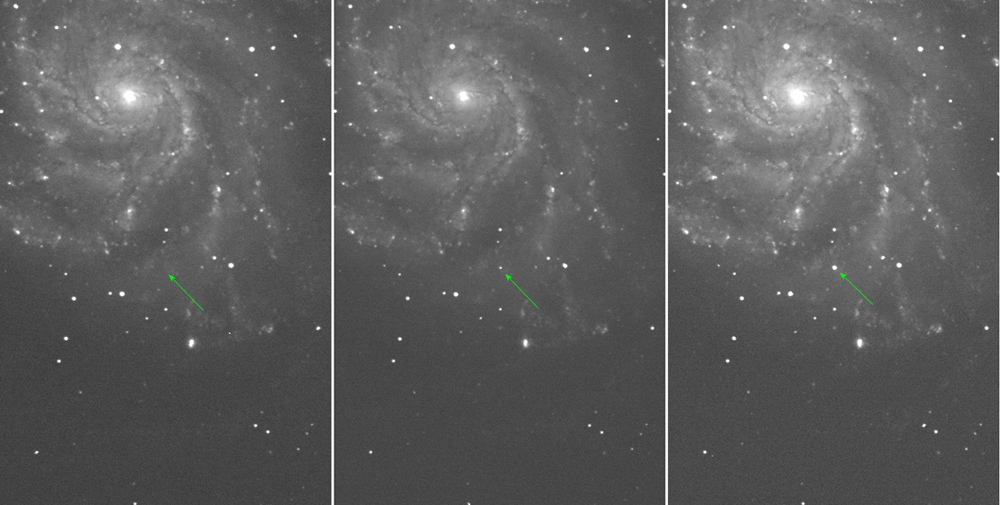
The arrow marks PTF 11kly in images taken on the Palomar 48-inch telescope over the nights of, from left to right, Aug. 22, 23 and 24. The supernova wasn't there Aug. 22, was discovered Aug. 23, and brightened considerably by Aug. 24. CREDIT: Peter Nugent and the Palomar Transient Factory
Astronomers have spotted the closest supernova in a generation — and in a week or so, stargazers with a good pair of binoculars might be able to see it, too.
The supernova, or exploded star, flared up Tuesday night (Aug. 23) in the Pinwheel Galaxy, just 21 million light-years from Earth. It’s the closest star explosion of its type observed since 1986, and astronomers around the world are already scrambling to train their instruments on it.
Researchers said they think they caught the supernova, named PTF 11kly, within Read more…


![[Most Recent Quotes from www.kitco.com]](https://i0.wp.com/www.kitconet.com/charts/metals/gold/t24_au_en_usoz_2.gif)
![[Most Recent Quotes from www.kitco.com]](https://i0.wp.com/www.kitconet.com/charts/metals/silver/t24_ag_en_usoz_2.gif)

 crisisboom
 CRISISBOOM
You must be logged in to post a comment.