
Archive

Archive for the ‘Climate Change’ Category

Spring has Sprung, it’s getting warmer

April 9, 2012 Comments off

enn.com

Across the country, more than 7,700 daily temperature records were broken last month, on the heels of the fourth warmest winter on record.

While it might be time to lie on a blanket in the park, climate scientists are worried. They say all these sunny days are actually an extreme weather event, one with local and global implications.

In Iowa, March was so hot — a record-breaking 84 degrees — that some crops there, like oats, are now running way ahead of schedule.
Joe Prusacki, a statistician with the Department of Agriculture, says this time of year Iowa usually has just 7 percent of its oats planted.

“Right now, they’re at 58 percent planted,” Prusacki says. “That’s because if you plant the crop now, it’s going to germinate and grow.”

It’s hard to say whether that could be good for farmers, since crops could still get hit with frost as late as May.

Even with the early warm weather, that chance of a hit of frost could spell trouble for farmers. But if you’ve got allergies, you may already be in trouble.

“Barring some sort of dramatic snow or change, we probably won’t see much relief until midsummer when things do calm down,” says Jim Sublett, an allergist in Louisville, Ky. He says patients have been coming to him with runny noses, itchy eyes and even asthma flare-ups since mid-February, about a month earlier than normal.

Effective World Government Will Be Needed to Stave Off Climate Catastrophe

March 22, 2012 Comments off

blogs.scientificamerican.com

Receding Himalayan glaciers

Almost six years ago, I was the editor of a single-topic issue on energy for Scientific American that included an article by Princeton University’s Robert Socolow that set out a well-reasoned plan for how to keep atmospheric carbon dioxide concentrations below a planet-livable threshold of 560 ppm. The issue came replete with technical solutions that ranged from a hydrogen economy to space-based solar.

If I had it to do over, I’d approach the issue planning differently, my fellow editors permitting. I would scale back on the nuclear fusion and clean coal, instead devoting at least half of the Read more…

New figures: More of US at risk to sea level rise

March 14, 2012 2 comments

ap.org

WASHINGTON (AP) — Nearly 4 million people across the United States, from Los Angeles to much of the East Coast, live in homes more prone to flooding from rising seas fueled by global warming, according to a new method of looking at flood risk published in two scientific papers.

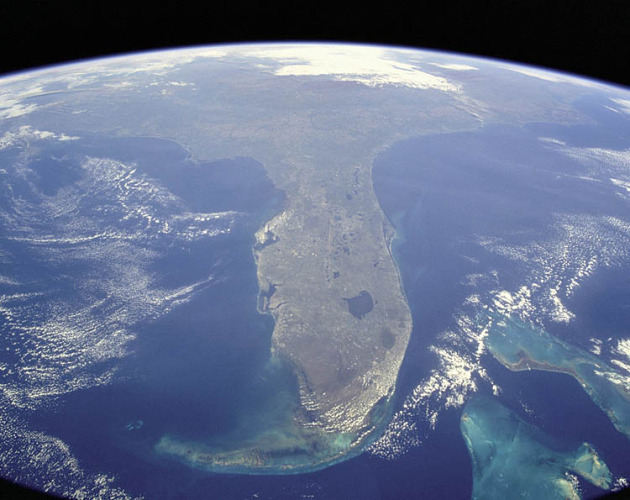
The cities that have the most people living within three feet (one meter) of high tide – the projected sea level rise by the year 2100 made by many scientists and computer models – are in Florida, Louisiana, and New York. New York City, often not thought of as a city prone to flooding, has 141,000 people at risk, which is second only to New Orleans’ 284,000. The two big Southeast Florida counties, Miami-Dade and Broward, have 312,000 people at risk combined.

All told, 3.7 million people live in homes within three feet of high tide. More than 500 US cities have at least 10 percent of the population at increased risk, the studies said.

“Southeast Florida is definitely the highest density of population that’s really on Read more…

More Americans believe in climate change: poll

February 29, 2012 Comments off

rawstory.com

Ice Fjord of Ilulissat in Greenland via AFP

WASHINGTON — Nearly two-thirds of Americans believe that climate change is real — the highest level in two years — as the public trusted its own observations of rising temperatures, a poll said Tuesday.

The growing acceptance of global warming comes despite fierce political division over the issue in the world’s largest economy, with proposals to mandate cuts on carbon emissions failing in Congress.

Sixty-two percent of Americans agree that there is solid evidence that the Earth’s average temperature has been getting warmer over the past four decades, according to the survey by the University of Michigan’s Gerald Ford School of Public Policy and the Muhlenberg College Institute of Public Opinion.

Twenty-six Read more…

Melting Arctic link to cold, snowy UK winters

February 28, 2012 Comments off

bbc

Boat trapped in ice on Greek lake This winter brought snow as far south as Greece

The progressive shrinking of Arctic sea ice is bringing colder, snowier winters to the UK and other areas of Europe, North America and China, a study shows.

As global temperatures have risen, the area of Arctic Ocean covered by ice in summer and autumn has been falling.

Writing in Proceedings of the National Academy of Sciences (PNAS), a US/China-based team show this affects the jet stream and brings cold, snowy weather.

Whether conditions will get colder still as ice melts further is unclear.

There was a marked deterioration in ice cover between the summers of 2006 and 2007, which still holds the record for the lowest extent on record; and it has not recovered since.

The current winter is roughly tracking the graph of 2007, according to the US National Snow and Ice Data Center (NSIDC).

The new study is not the first to propose a causal relationship between Read more…

Climate change will shake the Earth

February 27, 2012 Comments off

guardian

As the Earth's crust buckles, volcanic activity will increase.

As the Earth’s crust buckles, volcanic activity will increase. Photograph: Corbis

The idea that a changing climate can persuade the ground to shake, volcanoes to rumble and tsunamis to crash on to unsuspecting coastlines seems, at first, to be bordering on the insane. How can what happens in the thin envelope of gas that shrouds and protects our world possibly influence the potentially Earth-shattering processes that operate deep beneath the surface? The fact that it does reflects a failure of our imagination and a limited understanding of the manner in which the different physical components of our planet – the atmosphere, the oceans, and the solid Earth, or geosphere – intertwine and interact.

If we think about climate change at all, most of us do so in a very simplistic way: so, the weather might get a bit warmer; floods and droughts may become more of a problem and sea levels will slowly creep upwards. Evidence reveals, however, that our planet is an almost unimaginably complicated beast, which reacts to a dramatically changing climate in all manner of different ways; a few – like the aforementioned – straightforward and predictable; some Read more…

Climate change threatens tropical birds

February 16, 2012 Comments off

sciencecodex.com

Rainbow-billed toucans like the one shown here normally are confined to lower elevations in Costa Rica, but global warming is allowing them to colonize mountain forests, where they compete with resident birds for food and nesting holes, and prey on their eggs and nestlings. (Photo Credit: Cagan Sekercioglu, University of Utah)

SALT LAKE CITY — Climate change spells trouble for many tropical birds – especially those living in mountains, coastal forests and relatively small areas – and the damage will be compounded by other threats like habitat loss, disease and competition among species.

That is among the conclusions of a review of nearly 200 scientific studies relevant to the topic. The review was scheduled for online publication this week in the journal Biological Conservation by Çağan Şekercioğlu (pronounced Cha-awn Shay-care-gee-oh-loo), an assistant professor of biology at the University of Utah.

There are roughly 10,000 bird species worldwide. About 87 percent spend at least some time in the tropics, but if migratory birds are excluded, about 6,100 bird species live only in the tropics, Şekercioğlu says.

He points out that already, “12.5 percent of the world’s 10,000 bird species are threatened with extinction” – listed as vulnerable, endangered or critically endangered by the International Union for Conservation of Nature (http://www.redlist.org).  Şekercioğlu’s research indicates about 100 to 2,500 land bird species may go extinct due to climate  Full article here

CU-Boulder study shows global glaciers, ice caps, shedding billions of tons of mass annually

February 13, 2012 Comments off

eurekalert.org

Study also shows Greenland, Antarctica and global glaciers and ice caps lost roughly 8 times the volume of Lake Erie from 2003-2010

IMAGE: A new CU-Boulder study using the NASA/Germany GRACE satellite shows Earth is losing roughly 150 billion tons of ice annually. Credit-NASA

Earth’s glaciers and ice caps outside of the regions of Greenland and Antarctica are shedding roughly 150 billion tons of ice annually, according to a new study led by the University of Colorado Boulder.

The research effort is the first comprehensive satellite study of the contribution of the world’s melting glaciers and ice caps to global sea level rise and indicates they are adding roughly 0.4 millimeters annually, said CU-Boulder physics Professor John Wahr, who helped lead the study. The measurements are important because the melting of the world’s glaciers and ice caps, along with Greenland and Antarctica, pose the greatest threat to sea level increases in the future, Wahr said.

The researchers used satellite measurements taken with the Gravity Recovery and Climate Experiment, or GRACE, a joint effort of NASA and Germany, to calculate that the world’s glaciers and ice caps had lost about 148 billion tons, or about 39 cubic miles of ice annually from 2003 to 2010. The total does not count the mass from individual glacier and ice caps on the fringes of the Greenland and Antarctic ice sheets — roughly an additional 80 billion tons.

“This is the first time anyone has looked at all of the mass loss from all of Earth’s glaciers and Read more…

Island nations want climate change in world court

February 8, 2012 Comments off

dawn.com

The small island nations who are highly vulnerable due to climate change are seeking to take the issue before International Court of Justice. – File Photo

UNITED NATIONS: Small island nations, whose very existence is threatened by the rising sea levels brought about by global warming, are seeking to take the issue of climate change before the International Court of Justice.

Johnson Toribiong, president of Palau, said Friday his country and other island nations had formed an expert advisory committee to bring the issue before the U.N. General Assembly. That would allow the world court in the Hague to determine the legal ramifications of Read more…

Manhattan-sized Glaciers Break off at Both Ends of the Globe

February 6, 2012 Comments off

technorati.com

Following the recent report by MSNBC of a glacier break up in Greenland estimated at twice the size of Manhattan, the National Geographic now reported that another glacier in Antarctica, this time just about the size of Manhattan (is the size of Manhattan the rule of thumb when calculating glacier sizes?) is about to break off as well.

Experts relate that they are worried about the effects this may have on the rising sea level, but what about the collective effects ? Both sites are deemed responsible for possible changes to the ocean currents.

Take the North Atlantic for example, the gulf stream takes warm water from the tropics upstream towards the north, contributing to the warm climate in Europe. As the current hits Greenland it reaches fresh water which causes the salty water to sink and sends warm water back down towards the south.

The problem with glaciers breaking off and eventually melting is that it is reducing the salty warm water moving south, thus slowing down the entire flow. This flow reduction may cause Read more…