Archive
Quantitative Easing Rounds 1 and 2 Hurt the Economy … Bernanke Proposes Round 3
georgewashington2.blogspot.com
 Federal Reserve chairman Ben Bernanke is hinting at a third round of quantitative easing.
But Dallas Federal Reserve Bank president Richard Fisher said today:
I firmly believe that the Federal Reserve has already pressed the limits of monetary policy. So-called QE2, to my way of thinking, was of doubtful efficacy, which is why I did not support it to begin with. But even if you believe the costs of QE2 were worth its purported benefits, you would be hard pressed to now say that still more liquidity, or more fuel, is called for given the more than $1.5 trillion in excess bank reserves and the Read more…
New signs economy’s recovery faltering

Evan Solomon worked at the New York Stock Exchange Wednesday as fears that the economy was stalling rattled the markets.
The U.S. economic recovery is faltering, and Washington is running out of ways to get it back on track.
New reports Wednesday showed a steep slowdown in the manufacturing sector and weak private-sector job creation in May. The grim news comes on the heels of other recent indicators — falling home prices and consumer spending — that reflect an economy slowing to a limp this spring.
The data dash the sunnier expectations that many analysts had entering the year; many forecasters had expected economic growth of 3.5 to 4 percent in 2011.
Instead, the U.S. economy appears to be settling back into a pattern of Read more…
Stimulus law will cost $43 billion more than estimated

The Congressional Budget Office said in a new report that President Obama’s economic stimulus law will raise the federal deficit $830 billion over ten years, $43 billion more than the initially estimated cost of $787 billion.
During the law’s consideration in Congress, the Joint Committee on Taxation made the initial estimate.
CBO estimated the law lowered the unemployment rate by between .6 and 1.8 percent in the first quarter of 2011 and increased the number of people employed by between 1.2 million and 3.3 million during that same period.
Obama and congressional Democrats enacted the law, arguing it would provide a quick jolt to the economy. Republicans opposed the law, saying it would increase deficits and wasn’t designed to work quickly.
CBO estimated the government spending in the law had a major impact on the economy, increasing the Gross National Product by as much as 4.6 percent in the second quarter of 2010.
However, the unemployment rate has continued to remain high since 2009, hurting Obama politically.
CBO based its estimate on macroeconomic modelling, saying the jobs “created or saved” reports by recipients of stimulus dollars could not provide a full picture of the economic impact.
Where is the Global Economy Headed? The Experts Weigh In
 I’m writing today after spending the last three days in Boca Raton, Florida, attending The Next Few Years: A Casey Research Summit. If you’re not already familiar, the purpose of this summit was to bring together many of the world’s top economic and investing minds to share with us where they believe we’re headed in the months and years ahead.
The cast of speakers was impressive, to say the least. They brought a variety of view points, an almost overwhelming amount of data and analysis, and a perspective on what the current world means for investors that would be hard to build on. Yet, with all this variety of thought and perspective, one central theme seemed to emerge.
If you’re able to see the annihilation of your currency coming down the pike, and you take the right steps to protect your wealth, you can come out on the other side largely unscathed. Given the right investment strategy, you may even be able to grow your wealth significantly during this time.
While I knew this on some level coming into this event – I’ve been reading Casey Research’s work for just a few months now, and this was the first of their events I’ve attended – I was given pause by Casey CEO Olivier Garret’s welcoming remarks.
“While no one can predict the future with complete certainty,” he said, “it should give you comfort to know that the faculty for this summit have in common that they correctly anticipated the trends now dominating the global landscape.”
When you bring together 35 experts who each correctly predicted what’s happened in recent years – while the mainstream media Read more…
QE2 Is Damaging The Economy And Reducing GDP Growth
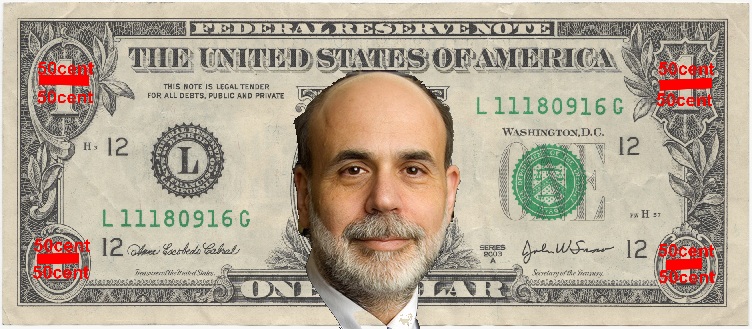 QE2 is going to go down as one of the worst monetary policy initiatives in the history of the modern Federal Reserve era. On almost any metric applied, QE2 ends up not only falling well short of its proposed goals, but actually turns certain metrics like GDP growth negative compared with the prior quarter, and heading in the wrong direction.
Costs Eat into Corporate Profits = No Hiring
Analysts all over Wall Street are starting to revise their 2nd quarter GDP forecasts down, and some like Goldman Sachs have made several downward revisions as higher input costs due to a weak dollar are creating an additional burden on businesses and consumers and thus slowing economic growth.
A weak dollar (Fig. 1) to a point can help exports, but an extremely weak dollar which in combination with QE2 liquidity juicing up commodities even further, turns out to be a net negative on the economy, and risks sending the Read more…
IMF bombshell: Age of America nears end: China’s economy will surpass the U.S. in 2016
 For the first time, the international organization has set a date for the moment when the “Age of America” will end and the U.S. economy will be overtaken by that of China.
The Obama deficit tour
The Wall Street Journal editorial page’s Steve Moore critiques the president’s speeches attacking Republican budget plans.
And it’s a lot closer than you may think.
According to the latest IMF official forecasts, China’s economy will surpass that of America in real terms in 2016 — just five years from now.
Put that in your calendar.
It provides a painful context for the budget wrangling taking place in Washington, D.C., right now. It raises enormous questions about what the international security system is going to look like in just a handful of years. And it casts a deepening cloud over both the U.S. dollar and the giant Treasury market, which have been propped up for decades by their privileged status as the liabilities of the world’s hegemonic power.
According to the IMF forecast, whomever is elected U.S. president next year — Obama? Mitt Romney? Donald Trump? — will be the last to preside over the world’s largest economy.
Most people aren’t prepared for this. They aren’t even aware it’s that close. Listen to experts of various stripes, and they will tell you Read more…
Stocks Sink on U.S. Credit Outlook as Euro Falls on Debt Crises
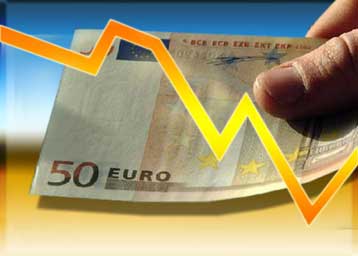 U.S. stocks sank the most in a month, oil slid and gold rose to a record after Standard & Poor’s cut the American credit outlook to negative and concern about Europe’s debt crisis worsened. Greek two-year bond yields surged to 20 percent for the first time since at least 1998.
The S&P 500 tumbled 1.6 percent to 1,298.09 at 1:13 p.m. in New York and the Stoxx Europe 600 Index slid 1.7 percent. Ten- year Treasury yields lost three basis points to 3.38 percent as concern about Europe’s finances overshadowed S&P’s move. The euro lost 1.4 percent to $1.4227, while Portuguese debt- insurance costs rose to a record. The S&P GSCI index of 24 commodities slid 1.3 percent as oil and cocoa tumbled.
S&P assigned a one-in-three chance it will lower the U.S. rating in the next two years, saying the credit crisis and recession that began in 2008 worsened a deterioration in public finances. Budget differences among Democrats and Republicans remain wide and it may take until after the 2012 elections to get a proposal that addresses the concern, S&P said.
“This is another indication of the need for the U.S. to better control its fiscal destiny, both for its sake and that of the global economy,” said Mohamed El-Erian, chief executive officer at Newport Beach, California-based Pacific Investment Management Co., the world’s biggest manager of bond funds. “Absent credible medium-term fiscal reform, every segment of U.S. society would be faced with higher borrowing costs, a weaker dollar and a less bright outlook for employment, investment and growth.”
Broad Decline
Commodity, industrial and technology companies had the biggest Read more…
Joseph Stiglitz slams US dollar
A global energy war looms
Here’s an alarming chart to ponder. HSBC has calculated what would happen to energy consumption by 2050 given plausible forecasts for economic growth and assuming no constraint on resources, or that humans carry on using energy in the “taken for granted” way they do at the moment.
As you can see, demand in China, India and other emerging markets soars, but there is also quite considerable growth from advanced economies too. The big picture is that with an additional one billion cars on the road, demand for oil would grow 110pc to more than 190 million barrels per day. Total demand for energy would rise by a similar order of magnitude, doubling the Read more…
Japan catastrophe could make U.S. debt costlier
 The U.S. Treasury market could feel financial aftershocks from Japan’s tragic U.S. Treasury. Offloading some of the Asian giant’s $1 trillion of foreign reserves could raise cash to help rebuild after Friday’s disaster. Meanwhile, the Federal Reserve is due to end its Treasury bond-buying program in June. If Japan, the second-biggest foreign holder, starts selling that’s another support gone — with the potential to make borrowing more expensive for the U.S. government.
It’s too early to estimate the cost the Japanese government and private sectors will have to shoulder for reconstruction efforts. But bond investors can’t any longer take for granted that Japan will leave its ample reserves intact as it has, broadly speaking, for the past several years. For the government, cashing in could be more palatable than yet more borrowing. Japan’s debt already amounted to more than 200 percent of Read more…


![[Most Recent Quotes from www.kitco.com]](https://i0.wp.com/www.kitconet.com/charts/metals/gold/t24_au_en_usoz_2.gif)
![[Most Recent Quotes from www.kitco.com]](https://i0.wp.com/www.kitconet.com/charts/metals/silver/t24_ag_en_usoz_2.gif)

 crisisboom
 CRISISBOOM
You must be logged in to post a comment.