Archive
Iran launches home-made satellite into orbit
Iran has launched a satellite into earth orbit in a feat that is likely to raise concerns among those who fear Iran’s intentions and nuclear development program.

“Our glorious scientists successfully put Iran’s first image-collecting satellite into orbit,” the TV report said.
Iran has made a series of claims about advances in its ambitious space program in recent years, which has Western powers worried about the possibility of its military applications.
Last year, Iran announced it had successfully launched a rocket carrying a mouse, turtle and worms into space.
Iran’s space program has expressed a goal of putting a man in orbit within 10 years, despite the Read more…
Iran Speeding Up Long-Range Missile Drive: U.N. Experts
 A recent U.N. expert review asserts that Iran has increased the rate of activities aimed at producing long-range missiles, Haaretz reported last week (see GSN, June 13).
Iran has tamped down public references to its ballistic missile advancements, possibly in part due to international uncertainty over its capacities in the area as well as over penalties other governments have adopted in a bid to curb Tehran’s disputed nuclear and missile activities, the Israeli newspaper said (see GSN, May 14).
Iran has conducted trial flights of its Shahab 3 and Sajjil ballistic missiles in three instances in less than half a year, and some of the weapons can travel farther than 620 miles, the report says. The Shahab 3 missile has proven in tests its ability to fly as far as 560 miles, and the Sajjil 1 missile has a range of Read more…
Iran Vows To Triple Uranium-Enrichment Capacity
International tensions over Iran’s disputed nuclear program look set to rise further after that country’s atomic energy chief, Fereidoun Abbasi, announced plans to drastically step up production of enriched uranium.
Abbasi also said output would be transferred from Natanz to a new secretly built facility at Fordow, near Qom, whose existence paved the way for a fresh round of United Nations sanctions against Iran when it was revealed in 2009.
The announcement came after Read more…
Iran Vows To Unplug The Internet

The leadership in Iran sees the project as a way to end the fight for control of the Internet, according to observers of Iranian policy inside and outside the country. Iran, already among the most sophisticated nations in online censoring, also promotes its national Internet as a cost-saving measure for consumers and as a way to uphold Islamic moral codes.
In February, as pro-democracy protests spread rapidly across the Middle East and Read more…
Iran’s largest lake turning to salt

OROUMIEH LAKE, Iran – From a hillside, Kamal Saadat looked forlornly at hundreds of potential customers, knowing he could not take them for trips in his boat to enjoy a spring weekend on picturesque Oroumieh Lake, the third largest saltwater lake on earth.
“Look, the boat is stuck… It cannot move anymore,” said Saadat, gesturing to where it lay encased by solidifying salt and lamenting that he could not understand why the lake was fading away.
The long popular lake, home to migrating flamingos, pelicans and gulls, has shrunken by 60 percent and could disappear entirely in just a few years, experts say — drained by drought, misguided Read more…
Iran to Display New Ballistic Missiles
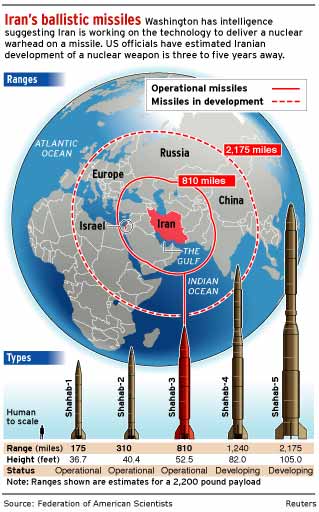 Iran plans next Tuesday to show off a new set of ballistic missiles built recently within its borders, the country’s Fars News Agency reported (see GSN, March 1).
Military equipment “including some vessels, ballistic missiles and new ammunitions will come into use on the occasion of Khorramshahr Liberation Anniversary,” Iranian Defense Minister Ahmad Vahidi said on Wednesday, referring to Iran’s 1982 victory against Iraq in a southern coastal city.
The nation’s military would soon formally receive the new missiles, Vahidi said.
Iran’s missile manufacturing systems have advanced significantly over the past 10 years, according to the media report. The Middle Eastern nation tested an antiship ballistic missile in February (see GSN, Feb. 10).
Iran’s Revolutionary Guard last October received the third variant of the Fateh 110 ballistic missile, and another version of the weapon was due for testing soon, Fars reported. The Fateh 110 is a short-range, solid-fuel weapon suited for firing from a mobile launcher. The missile has sophisticated command and guidance mechanisms, the news report said (see GSN, Sept. 22, 2010; Fars News Agency, May 18).
Iran’s Shahab 3 ballistic missile is the greatest source of worry for Western countries, Deutsche Presse-Agentur reported. The weapon has a 1,240-mile range and could strike any point in Israel (Deutsche Presse-Agentur/Monsters and Critics, May 18).
Iran Moving Ahead on Venezuelan Missile Bases that Bring Miami Well Within Range
unsettling similarities to 1962 Cuba…
except this time facing advanced air defenses

Iran, North Korea Partnering on Ballistic Missiles, U.N. Says

(May. 16) - An Iranian Shahab 3 ballistic missile lifts off in a 2009 test. The Shahab 3's warhead appears comparable in design to a North Korean warhead unveiled last year, according to a U.N. report that says the countries seem to have exchanged ballistic missile technology (Shaiegan/Getty Images). Iran and North Korea seem to routinely be swapping ballistic missile equipment in breach of U.N. Security Council directives, a classified expert report to the international body stated on Friday (see GSN, Dec. 1, 2010).
Illegal trades of missile technology had “transshipment through a neighboring third country,” the report states. Multiple envoys told Reuters the nation in question is China.
The report by the Panel of Experts assigned to oversee adherence to U.N. sanctions levied against North Korea was sent to the Security Council on Friday and viewed by Reuters on Saturday.
The document is expected to increase apprehension over Pyongyang’s collaboration with Tehran and to bolster worries about Beijing’s willingness to implement sanctions targeting North Korea and Iran’s nuclear activities, diplomats said.
The Security Council sanctions forbid commerce in atomic and missile systems with the North.
“Prohibited ballistic missile-related items are suspected to have been transferred between the Democratic People’s Republic of Korea and the Islamic Republic of Iran on regular scheduled flights of Air Koryo and Iran Air,” the experts stated.
“For the shipment of cargo, like arms and related materiel, whose illicit nature would become apparent on any cursory physical inspection, (North) Korea seems to prefer chartered cargo flights,” the document says.
Chartered cargo flights typically travel “from or to air cargo hubs which lack the kind of monitoring and security to which passenger terminals and flights are now subject,” according to the report.
A number of envoys to the Security Council said Beijing was not pleased with Read more…
U.S. Worried by Potential Chinese CW Tech Sales to Iran

A leaked diplomatic cable indicates that the U.S. State Department believed in 2009 that a Chinese firm was providing Iran with equipment that could be used in producing chemical weapons agents, Haaretz reported on Thursday (see GSN, Feb. 3).
“We have new information indicating that Zibo Chemet transferred technology for the production of glass-lined reactor equipment to Iranian customers, significantly enhancing Iran’s ability to produce indigenously chemical equipment suitable for a chemical warfare program,” Secretary of State Hillary Clinton stated in a message to the U.S. Embassy in Beijing.
The Obama administration’s top diplomat requested that the embassy inform the Chinese government of the situation and press Beijing to put an end to the exports, according to the July 24, 2009, dispatch obtained by the transparency group WikiLeaks.
Zibo Chemet is suspected of providing sensitive technology to Iran, North Korea and Syria, and was sanctioned by Washington in 2007, according to the cable. Beijing subsequently took unspecified “limited punitive action” against the firm, it states.
Nonetheless, Zibo Chemet “recently transferred Australia Group-controlled technology to manufacture glass-lined chemical reactor vessels to the Iranian entity Shimi Azarjaam. This glass-lining plant is located in Shokoohieh Industrial Park, Qum,” Clinton stated.
Such reactor vessels are produced to withstand chemicals they hold, which can include precursors for nerve agents, according to Haaretz.
China is not a member of the Australia Group, a multinational organization that seeks to prevent exports of materials intended for use in biological or chemical weapons programs.
The United States and other nations have accused Tehran of developing chemical-warfare capabilities. Iran, whose troops and citizens were subjected to chemical weapons attacks during the nation’s 1980s war with Iraq, denies operating such a program (Yossi Melman, Haaretz, April 21).
Iran to build new nuclear research reactors-report
 TEHRAN, April 11 (Reuters) – Iran plans to build “four to five” nuclear research reactors and will continue to enrich uranium to provide their fuel, a nuclear official said on Monday despite Western pressure on Tehran to curb atomic work.
The head of Iran’s Atomic Energy Organisation, Fereydoon Abbasi, said Tehran would build the reactors “in the next few years” to produce medical radioisotopes, according to the students news agency ISNA.
“To provide the fuel for these (new) reactors, we need to continue with the 20 percent enrichment of uranium,” ISNA quoted him as saying.
Abbasi’s remarks are likely to deepen Western fears that Iran’s atomic work is aimed at Read more…


![[Most Recent Quotes from www.kitco.com]](https://i0.wp.com/www.kitconet.com/charts/metals/gold/t24_au_en_usoz_2.gif)
![[Most Recent Quotes from www.kitco.com]](https://i0.wp.com/www.kitconet.com/charts/metals/silver/t24_ag_en_usoz_2.gif)

 crisisboom
 CRISISBOOM
You must be logged in to post a comment.