Archive
Two sunspots on the Sun currently pose a threat for x-class solar flares
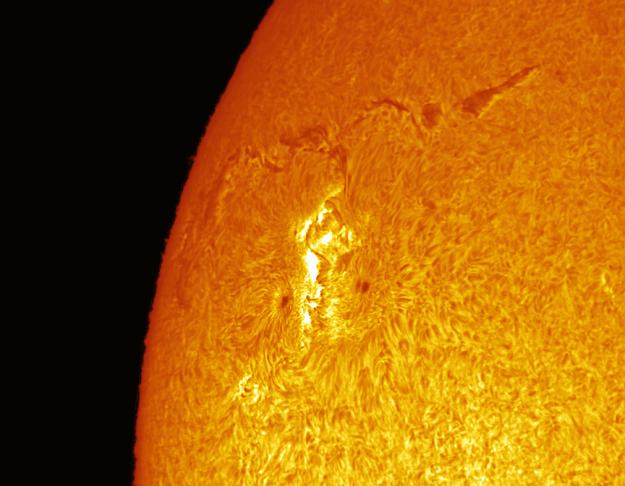 Here we go again, this time two spots on the Sun turning toward our planet now that are capable of producing powerful X-Class flares.
Two sunspots are now rotating toward the planet over the face of the Sun. Sunspots 1271 and 1272 remain quiet but pose a threat for X-class solar flares.
X-class solar flares are the most powerful solar flare the Sun can produce, according to our planetary scale. These could produce radio and electrical blackouts as well as a brilliant display of aurora if they unleash powerful Earth-directed flares.
The last solar storms a week ago were from sunspots on the farside of the Sun now. They are still together and out of our view, Venus was seen in the same field of view as one blasted toward the planet on the far side of the Sun.
Stay tuned to the sunspots, it could ‘pop’ at anytime.
Solar Storms Building Toward Peak in 2013, NASA Predicts
 |
| This image from the Solar Dynamics Observatory shows the X6.9 solar flare of Aug. 9, 2011 near the western limb (right edge) of the sun. CREDIT: NASA/SDO/Weather.com |
Solar flares like the huge one that erupted on the sun early today (Aug. 9) will only become more common as our sun nears its maximum level of activity in 2013, scientists say.
Tuesday’s flare was the most powerful sun storm since 2006, and was rated an X6.9 on the three-class scale for solar storms (X-Class is strongest, with M-Class in the middle and C-Class being the weakest).
Flares such as this one could become the norm soon, though, as our sun’s 11-year cycle of magnetic Read more…
Powerful Solar Flare Could Have Caused Serious Damage: Earth ‘Lucked Out’
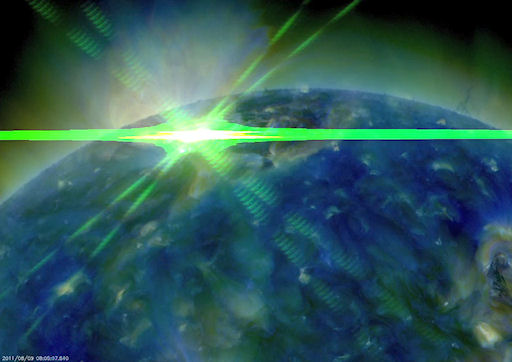 The sun unleashed its most powerful solar flare in four years Tuesday — an eruption that could have had serious consequences on Earth if it had taken place on the side of the sun facing the planet.
“We lucked out because the site of the eruption at the sun was not facing the Earth, so we will probably feel no ill effects,” Joe Kunches, a space scientist with the National Oceanic and Atmospheric Administration’s Space Weather Prediction Center, told MSNBC.
So far, it appears that any consequence felt on the Earth will not cause human injury. A minor proton storm currently on the Earth’s surface could affect satellites in high-altitude orbits, and radiation briefly disrupted Read more…
A Strong M-class solar flare headed for Earth
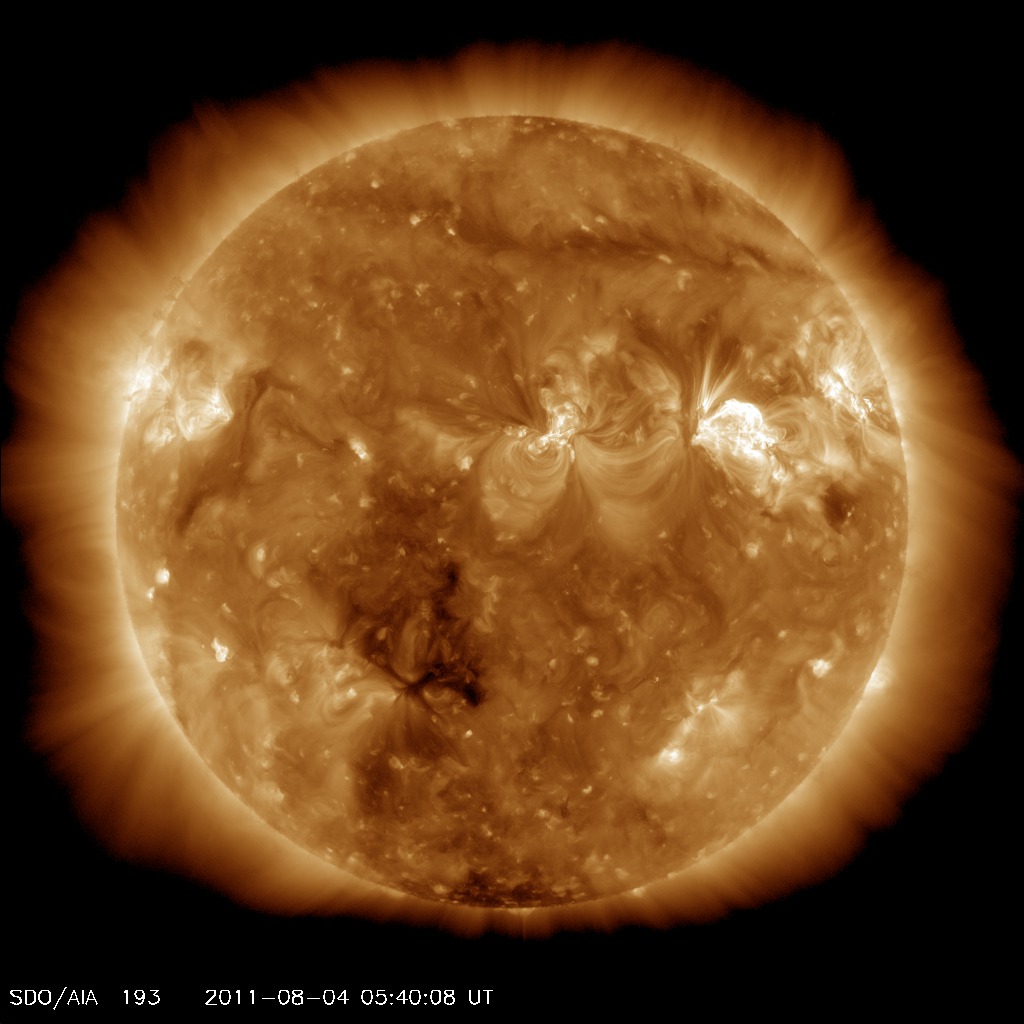
A solar wind stream flowing from the indicated coronal hole should reach Earth on Aug. 7th or 8th. Credit: SDO/AIA.
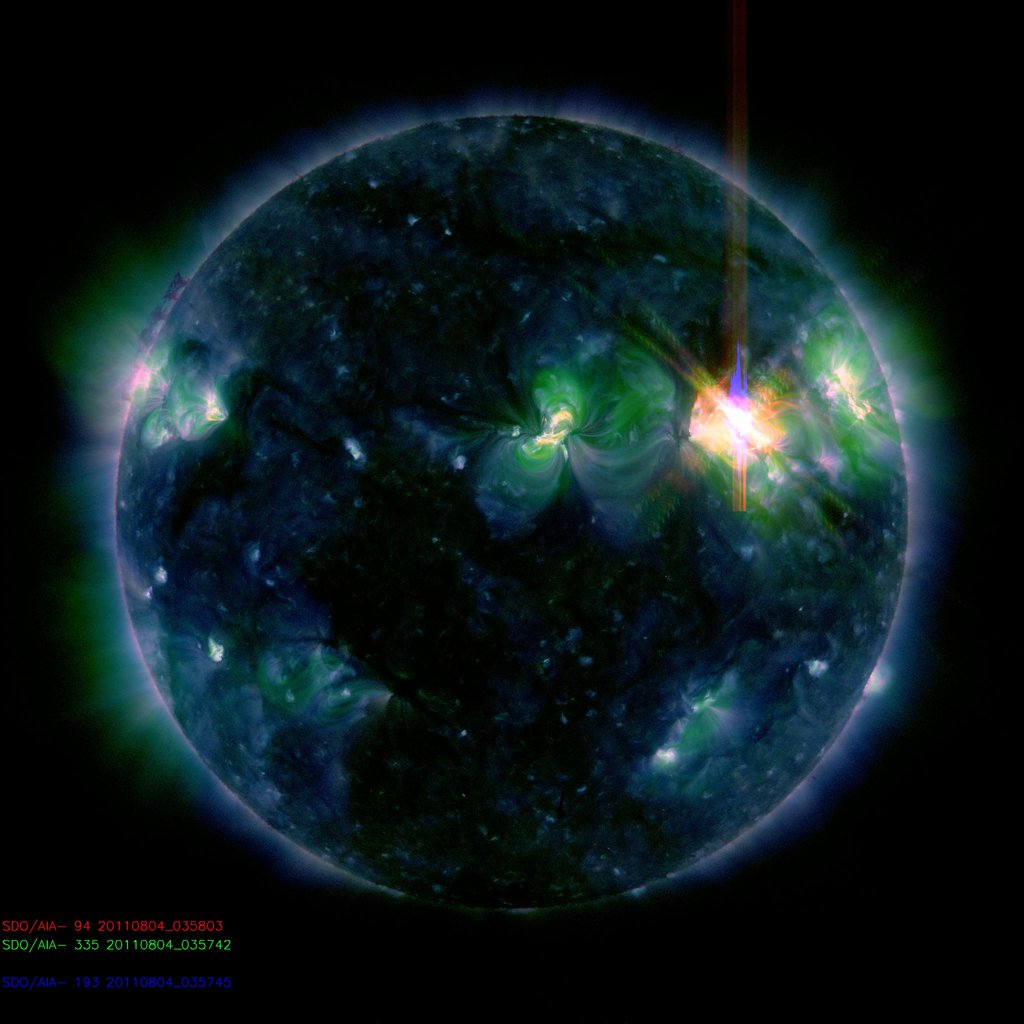
STRONG SOLAR ACTIVITY: For the third day in a row, active sunspot 1261 has unleashed a strong M-class solar flare. The latest blast at 0357 UT on August 4th registered M9.3 on the Richter Scale of Flares, almost crossing the threshold into X-territory (X-flares are the most powerful kind). The number of energetic protons around Earth has jumped nearly 100-fold as a result of this event. Stay tuned for updates.
INCOMING CLOUDS: At least two coronal mass ejections (CMEs) are now en route to Earth, propelled toward us by eruptions in the magnetic canopy of sunspot 1261 on August 2nd and 3rd. Analysts at the GSFC Space Weather Lab have just produced a new 3-D model of the advancing CMEs. Click on the image to set the clouds in motion below:
Intense Solar Flare Erupts From the Sun
 |
| A powerful M9-class solar flare erupted from the sun at 10:09 p.m. EDT on July 29 (0209 GMT July 30). CREDIT: NASA/SDO |
A powerful flare erupted from the sun this past weekend, but while the storm was not aimed directly at Earth, it was nearly the most powerful type of solar storm there is, scientists say.
The brief but strong solar flare occurred late Friday (July 29) at 10:09 p.m. EDT (0209 GMT July 30), and grew in intensity. The flare was followed by an unrelated geomagnetic storm, which was triggered by fluctuations in the solar wind, according to Spaceweather.com, a website that monitors space weather events.
As a result of the solar storm, skywatchers at high latitudes, particularly in the southern Read more…
NASA warns of global catastrophe post upcoming ‘huge space storm’
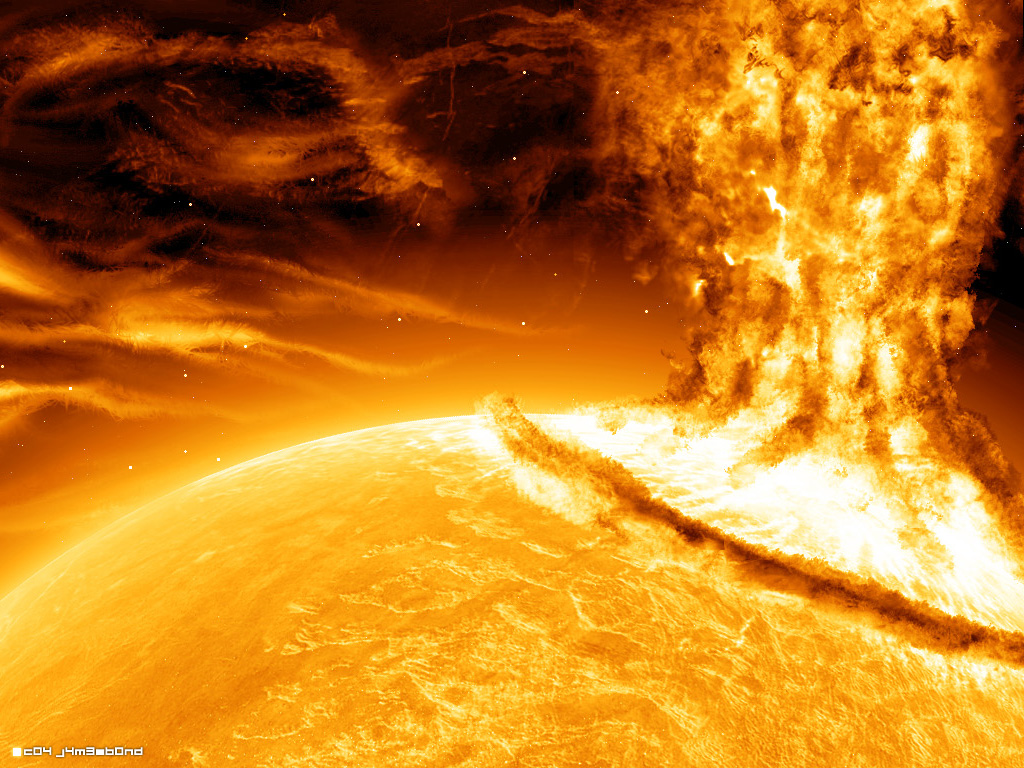 NASA has warned of a once-in-a-lifetime ‘space storm’ after the sun wakes ‘from a deep slumber’ sometime around 2013, causing ‘20 times more economic damage than Hurricane Katrina’.
Senior space agency scientists believe that the super storm would hit like ‘a bolt of lightning’ and damage everything from emergency services’ systems, hospital equipment, banking systems and air traffic control devices, through to “everyday” items such as home computers, iPods and Sat Navs.
And unless precautions are taken, it could cause catastrophic consequences for the world’s health, emergency services and national security.
“We know it is coming but we don’t know how bad it is going to be,” Dr Richard Fisher, the director of NASA’s Heliophysics division, said in an interview with The Daily Telegraph.
He, however, said that preparations were similar to those in a hurricane season, where authorities knew a problem was imminent but did not know how serious it would be.
“I think the issue is now that modern society is so dependant on Read more…
Bastille Day Solar Storm: Anatomy of a Gargantuan Sun Tempest

The "Bastille Day" solar flare as seen by SOHO's EIT instrument in the 195 Å emission line. CREDIT: NASA
One of the most violent sun storms in recorded history erupted 11 years ago today (July 14).
The event was called the Bastille Day Solar Storm, and it registered as an X-class flare, the highest designation possible. (One storm since then, in October 2003, was even more powerful.)
Ever wonder just how a solar storm brews? So do scientists. Here’s a rundown of what happened on July 14, 2000, one of the sun’s most violent days:
A sunspot was born. This occurred when magnetic field lines became tangled by the  churning and shifting of plasma bubbles on the sun’s surface. These twisted magnetic field lines formed a sunspot — an active region that appeared darker than the surrounding area. [Infographic: Anatomy of Solar Storms & Flares]
As the magnetic field lines became more and more twisted, magnetic potential energy built up, similar to how a roller coaster car at the top of the track builds up gravitational potential energy, which is then converted to the kinetic energy of motion as the car zooms downward.

CREDIT: NASA/TRACE
When the magnetic potential energy of the sun finally hit a certain point, it snapped, releasing that energy in the form of heat, light and the motion of particles. Plasma on the sun was heated up to 20 million or 30 million degrees Kelvin (36 million to 54 million degrees Fahrenheit). Plasma particles were accelerated along giant loops that traced magnetic field lines down through successive layers of the sun’s atmosphere.
These loops connected to form large ribbons of superheated plasma.
At the same time, some plasma particles from the sun’s atmosphere were accelerated away from the surface, out into space. Such a release of material is called a coronal mass ejection. Many of these protons and electrons made their way to Earth, where they disrupted satellites and blocked radio communications.
Though scientists understand many aspects of the storm’s process, there are still some pressing questions. One of the biggest is: What sparked the storm in the first place? [Hell Unleashed: Sun Spits Fire in Close-Up]
“The holy grail, which is not solved yet, is, what is the actual trigger mechanism that causes this buildup of energy to be released?” said Phil Chamberlin, a solar scientist at NASA’s Goddard Space Flight Center in Greenbelt, Md.
However, the Bastille Day solar storm did go a long way toward helping scientists piece together a general theory of how eruptions on the sun occur.
“This theory is all based on observations from the Bastille Day flare,” Chamberlin told SPACE.com.
That knowledge will come in especially handy in the coming years, as the sun ramps up toward a peak in its 11-year cycle of activity. Near the end of 2013, we are likely to see storms that rival, or even surpass, the Bastille Day event.
Solar Activity Intensifying
Dr. Mark Sircus, Contributing Writer
Activist Post
On June 7th, Dr. C. Alex Young from the NASA Goddard Space Flight Center woke to an email from a friend saying, “I have never seen anything like this before.” There are many things happening around us that we have not seen before, but when it happens on the sun certain people take notice. On the 7th the sun produced a prominence eruption and Dr. Young had never seen such a spectacular event, which luckily did not affect the Read more…
Giant “Surfing” Waves Roll Through Sun’s Atmosphere
 Surfer waves — initiated in the sun, as they are in the water, by a process called a Kelvin-Helmholtz instability — have been found in the sun’s atmosphere. Credit: NASA/SDO/Astrophysical Journal Letters
Surf’s up on the Sun! Our favorite gnarly spacecraft, the Solar Dynamics Observatory (SDO) has caught conclusive evidence of classic “surfer waves” in the Sun’s atmosphere. But these waves trump ‘Hawaii Five-O’ surfing big time. These solar waves are about the same size as the continental U.S, and spotting these waves will help our understanding of how energy moves through the solar atmosphere, known as the corona.
Just like a surfing wave on Earth, the solar counterpart is formed by Read more…
Solar flaring warning issued

A solar wind stream flowing from the indicated coronal hole could reach Earth on or about June 4th. . Credit: SDO/AIA.
Cape Town – The Space Weather Centre has warned that the sun is undergoing some instability, which has implications for electronic communications.
“There is a very active area on the sun as rotated onto the invisible solar disc. This active area has got the potential for more flaring for the next five to six days,” space weather forecaster Kobus Olckers of the Space Weather Warning Centre at the Hermanus Magnetic Observatory told News24.
He said that communications and electronic systems might be affected.
“The internet could be a little slower for the next week or so and especially long distance communications.”
Polar routes
Scientists recognize three major Read more…


![[Most Recent Quotes from www.kitco.com]](https://i0.wp.com/www.kitconet.com/charts/metals/gold/t24_au_en_usoz_2.gif)
![[Most Recent Quotes from www.kitco.com]](https://i0.wp.com/www.kitconet.com/charts/metals/silver/t24_ag_en_usoz_2.gif)

 crisisboom
 CRISISBOOM
You must be logged in to post a comment.