Archive
Intense Solar Flare Erupts From the Sun
 |
| A powerful M9-class solar flare erupted from the sun at 10:09 p.m. EDT on July 29 (0209 GMT July 30). CREDIT: NASA/SDO |
A powerful flare erupted from the sun this past weekend, but while the storm was not aimed directly at Earth, it was nearly the most powerful type of solar storm there is, scientists say.
The brief but strong solar flare occurred late Friday (July 29) at 10:09 p.m. EDT (0209 GMT July 30), and grew in intensity. The flare was followed by an unrelated geomagnetic storm, which was triggered by fluctuations in the solar wind, according to Spaceweather.com, a website that monitors space weather events.
As a result of the solar storm, skywatchers at high latitudes, particularly in the southern Read more…
Solar Climate Change: Armageddon Ready: Russian solar probe to predict Earthly cataclysms
Some scientists believe bursts of solar activity cause natural disasters on our planet, but until now the Read more…
Laws of physics must be rewritten: Mysterious sun particles alter radioactive decay on Earth
 The scientific process, as any experienced researcher can attest, provides a kind of road map through the forest of the natural world. By developing hypotheses and designing methods by which to test them, we use the scientific process to make the abstract world more concrete.
Once we clarify our questions about matter, time, and reality, we can move forward from one conclusion to another in a logical attempt to answer them. But the path in front of us often extends into kind of fog, a compounding cloud of questions, with each conclusion often leading only to additional questions that multiply indefinitely.
And the path behind us can be equally shrouded. Sometimes generations of observations about the Read more…
Bastille Day Solar Storm: Anatomy of a Gargantuan Sun Tempest

The "Bastille Day" solar flare as seen by SOHO's EIT instrument in the 195 Å emission line. CREDIT: NASA
One of the most violent sun storms in recorded history erupted 11 years ago today (July 14).
The event was called the Bastille Day Solar Storm, and it registered as an X-class flare, the highest designation possible. (One storm since then, in October 2003, was even more powerful.)
Ever wonder just how a solar storm brews? So do scientists. Here’s a rundown of what happened on July 14, 2000, one of the sun’s most violent days:
A sunspot was born. This occurred when magnetic field lines became tangled by the  churning and shifting of plasma bubbles on the sun’s surface. These twisted magnetic field lines formed a sunspot — an active region that appeared darker than the surrounding area. [Infographic: Anatomy of Solar Storms & Flares]
As the magnetic field lines became more and more twisted, magnetic potential energy built up, similar to how a roller coaster car at the top of the track builds up gravitational potential energy, which is then converted to the kinetic energy of motion as the car zooms downward.

CREDIT: NASA/TRACE
When the magnetic potential energy of the sun finally hit a certain point, it snapped, releasing that energy in the form of heat, light and the motion of particles. Plasma on the sun was heated up to 20 million or 30 million degrees Kelvin (36 million to 54 million degrees Fahrenheit). Plasma particles were accelerated along giant loops that traced magnetic field lines down through successive layers of the sun’s atmosphere.
These loops connected to form large ribbons of superheated plasma.
At the same time, some plasma particles from the sun’s atmosphere were accelerated away from the surface, out into space. Such a release of material is called a coronal mass ejection. Many of these protons and electrons made their way to Earth, where they disrupted satellites and blocked radio communications.
Though scientists understand many aspects of the storm’s process, there are still some pressing questions. One of the biggest is: What sparked the storm in the first place? [Hell Unleashed: Sun Spits Fire in Close-Up]
“The holy grail, which is not solved yet, is, what is the actual trigger mechanism that causes this buildup of energy to be released?” said Phil Chamberlin, a solar scientist at NASA’s Goddard Space Flight Center in Greenbelt, Md.
However, the Bastille Day solar storm did go a long way toward helping scientists piece together a general theory of how eruptions on the sun occur.
“This theory is all based on observations from the Bastille Day flare,” Chamberlin told SPACE.com.
That knowledge will come in especially handy in the coming years, as the sun ramps up toward a peak in its 11-year cycle of activity. Near the end of 2013, we are likely to see storms that rival, or even surpass, the Bastille Day event.
Comet’s Death by Sun Photographed for First Time
 |
| The Solar Dynamics Observatory AIA imager (observing in extreme ultraviolet light) actually spotted a sun-grazing comet as it disintegrated over about a 15 minute period (July 6, 2011), something never observed before. The angle of the comet’s orbit brought it across the front half of the Sun. Given the intense heat and radiation, the comet simply evaporated away completely. The comet was probably a member of the Kreutz sun-grazer family. CREDIT: NASA/SDO/AIA |
The death of a comet that plunged into the sun was captured on camera this month for the first time in history, scientists say.
The comet met its fiery demise on July 6 when it zoomed in from behind the sun and melted into oblivion as it crashed into the star. It was NASA’s Solar Dynamics Observatory (SDO), a satellite orbiting Earth that studies the sun, which witnessed the comet’s death-blow.
One of the SDO spacecraft’s high-definition imagers “actually spotted a sun-grazing comet as it disintegrated over about a 15 minute period (July 6, 2011), something never observed Read more…
Behemoth sunspots evolve
The SDO team has just prepared a beautiful movie of the explosion that produced the CME.
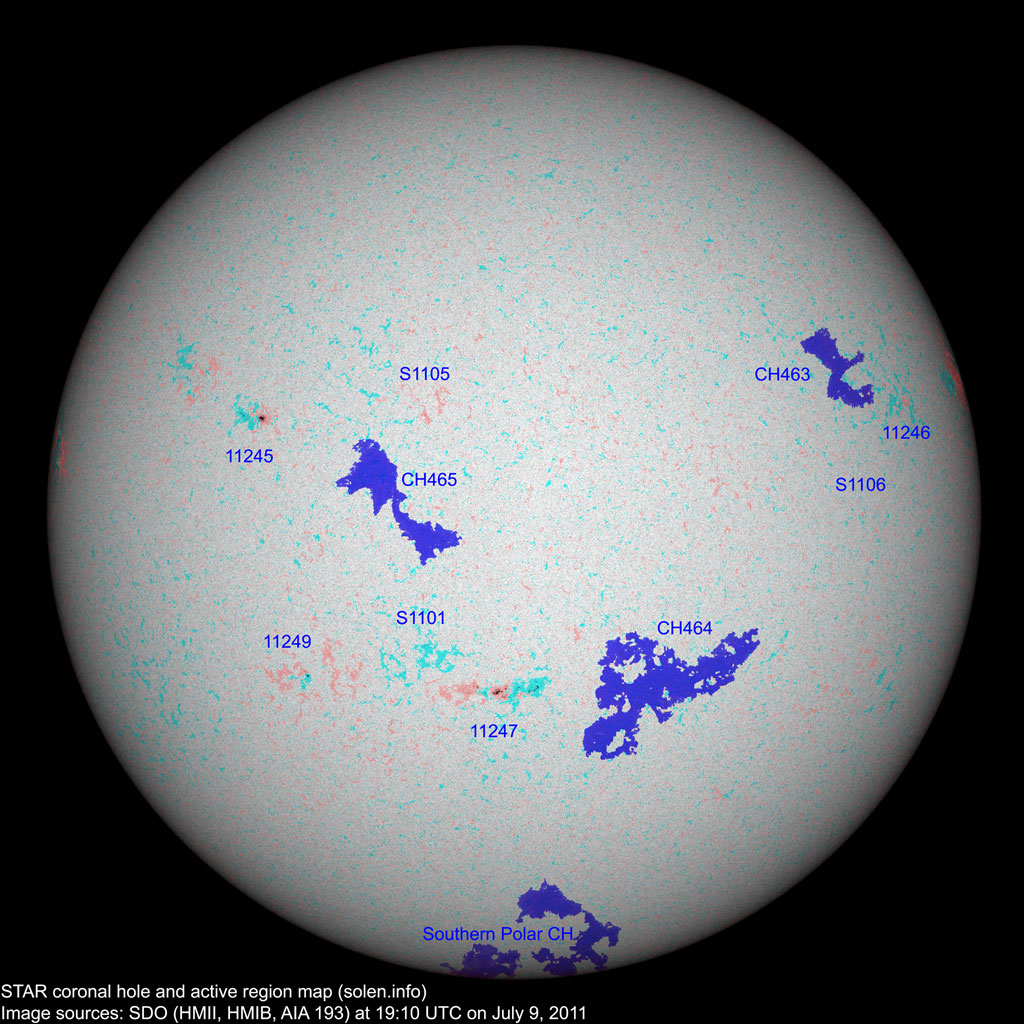
Sunspot group 1247 is expanding rapidly and in an interesting way. The active region is organizing itself as a linear Read more…
Solar Activity Intensifying
Dr. Mark Sircus, Contributing Writer
Activist Post
On June 7th, Dr. C. Alex Young from the NASA Goddard Space Flight Center woke to an email from a friend saying, “I have never seen anything like this before.” There are many things happening around us that we have not seen before, but when it happens on the sun certain people take notice. On the 7th the sun produced a prominence eruption and Dr. Young had never seen such a spectacular event, which luckily did not affect the Read more…
Incoming Geomagnetic Storm Alert:C7-Flare/CME (June 21st, 2011).
INCOMING: Magnetic fields above sunspot complex 1236 erupted during the early hours of June 21st, producing a C7-class solar flare and a full-halo CME. The expanding cloud appears to be heading almost directly toward Earth:
This does not appear to be an especially powerful CME. Nevertheless, the incoming cloud could trigger polar geomagnetic storms when it reaches Earth on or about June 23rd. The aurora outlook favors southern hemisphere observers, where solstice skies are winter-dark. Stay tuned for updates.
Giant “Surfing” Waves Roll Through Sun’s Atmosphere
 Surfer waves — initiated in the sun, as they are in the water, by a process called a Kelvin-Helmholtz instability — have been found in the sun’s atmosphere. Credit: NASA/SDO/Astrophysical Journal Letters
Surf’s up on the Sun! Our favorite gnarly spacecraft, the Solar Dynamics Observatory (SDO) has caught conclusive evidence of classic “surfer waves” in the Sun’s atmosphere. But these waves trump ‘Hawaii Five-O’ surfing big time. These solar waves are about the same size as the continental U.S, and spotting these waves will help our understanding of how energy moves through the solar atmosphere, known as the corona.
Just like a surfing wave on Earth, the solar counterpart is formed by Read more…
Study finds global warming over past 400 years was due to increased Solar activity

Apparently previous studies of the sun-climate connection looked at the equatorial polar magnetic field which produces sun spots, but they did not consider the polar magnetic component of the solar dynamo. The polar fields are less strong than the equatorial fields, but it is claimed that the total magnetic fluxes of both fields are comparable. With proxy data they derive an empirical relation between tropospherical temperatures and solar equatorial and polar magnetic fields. The polar field could contribute about Read more…


![[Most Recent Quotes from www.kitco.com]](https://i0.wp.com/www.kitconet.com/charts/metals/gold/t24_au_en_usoz_2.gif)
![[Most Recent Quotes from www.kitco.com]](https://i0.wp.com/www.kitconet.com/charts/metals/silver/t24_ag_en_usoz_2.gif)

 crisisboom
 CRISISBOOM
You must be logged in to post a comment.