House Passes Authority for Worldwide War

The House just passed the National Defense Authorization Act (NDAA), including a provision to authorize worldwide war, which has no expiration date and will allow this president — and any future president — to go to war anywhere in the world, at any time, without further congressional authorization. The new authorization wouldn’t even require the president to show any threat to the national security of the United States. The American military could become the world’s cop, and could be sent into harm’s way almost anywhere and everywhere around the globe.
Before the vote, the House debated an amendment that would have struck the worldwide war provision. That amendment was introduced by a bipartisan group of representatives: Rep. Justin Amash (R-Mich.), Rep. John Conyers (D-Mich.), Rep. Walter Jones (R-N.C.), Rep. Barbara Lee (D-Calif.), Rep. Jerrold Nadler (D-N.Y.), and Rep. Ron Paul (R-Texas). Given the enormity of the proposed law, you’d expect the House to debate the amendment to strike it extensively, but that’s not what happened. The amendment was debated for a total of 20 minutes. That’s right. Twenty minutes to debate whether Congress should hand the executive branch sweeping worldwide war authority.
The vote on the amendment took place earlier this afternoon, and it failed on the House floor by a vote of 187-in favor to 234-opposed. Check the vote here.
But not to worry, all of your efforts to bring the importance of the new law and the amendment to strike it to your representatives’ attention have Read more…
New leak seen at Japan quake-hit plant

Tokyo Electric Power Company (TEPCO), the operator of the plant, said on Thursday that up to 57 tons of contaminated water has leaked from a storage facility, Reuters reported.
The environmental group, Greenpeace, has criticized the Japanese government’s assessment of the contamination level, saying, “Radioactive hazards are not decreasing through dilution or dispersion of materials, but the radioactivity is instead accumulating in marine life.”
“Our data show that significant amounts of contamination continue to spread over great distances from the Fukushima nuclear plant,” the group added.
Greenpeace has also accused TEPCO of covering up the actual severity of the disaster in the Asian Read more…
Super Typhoon Songda Projected To Pass Over Fukushima Nuclear Power Plant
So far the only good news to accompany the Fukushima catastrophe has been that for all the fallout, the radiation has been mostly contained due to Northwesterly winds which have been blowing any radioactivity mostly out and into the Pacific (coupled with relatively little rainfall), as well as the dispersion of irradiated cooling water which promptly enters the Pacific after which it is never heard of or seen again (there is at least a several year period before 3 eyed tuna fish feature prominently in restaurants across the country). This may be changing soon now that Super Typhoon Songda, which according to Weather Underground will form shortly as a Category 5 storm with 156+ mph winds, will take a northeasterly direction and 2 days later will pass right above Fukushima. The good news: by the time it passes over Fukushima, Songda will be merely a Tropical storm. The bad news: by the time it passes over Fukushima, Songda will be a Tropical storm. As the latest dispersion projection from ZAMG shows, over the next two days the I-131 plume will be covering all of the mainland. Although judging by how prominent this whole topic is in the MSM lately, it seems that conventional wisdom now agrees with Ann Coulter that radioactivity is actually quite good for you.
From wunderground.com:

And the latest plume projection: Read more…
UN Experts to Consider Proposal Condemning Syria

Photo: AFP An image taken from a video posted on YouTube, May 20, 2011, shows a Syrian soldier pointing his rifle and firing at anti-regime protesters during a demonstration in Hama, north of Damascus
U.N. Security Council experts are expected to discuss a draft resolution on Thursday that would condemn Syria for its crackdown on peaceful protesters.
The draft – put forth by Britain, France, Germany and Portugal – appeals for an immediate end to violence in Syria. It also condemns what the European sponsors call a “systematic violation of human rights” that includes killings, arbitrary detentions, disappearances and the torture of peaceful demonstrators.
Rights groups estimate that roughly 1,000 people have died since the government started a crackdown to stop protests against Read more…
Antibiotics In Animal Feed Encourage Emergence Of Superbugs – FDA Sued By Health And Consumer Organizations
medicalnewstoday
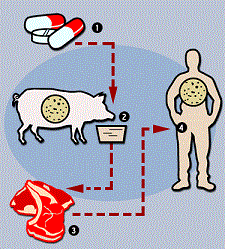 If the FDA concluded in 1977 that adding low-dose antibiotics used in human medicine to animal feed raised the risk of antibiotic-resistant bacteria, why has it still done nothing about it? A suit filed by some health and consumer organizations says the FDA has not met its legal responsibility to protect public health – the practice of routinely adding low-dose antibiotics to animal feed has to stop, and the FDA has the authority to make it so.
Peter Lehner, Natural Resources Defense Council (NRDC) executive director, said:
“More than a generation has passed since FDA first recognized the potential human health consequences of feeding large quantities of antibiotics to healthy animals.
Accumulating evidence shows that antibiotics are becoming less effective, while our grocery store meat is increasingly laden with drug-resistant bacteria. The FDA needs to put the American people first by ensuring that antibiotics continue to serve their primary purpose – saving human lives by combating disease.”
70% of all US antibiotic consumption is used up in adding low-doses to animal feed to make up for unsanitary living conditions and promote faster growth, according to NRDC. This practice has been steadily growing over the last six decades, despite the every-growing threat to humans of superbugs.
The antibiotic doses used in feed or water for turkeys, cows, pigs and chickens are too low to treat diseases – however, they are low enough for a significant number of bacteria to survive and build Read more…
Sprint, MasterCard, Citibank Partner Up For ‘Google Wallet’
 A Google Partner Event in New York kicks off in a couple hours with all signs pointing to an announcement about a mobile payments platform that’ll let you tap your phone against a card reader to pay for an item, using technologythat has been implemented in Japan for years. But if the groundswell of rumors is to be believed, there’s not much left to announce:
Late Wednesday night This Is My Next unearthed an internal announcement from The Container Store, believed to be a launch partner for Google’s mobile payment platform, dubbed “Google Wallet”:
It sounds like Google has chosen some major “innovative” retailers to kickstart a mobile payment platform that lets customers tap their phones against a contact-less card reader to pay for an item. And it sounds like The Container Store will start using the readers on September 1.
Bloomberg reported Tuesday that Google will use the event to unveil a mobile payment platform on Sprint phones embedded with NFC chips. Customers with these NFC-supported phones, currently limited to Google’s Nexus S 4G (Sprint) and Nexus S (T-Mobile) in the U.S., will be able to tap their devices against an NFC-enabled card reader to make an instant payment. The program will launch in Read more…
US to store passenger data for 15 years

The personal data of millions of passengers who fly between the US and Europe, including credit card details, phone numbers and home addresses, may be stored by the US department of homeland security for 15 years, according to a draft agreement between Washington and Brussels leaked to the Guardian.
The “restricted” draft, which emerged from negotiations between the US and EU, opens the way for passenger data provided to airlines on check-in to be analysed by US automated data-mining and profiling programmes in the name of fighting terrorism, crime and illegal migration. The Americans want to require airlines to supply passenger lists as near complete as possible 96 hours before takeoff, so names can be checked against terrorist and immigration watchlists.
The agreement acknowledges that there will be occasions when people are delayed or prevented from flying because they are wrongly identified as a threat, and gives them the right to petition for judicial review in the US federal court. It also outlines procedures in the event of anticipated data losses or other unauthorised disclosure. The text includes provisions under which “sensitive personal data” – such as ethnic origin, political opinions, and details of health or sex life – can be used in exceptional circumstances where an individual’s life could be imperilled.
The 15-year retention period is likely to prove highly controversial as it is three times the five years allowed for in the EU’s PNR (passenger name record) regime to cover flights into, out of and Read more…
India Worried About Pakistani Nuke Arsenal Defenses
 India’s defense chief on Wednesday voiced worries about the defenses of nuclear weapons in rival Pakistan following a militant siege this week of a naval base in Karachi, Reuters reported (see GSN, May 24).
“Naturally it is a concern not only for us but for everybody,” Defense Minister A.K. Antony said on the question of whether the assault by a minimum of six Pakistani Taliban fighters on the Mehran Naval Station had raised doubts about the security of the Pakistani nuclear arsenal, the Press Trust of India reported.
“Our services are taking all precautions and are ready round-the-clock. But at the same time we don’t want to overreact,” Antony said.
Though estimates vary, recent analyses indicate Islamabad could hold more than 110 nuclear weapons. The country’s is viewed as having the world’s fastest growing nuclear arsenal.
Some defense authorities have said the Sunday siege could have involved insiders at the base, renewing worries about Pakistani military personnel who might have extremist affinities (see GSN, Jan. 11; Reuters, May 25).
Separately, not long before he became Pakistan’s president, Asif Ali Zardari in 2008 told U.S. envoys he supported providing U.N. investigators access to nuclear scientist and proliferator Abdul Qadeer Khan, Asian News International reported on Wednesday (see GSN, May 25).
The United States has long pressed for access to Khan, Pakistan’s former top nuclear weapons scientist who in 2004 confessed to exporting nuclear technology and information to Iran, Libya and Read more…
China drought ignites global grain supply concerns
 A prolonged drought in China could hit grains output in key growing regions, further squeezing global supplies and putting upward pressure on prices, but plentiful domestic wheat stocks will act as a cushion and keep import volumes low.
Analysts are closely watching the weather in China, warning any further supply shocks in the grain markets would fuel a further rally in U.S. corn and wheat futures, already stoked by harsh crop weather in the United States and Europe.
“Parts of China have been too dry and if we did see crop failures in that part of the world they are going to look to the global market for supplies,” said Luke Mathews, a commodity strategist with Commonwealth Bank of Australia in Sydney.
“They are going to be looking to North America and Europe and there is significant amount of concern whether those particular countries will be able to satisfy those needs.”
Chicago Board of Trade corn has climbed 80 percent since the start of May last year, while wheat has risen around 50 percent. Last week alone corn and wheat jumped more than 10 percent on expectations of a global squeeze in supplies.
CROP CONCERNS & TIGHT GLOBAL SUPPLIES
Timely corn seeding is crucial for optimal yields needed to replenish U.S. supplies that are projected at the lowest level in 15 years amid strong demand from livestock feeders, ethanol makers and exporters.
About 80 percent of the U.S. corn crop has been planted, according to the U.S. Agriculture Department, but showers this week are expected to bring the final corn seedings to Read more…
Dane County judge strikes down collective bargaining law

Madison – A Dane County judge has struck down Gov. Scott Walker’s legislation repealing most collective bargaining for public employees.
In a 33-page decision issued Thursday, Dane County Circuit Judge Maryann Sumi said she would freeze the legislation because GOP lawmakers on a committee broke the state’s open meetings law in passing it March 9.
The legislation limits collective bargaining to wages for all public employees in Wisconsin except for police and firefighters.
“It’s what we were looking for,” said Dane County District Attorney Ismael Ozanne, a Democrat.
Ozanne sued to block the law after Assembly Minority Leader Peter Barca (D-Kenosha) filed a complaint saying that GOP legislative leaders had not given proper notice in convening a conference committee of lawmakers from both houses to approve Walker’s budget-repair bill.
A spokesman for state Attorney General J.B. Van Hollen and the state Department of Justice could not be reached immediately for comment on the decision. A spokesman for Walker also could not be immediately reached.
In the decision, Sumi appeared to be bracing for an outcry from Republicans and supporters of the law, noting that judges are supposed to apply the law even if their decisions will be “controversial or unpopular.” Sumi writes that Ozanne showed by “clear and convincing evidence” that the open meetings law had been violated.
“This decision explains why it is necessary to void the legislative actions flowing from those violations,” wrote Sumi, who was appointed to the bench by former GOP Gov. Tommy Thompson.
But the issue is far from settled. The state Supreme Court has scheduled arguments for June 6 on whether to take over the case.
“It’s not over yet. I’m positive of that,” Ozanne said. “The supremes are the supremes. They can do what they want.”
GOP lawmakers also have said they would consider passing the law a second time as part of the 2011-’13 state budget if it was necessary to ensure that it takes effect.


![[Most Recent Quotes from www.kitco.com]](https://i0.wp.com/www.kitconet.com/charts/metals/gold/t24_au_en_usoz_2.gif)
![[Most Recent Quotes from www.kitco.com]](https://i0.wp.com/www.kitconet.com/charts/metals/silver/t24_ag_en_usoz_2.gif)

 crisisboom
 CRISISBOOM
You must be logged in to post a comment.