China Stealth Jet Fighter J-20
 Aviation experts believe China may have started testing a new stealth aircraft – putting it well ahead of Western predictions that a revamped air force would not be ready for take-off for another decade.
Photographs of the J-20 taking high-speed taxi tests at an airfield have appeared on several websites, fueling speculation that Beijing is not particularly concerned about keeping its latest weapon under wraps – at least unofficially.
The plane photos surfaced just one week after a U.S. naval commander warned that China is stepping up testing on a space missile that could sink American aircraft carriers in the Pacific.
The Chinese prototype looks like it has “the potential to be a competitor with the F-22 and to be decisively superior to the F-35,” said Mr. Fisher. The J-20 has two engines, like the F-22, and is about the same size, while the F-35 is smaller and has only one engine.
China’s stealth-fighter program has implications also for Japan, which is considering buying F-35s, and for India, which last month firmed up a deal with Russia to jointly develop and manufacture a stealth fighter.
The Chinese military are also expected to launch their first aircraft carrier next year – a year earlier than anticipated by U.S. experts.
But China’s Foreign Ministry insists his military is one of peace, saying: ‘We pose no threat to other countries.’
According to the Aviation Week website, security at the airfield where the J-20 was photographed was slack and the prototype could be viewed from several public areas.
The ‘leak’ supports earlier claims by the Chinese military that a stealth aircraft would be airborne by 2011 and could be operational by 2017.
U.S. Defense Secretary Robert Gates dismissed that idea at the time, claiming that China would not have stealth fighters operational before 2020. “China has the money, they have the industrial expertise, they have the scientific base, the drive and motivation and of course the benefit of American research over 30 years acquired by legal or illegal means,” one anonymous observer was quoted by a Time magazine blog site. “These enablers give China wide latitude in matching or exceeding American designs that are now 20 years old.”
Stealth aircraft – which can evade detection by radar, infrared and other tracking devices – have been in development since the end of World War Two.
Experts point out that the Chinese version is larger than most observers expected – ‘pointing to long range and heavy weapon loads’.
National Debt $200 Trillion Dollars
Dr. Laurence Kotlikoff economics professor at Boston University, discusses the national debt and unfunded liabilities – Aug. 11, 2010
Using CBO data, Kotlikoff says the real national debt is $202 trillion.
Compare the official deficit numbers for July – $165 billion – with the numbers for all of 2002 – where $165 billion covered the deficit for the entire fiscal year.
—
Excerpt:
The Congressional Budget Office whose Long-Term Budget Outlook, released in June, shows an even larger problem.
‘Unofficial’ Liabilities
Based on the CBO’s data, I calculate a fiscal gap of $202 trillion, which is more than 15 times the official debt. This gargantuan discrepancy between our “official” debt and our actual net indebtedness isn’t surprising. It reflects what economists call the labeling problem. Congress has been very careful over the years to label most of its liabilities “unofficial” to keep them off the books and far in the future.
295,000 Deaths :950 Natural Disasters in 2010
By: Munich RE
Jan. 3, 2011 – Several major catastrophes in 2010 resulted in substantial losses and an exceptionally high number of fatalities. The overall picture last year was dominated by an accumulation of severe earthquakes to an extent seldom experienced in recent decades. The high number of weather-related natural catastrophes and record temperatures both globally and in different regions of the world provide further indications of advancing climate change.
Altogether, a total of 950 natural catastrophes were recorded last year, nine-tenths of which were weather-related events like storms and floods. This total makes 2010 the year with the second-highest number of natural catastrophes since 1980, markedly exceeding the annual average for the last ten years (785 events per year). The overall losses amounted to around US$ 130bn, of which approximately US$ 37bn was insured. This puts 2010 among the six most loss-intensive years for the insurance industry since 1980. The level of overall losses was slightly above the high average of the past ten years.
“2010 showed the major risks we have to cope with. There were a number of severe earthquakes. The hurricane season was also eventful – it was just fortunate that the tracks of most of the storms remained over the open sea. But things could have turned out very differently”, said Torsten Jeworrek, Munich Re’s Reinsurance CEO. “The severe earthquakes and the hurricane season with so many storms demonstrate once again that there must be no slackening of our efforts to analyze these risks in detail and provide the necessary insurance covers at adequate prices. These prices calculated by the insurance industry make it possible to assess the economic consequences of these otherwise difficult-to-evaluate risks.”
Major catastrophes dominate the list of losses
In all, there were five catastrophes last year assignable to the top category of “great natural catastrophes” based on the definition criteria of the United Nations: the earthquakes in Read more…
South Africa: Another BRIC in China’s Wall
 China’s President Hu Jintao has sent an invitation to South African President Jacob Zuma to attend the third BRICs leaders’ summit to be held in China. Picture: Zuma (center) celebrates the 25th anniversary of the Congress of South African Trade Unions (COSATU) on December 4, 2010 in Johannesburg. (File Photo/CFP)
At China’s invitation, South Africa is set to join the Brazil, Russia, India and China (BRIC) group of emerging nations and will attend the first summit of the leading emerging economies in April this year. The group will thus be renamed the “BRICS,” but doubts remain over the suitability of the African nation to join the exclusive club of the fast-growing economies.
Lauding the Chinese decision to invite her country to the BRIC bloc, South Africa’s Cooperation Minister Maite Nkoana-Mashabane said the invitation was conveyed to her by China’s Foreign Minister Yang Jiechi. She said Chinese President Hu Jintao also sent an invitation to President Jacob Zuma to attend the third BRIC leaders’ summit to be held in China. Read more…
Nuclear Targets in America
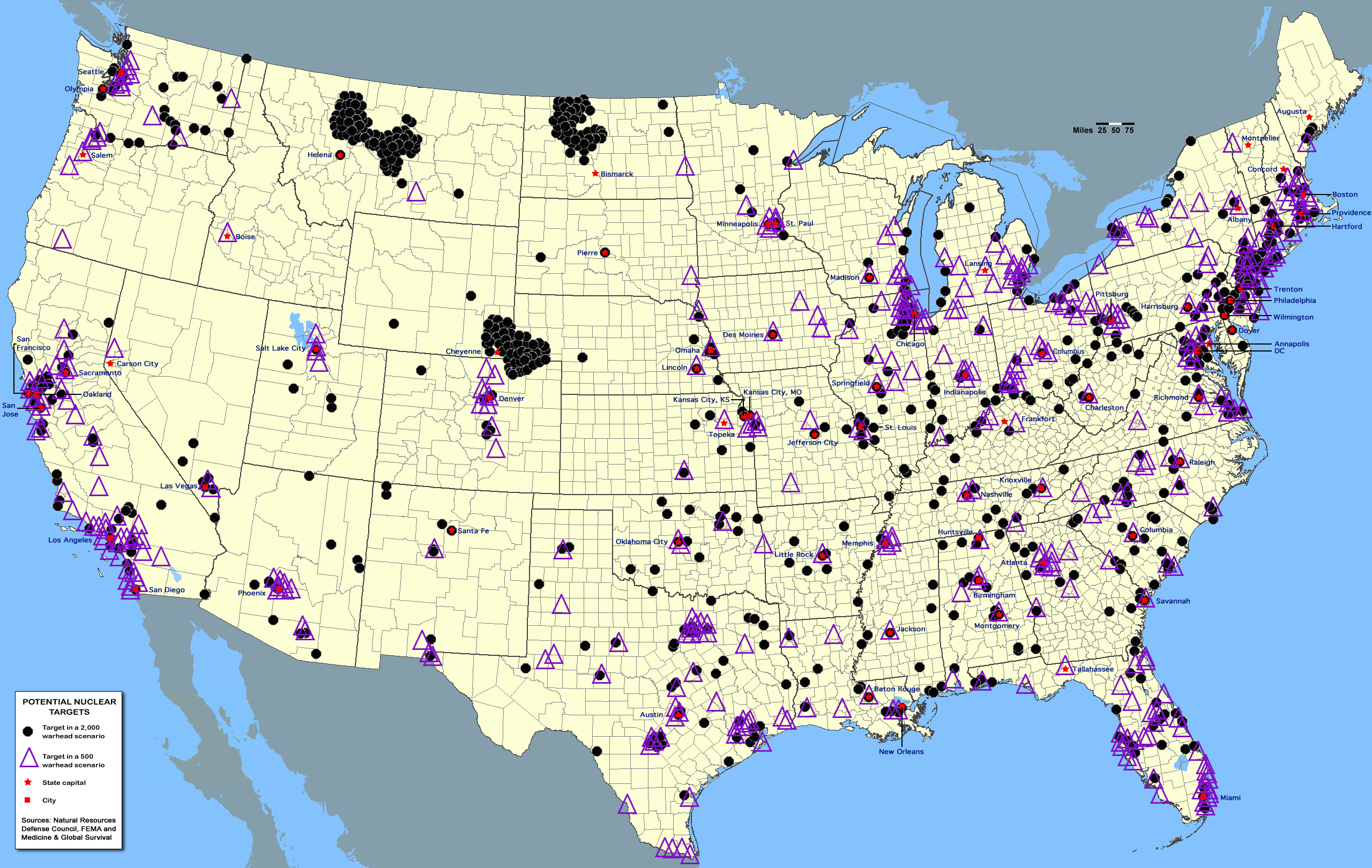
In the event of a nuclear war many of these cities have been mapped as potential Nuclear Targets due to being economic centers, tourism, military, local governments Eco hubs etc.. Click on the map to see your town enlarged. Hard to believe is it not? The town that I reside in is not that large in size however it is marked.
This information and other valuable information regarding the “Safeness” of America can be found at http://www.standeyo-cart.com/ProductDetails.asp?ProductCode=PPUSA
2010 in Review-Commodities affected by World Events
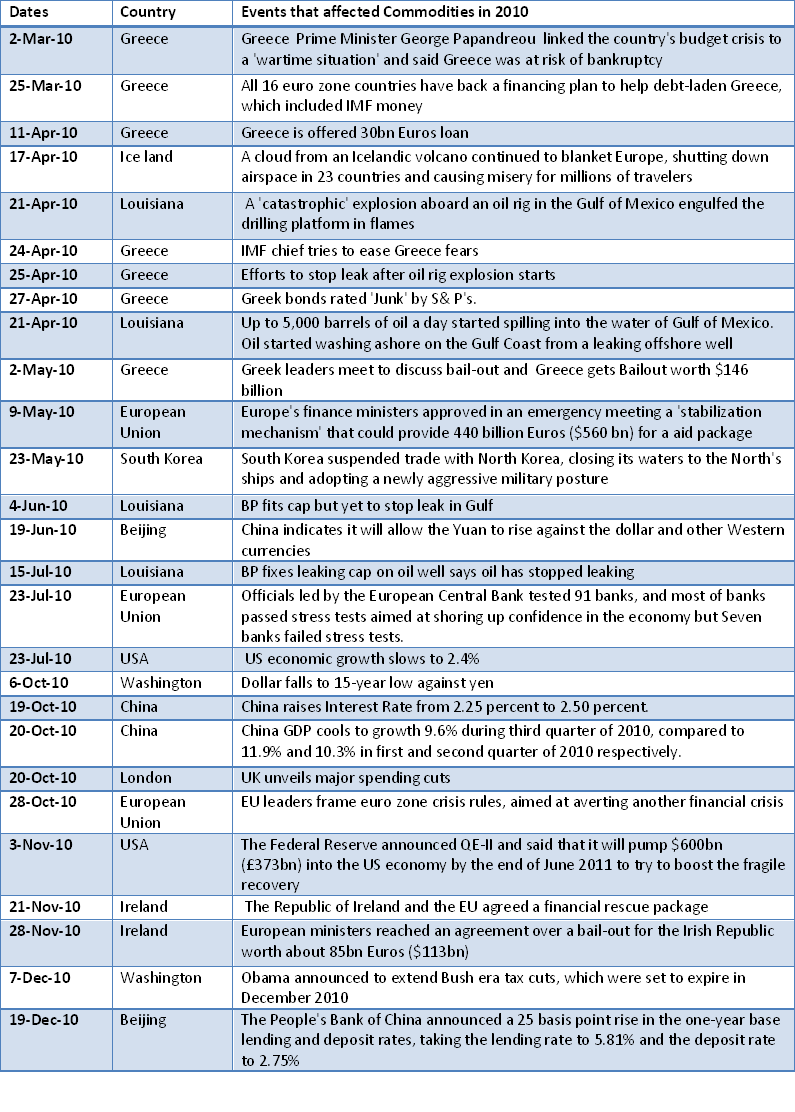 Notable events that affected commodity prices in 2010
Food Crisis of 2011
The Food Crisis of 2011

- Corn: Up 63%
- Wheat: Up 84%
- Soybeans: Up 24%
- Sugar: Up 55%
- Aug. 5: A failed wheat harvest prompted Russia to ban grain exports through the end of the year. Later in August, the ban was extended through the end of 2011. Drought has wrecked the harvest in Russia, Ukraine and Kazakhstan – home to a quarter of world production.
- Oct. 8: For a second month running, the Agriculture Department cut its forecast for US corn production. The USDA predicts a 3.4% decline from last year. Damage done by Midwestern floods in June was made worse by hot, dry weather in August.
Top 10 Survival Downloads
Top 10 Survival Downloads You Should Have

There are tons of good downloads in the Survival Database Download section of this website. For this article – I have selected 10 that everyone should have either printed and put away, or placed on a USB drive – or better yet both.
So – let’s get to it:
#10. FM 4-25-11 First Aid (2002) – Military First Aid Manual. First aid information is a must – get training before you need it – use this manual for reference.
#9. Guide to Canning – Being able to preserve crops to be able to provide for yourself and your family long after the growing season is over is important. This guide will help with that.
#8. Rangers Handbook (2006) – Crammed with info on demolitions, booby traps, communications, patrolling, tactical movement, battle drills, combat intelligence and much more
#7. Where There is No Dentist – The author uses straightforward language and careful instructions to explain how to: examine patients; diagnose common dental problems; make and use dental equipment; use local anesthetics; place fillings; and remove teeth.
#6. NATO Emergency War Surgery – While this is certainly not a manual that would stand alone in most persons emergency/disaster library, it is an absolutely necessary resource if you expect to handle any type of trauma where immediate comprehensive medical care is not available.
#5. A Guide to Raised Bed Gardening – This is not an “all knowing” gardening book – however it provides a lot of information to the “urban gardener” before or after TSHTF. Best to get the experience and knowledge of gardening NOW rather than later.
#4. FM 3-06 Combined Arms Operations in Urban Terrain – Combat techniques covered in the manual which may be very valuable in a “Roadwarrior”-type world.
#3. 1881 Household Cyclopedia – A massive resource of information that much of it has been lost over the past 203 generations. From Angling to Knitting – its here.
#2. FM 21-76-1 Survival-Evasion-Recovery (1999) – Excellent manual geared towards the soldier that finds himself behind enemy lines
#1. FM 21-76 US Army Survival Manual – From Amazon.com: This manual has been written to help you acquire survival skills. It tells you how to travel, find water and food, shelter yourself from the weather and care for yourself if you become sick or injured. This information is first treated generally and then applied specifically to such special areas as the Arctic, the desert, the jungle and the ocean.1970 Military Issue Manual. General Introduction and Individual and Group Survival Orientation Navigation, Finding Water In All Parts of The Globe. How To Obtain Food, Start a Fire and much more!
RELATED ARTICLES:
How to Be a World-Class Survivalist in 5 Simple Steps
10 Skills Needed to Thrive in a Post-Collapse World
IN THE STOCK MARKET, IT’S 1937 ALL OVER AGAIN
One of the most worrisome problems in the stock market right now is that we are basically repeating the exact same situation that occurred from 1937 to 1942.
Most Americans think we’ve had this amazing stock market recovery since the financial crisis of 2008… and we have to a certain extent.
But we are by no means out of the woods.
In fact, during America’s last real economic collapse, in the 1930s and 1940s, we saw a similar drop and recovery… before the markets crashed all over again.
In fact, the situation is eerily similar.
 Look at this chart… it’s one of the scariest I’ve seen in a long time. It shows an overlay of what happened in the stock market in 1937 compared to 2008. In both situations, we saw big crashes, of about the exact same magnitude… then a big recovery, again of about the same size.
But what will happen next?
Well, if history is any guide, we could well have another big leg down in the stock market. That’s exactly what happened 70 years ago.
And with all of the problems left unresolved in our economy today, it could certainly happen again, especially if the U.S. dollar loses its reserve status.
http://www.stansberryresearch.com/pro/1011PSIENDVD/PPSILC42/PR
Normalcy bias-Term of the week
The normalcy bias refers to an extreme mental state people enter when facing a disaster. It causes people to underestimate both the possibility of a disaster occurring and its possible effects. This often results in situations where people fail to adequately prepare for a disaster, and on a larger scale, the failure of the government to include the populace in its disaster preparations. The assumption that is made in the case of the normalcy bias is that since a disaster never has occurred that it never will occur. It also results in the inability of people to cope with a disaster once it occurs. People with a normalcy bias have difficulties reacting to something they have not experienced before. People also tend to interpret warnings in the most optimistic way possible, seizing on any ambiguities to infer a less serious situation.
Hurricane Katrina…
Even as it became clear that the levee system was not going to work, tens of thousands of people stayed in their homes, directly in the line of the oncoming waves of water.
People had never seen things get this bad before… so they simply didn’t believe it could happen. As a result, nearly 2,000 residents died.
Again… it’s the “normalcy bias.”
We simply refuse to see the evidence that’s right in front of our face, because it is unlike anything we have experienced before.
The normalcy bias kicks in… and we continue to go about our lives as if nothing is unusual or out of the ordinary.
Well, we’re seeing the same thing happen in the United States right now.
We have been the world’s most powerful country for nearly 100 years. The U.S. dollar has reigned supreme as the world’s reserve currency for more than 50 years.
Most of us in America simply cannot fathom these things changing. But I promise you this: Things are changing… and faster than most people realize.
For a moment, just look at a tiny fraction of the evidence around us….
** 13% OF POPULATION ON FOODSTAMPS
Did you know that there are now nearly 42 million Americans on food stamps? That’s nearly 13% of the entire population. Those numbers are up 17.5% from last year… and the number of Americans on food stamps has gone up every month for 19 months.
Can a country really be in good shape when 13% of the population can’t even afford to buy food?
Or how about this…
** SHANTY TOWNS COMING TO YOUR NEIGHBORHOOD
Although it’s gone almost completely unreported in the mainstream press, in a dozen or so cities across the nation (like Fresno, Sacramento, and Nashville), there are hundreds of people living in modern-day, Depression-era shanty towns.
The Fresno shanty town has received the most publicity, after a visit by Oprah Winfrey. There, about 2,000 residents are homeless. They even have a security desk at the shelter, because the encampment has gotten so large. City officials say they have three major encampments near downtown, and smaller settlements along two local highways.
Also…
** 43% OF AMERICAN FAMILIES ARE ESSENTIALLY BROKE
According to a recent article on MSN Money, about 43% of the American families spend more than they earn each year.
http://www.stansberryresearch.com/pro/1011PSIENDVD/PPSILC42/PR


![[Most Recent Quotes from www.kitco.com]](https://i0.wp.com/www.kitconet.com/charts/metals/gold/t24_au_en_usoz_2.gif)
![[Most Recent Quotes from www.kitco.com]](https://i0.wp.com/www.kitconet.com/charts/metals/silver/t24_ag_en_usoz_2.gif)

 crisisboom
 CRISISBOOM
You must be logged in to post a comment.