Archive
Two planets found sharing one orbit
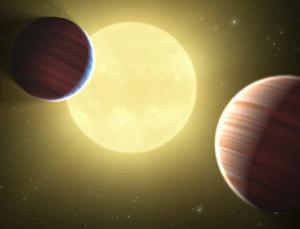 Buried in the flood of data from the Kepler telescope is a planetary system unlike any seen before. Two of its apparent planets share the same orbit around their star. If the discovery is confirmed, it would bolster a theory that Earth once shared its orbit with a Mars-sized body that later crashed into it, resulting in the moon’s formation.
The two planets are part of a four-planet system dubbed KOI-730. They circle their sun-like parent star every 9.8 days at exactly the same orbital distance, one permanently about 60 degrees ahead of the other. In the night sky of one planet, the other world must appear as a constant, blazing light, never fading or brightening.
Gravitational “sweet spots” make this possible. When one Read more…
Target Earth: Near Earth Asteroids Swarming the February Skies

Photo by Steve E. Farmer Jr.
February 12, another newly discovered hazardous asteroid (PHA) was announced. As most other NEO’s in the past, this one safely passed by Earth…this time.
Potentially Hazardous Asteroid 2011 CU46 was announced on February 12, 2011. This hazardous asteroid did not drift by Earth at only a few thousand miles as in the case of Near Earth Object 2011 CQ1; 2011 CU46 safely passed by at a distance of a little more than 316,000 miles – which is still considered a “near miss” in astronomical terms. PHA 2011 CU46 has a diameter of 20m – 50m; and this particular object would likely cause a massive fireball and surface damage if it were to impact Earth in a populated area.
Potentially Hazardous Asteroids & Near Earth Objects
As defined by NASA, A Potentially Hazardous Asteroid (PHA) is based on parameters that measure the asteroid’s potential to make threatening close approaches to the Earth. An asteroid which comes within an orbital intersection distance of 0.05 AU with Earths orbit and is of a diameter of 110m – 240m, is normally identified as a potentially hazardous object. Other factors are also included.
Since the February 4 announcement of NEO 2011 CQ1, over forty more Near Earth Objects have been discovered, identified, and catalogued.
Apophis Likely to Miss, What about PHA 2011 AG5?
PHA 2011 AG5 was discovered by Mt. Lemmon Survey on January 8, 2011. After more than one-hundred extra observations of this Potentially Hazardous Asteroid were collected by both amateur and professional astronomers, orbital elements were calculated and it was determined that 2011 AG5 could possibly impact Earth in the year 2052. More observations and research is needed to refine the orbit of this asteroid.


2011 AG5 is very similar to the famous asteroid Apophis which could possibly impact the Earth in the year 2036. Apophis is a little larger in diameter that 2011 AG5 and is expected to pass by Earth twice as close as 2011 AG5. Both of these minor planets are large enough to cause substantial damage to a major city on Earth if impact were to occur, but with any luck these minor planets will spare Earth and safely pass us by.
Preparing for Asteroid Impact
It’s only a matter of time before the announcement comes that Earth will obtain an impact from a minor planet large enough to cause wide-spread damage. It is this reason why more studies be performed on minor planets – to help further improve our understandings on these objects in hopes to give us a better defense option when that announcement comes. We have the technology to detect these hazardous objects and certain programs are working on methods to deflect or destroy asteroids. With any luck, they will design a fail-proof method to eliminate the potential risk from these objects impacting Earth.
68 New Earths and 288 New Super Earths: The New Kepler exoplanet data – NASA videos and pictures
NASA press release on the 1202 new Kepler telescope exoplanets.
Exoplanets classified by size which are:
- 68 Earth-size exoplanets with a radius (Rp) of less than 1.25 Earth radius (Re)
- 288 super-Earth size exoplanets with 1.25 x Re < Rp ≤ 2.0 x Re - 662 Neptune-size exoplanets with 2.0 x Re < Rp ≤ 6.0 x Re - 165
Jupiter-size exoplanets with 6.0 x Re < Rp ≤ 15 x Re - 19
very-large-size with 15.0 x Re < Rp ≤ 22 x Re
“We went from zero to 68 Earth-sized planet candidates and zero to 54 candidates in the habitable zone – a region where liquid water could exist on a planet’s surface. Some candidates could even have moons with liquid water,” said William Borucki of NASA’s Ames Research Center, Moffett Field, Calif., and the Kepler Mission’s science principal investigator. “Five of the planetary candidates are both near Earth-size and orbit in the habitable zone of their parent stars.”
Kepler will continue conducting science operations until at least November 2012, searching for planets as small as Earth, including those that orbit stars in a warm habitable zone where liquid water could exist on the surface of the planet. Since transits of planets in the habitable zone of solar-like stars occur about once a year and require three transits for verification, it is expected to Read more…

Nibiru planet X 2012 PROOF of Government conspiracy

This is very interesting if it is a cover up. I typed in the same coordinates 5h 53m 27s,-6 10′ 58 on Google Sky and the area was mysteriously blacked out! Why I don’t know but I do know this is the only “cropped” area in Google Sky. The first sighting of the object was detected by N.A.S.A in 1983 by IRAS spacecraft. The reason that it is not being seen anywhere except in the far south is because it’s path is bringing it towards Earth almost directly beneath the South Pole, a “blind spot” for astronomers. Another interesting fact to note is the proximity of the cropped area to Orion’s belt that is referred as the “Dark Rift” by the Ancient Mayans. Below are ancient tablets from the Sumerians in what was depicted as the Sun, its planets, the Earth’s moon, and Nibiru. Remember this created was millenia ago. If you add 2+2 it will give you 4.


![[Most Recent Quotes from www.kitco.com]](https://i0.wp.com/www.kitconet.com/charts/metals/gold/t24_au_en_usoz_2.gif)
![[Most Recent Quotes from www.kitco.com]](https://i0.wp.com/www.kitconet.com/charts/metals/silver/t24_ag_en_usoz_2.gif)

 crisisboom
 CRISISBOOM
You must be logged in to post a comment.