Archive
Bad News from NASA: Proof That Comet Elenin Is Affecting Earth
 |
| Dees Illustration |
Dr. Mark Sircus, Contributing Writer
Activist Post
This is going to be the most extraordinary communication so fasten your seatbelts; we are in for a rough ride. I have known in my heart for months that I would have to make a communication like this but had no idea it would be this soon. Back in January, while investigating the underground city that is alleged to have been built under the new Denver Airport, reported on by the former governor Jesse Ventura, I put the puzzle together and came to the conclusion that a planetary event was in store for us in 2012.
Today I am presenting rock solid information; it does not get any better when NASA is your source. What you are about to read and see is happening. Last night, looking at a NASA mathematical model of comet Elenin, I found out that a large celestial body has already penetrated the solar system and is on course for a near and possibly horrific encounter with the earth in the fall of 2011. What we do not know is the size and mass of comet Elenin though I have no doubt that it is known by Read more…
Comet Hale-Bopp ‘Frozen to Death’
Hale-Bopp, the most dazzling comet to grace our skies in the 20th Century, has drifted beyond the orbit of Neptune, over 30 AU from the sun (1AU = one sun-Earth distance).
Curious astronomers from Hungarian, U.S. and Australian research institutions decided to track the icy vagabond as it continued its outward journey on an epic 2,500 year orbit.
PHOTOS: 6 Intimate Comet Encounters
In 1997, Hale-Bopp gave us Earthlings a dazzling show. Heated by the sun, the comet underwent an impressive outburst, ices subliming into space, producing a dusty coma visible to the naked eye with bright dust and gas tails (plus the discovery of a previously unknown neutral sodium tail) carried away from the comet in the direction of the solar wind for millions of miles.
But what of the comet 15 years later? Read more…
Cosmic burst in distant galaxy puzzles NASA

This NASA image from Swift’s Ultraviolet/Optical (white, purple) and X-ray telescopes (yellow and red) were combined in this view of a cosmic burst at the center of distant galaxy that has burned for more than a week, longer than astronomers have ever seen before, the US space agency said Thursday.
NASA is studying a surprising cosmic burst at the center of distant galaxy that has burned for more than a week, longer than astronomers have ever seen before, the US space agency said Thursday.
Calling it “one of the most puzzling cosmic blasts ever observed,” NASA said it has mobilized the Hubble Space Telescope along with its Swift satellite and Chandra X-ray Observatory to study the phenomenon.
“More than a week later, high-energy radiation continues to brighten and fade from its location,” NASA said in a statement.
“Astronomers say they have never seen such a bright, variable, high-energy, long-lasting burst before. Usually, gamma-ray bursts mark the destruction of a massive star, and flaring Read more…
ELEnin Things to come in 2011-12
April 4th, two earthquakes with a strength of greater than 6 took place.
Data from USGS site
6.7 2011/04/03 20:06:42 -9.786 107.749 24.0 SOUTH OF JAVA, INDONESIA
6.4 2011/04/03 14:07:09 -17.649 -178.578 551.9 FIJI REGION
Astronomers: Comet Elenin may produce greatest meteor showers in history
 The unusual Comet Elenin is expected to pass within 21 million miles of Earth on October 16, 2011 and speeding by at more than 85,000 mph—so fast it could travel from Earth to the Moon in less than five hours.
Discovered by amateur Russian astronomer Leonid Elenin in Lyubertsy, Russia on December 10, 2010—who accessed the International Scientific Optical Network’s robotic observatory near Mayhill, New Mexico—the astronomical community has erupted with the excited possibility the celestial traveller could generate the most spectacular meteor showers ever recorded.
Although the comet’s path is expected to change as it draws closer to the sun, astronomical calculations appear to show Elenin’s perihelion occurring well inside Earth’s orbit by September 5th.
Astronomers believe the comet will be visible with a good pair of field binoculars about the middle of August. After then it should become visible in the Northern hemisphere’s predawn Read more…
Asteroid 2005 YU55 To Approach Earth Nov 8 2011
spacedaily.com
Near-Earth asteroid 2005 YU55 will pass within 0.85 lunar distances from the Earth on November 8, 2011. The upcoming close approach by this relatively large 400 meter-sized, C-type asteroid presents an excellent opportunity for synergistic ground-based observations including optical, near infrared and radar data.
An animated illustration by JPL shows the Earth and moon flyby geometry for November 8th and 9th when the object will reach a visual brightness of 11th magnitude and should be easily visible to observers in the northern and southern hemispheres.
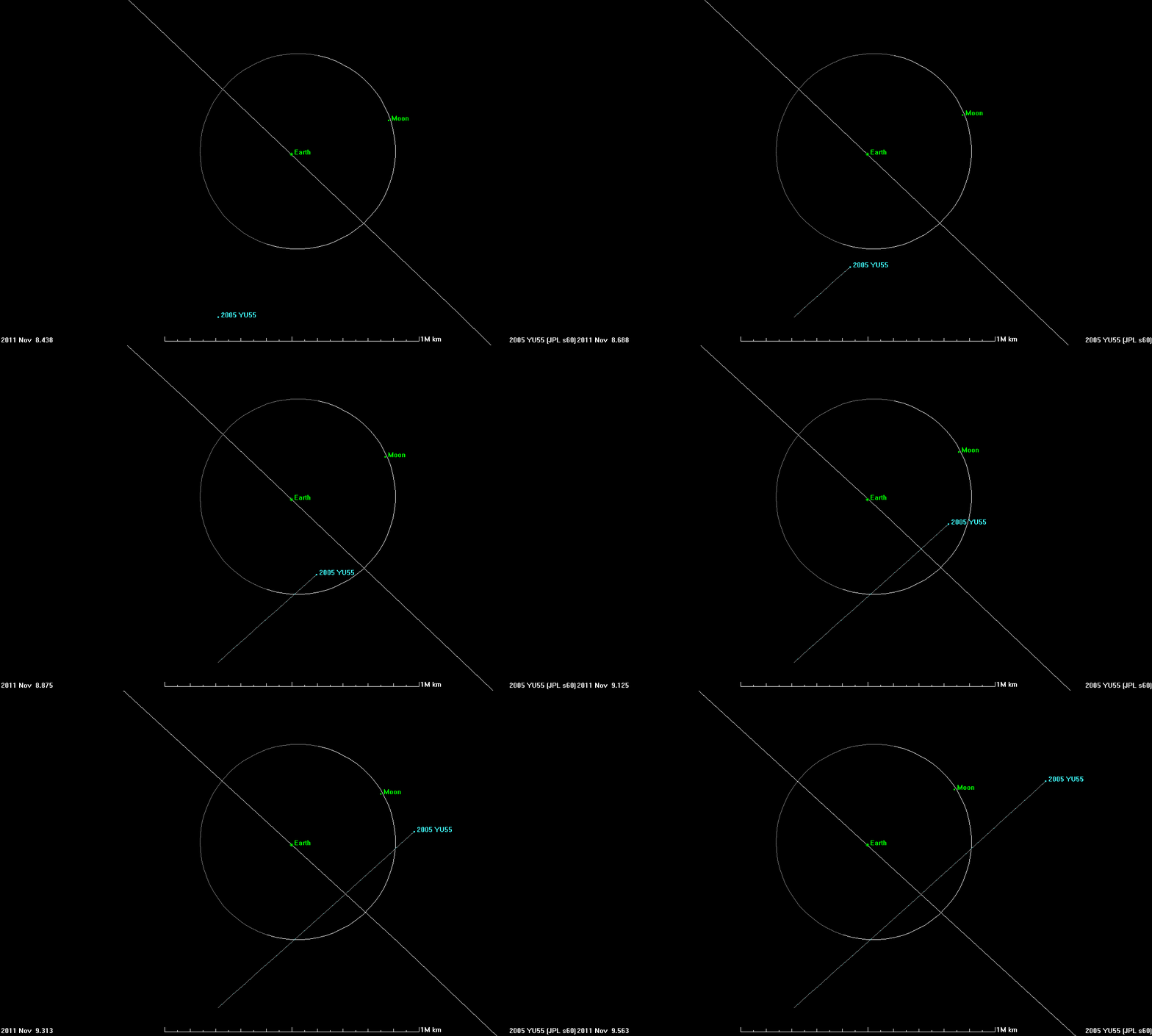
Click to view the projected movement in action
The closest approach to Earth and the Moon will be respectively 0.00217 AU and 0.00160 AU on 2011 November 8 at 23:28 and November 9 at 07:13 UT.
Discovered December 28, 2005 by Robert McMillan of the Spacewatch Program near Tucson Arizona, the object has been previously observed by Mike Nolan, Ellen Howell and colleagues with the Arecibo radar on April 19-21, 2010 and shown to be a very dark, nearly spherical object 400 meters in diameter.
Because of its approximate 20-hour rotation period, ideal radar observations should include tracks that are 8 hours or longer on multiple dates at Goldstone (November 3-11) and when the object enters Arecibo’s observing window on November 8th. Read more…
NASA’s buzz about comet Elenin

IMAGE: NASA JPL
NASA posted a video on their website Buzzroom last week, bringing attention to a recently discovered comet in our solar system. The comet was discovered by Russian astronomer Leonid Elenin in December last year. Comet Elenin, as it is called, is of particular interest to NASA because of the close proximity to Earth that its orbit will reach during its turn around the sun on its way back out through the solar system later this year.
Most orbits of planets are not circles; they are ellipses. The elongated ends of elliptical orbits are called aphelions and perihelions; the aphelion being the end farthest away from the stationary object being orbited, and perihelion being the end closest to the stationary object. In Elenin’s case, its trip around our sun represents the comet’s perihelion.
So little is known about this comet because of its relatively recent-discovery status, therefore, Read more…
Upcomming days of interest for possible Seismic Activity
- Keep in mind of sunspot 1176’s possible activity
Sun Emitting Solar Flare
Look at the size of that solar flare! Lots of activity on the way folks.

Planet “X” Revealed by Cornell University
Headlines from recent Cornell University web pages.:
Persistent Evidence of a Jovian Mass Solar Companion in the Oort Cloud
search.arxiv.org:8081/paper.jsp?r=1004.4584&qid=null&qs=nemesis&byDate=1
We present an updated dynamical and statistical analysis of outer Oort cloud cometary evidence suggesting the sun has a wide-binary Jovian mass companion. The results support a conjecture that there exists a companion of mass ~ 1-4 M_Jup orbiting in the innermost region of the outer Oort cloud. Our most restrictive prediction is that the orientation angles of the orbit normal in galactic coordinates are centered on the galactic longitude of the ascending node Omega = 319 degree and the galactic inclination i = 103 degree (or the opposite direction) with an uncertainty in the normal direction subtending ~ 2% of the sky. A Bayesian statistical analysis suggests that the probability of the companion hypothesis is comparable to or greater than the probability of the null hypothesis of a statistical fluke. Read more…


![[Most Recent Quotes from www.kitco.com]](https://i0.wp.com/www.kitconet.com/charts/metals/gold/t24_au_en_usoz_2.gif)
![[Most Recent Quotes from www.kitco.com]](https://i0.wp.com/www.kitconet.com/charts/metals/silver/t24_ag_en_usoz_2.gif)

 crisisboom
 CRISISBOOM
You must be logged in to post a comment.