Archive
Water shortages in the West: ‘You ain’t seen nothing yet’
An extraordinary set of circumstances produced the Colorado River Compact of 1922. The question now is whether the compact and other laws and treaties collectively called the Law of the River are sufficiently resilient to prevent teeth-barring among the seven states of the basin in circumstances that during the 21st century may be even more extraordinary.
For the most part, speakers at a recent conference sponsored by the University of Colorado Natural Resources Law Center agreed that there’s no need to start over even if future circumstances will require states of the Southwest to “bend the hell out of it,” in the words of law professor Douglas Kenney.
Kenney, director of the law school’s Western Water Policy Program, last winter released the first part of a several-tiered study of challenges to administration of the river. Obscured by drought that had left Lake Mead, near Las Vegas, reduced to its lowest level since 1938, demand had quietly crept up and overtaken supply during the last decade, he said.
Despite occasional wet years such as the current one, climate-change projections foresee significantly hotter temperatures and perhaps a 9 percent decline in water volume during coming decades, according to the newest study issued this spring by the U.S. Bureau of Reclamation.
DeBecque Canyon on the Colorado River near Palisade (Best)
Some people believe earlier spring, warmer temperatures, and the extended drought of the last decade are harbingersof Read more…
California releases 450 ‘violent and dangerous’ criminals after computer glitch sets them free
Hundreds of violent and dangerous prisoners have been released on unsupervised parole in California because of a computer glitch, according to the state’s inspector general.
Software errors led prison officials to mistakenly release some 450 inmates deemed to have a ‘high risk for violence’, as part of a programme meant to ease overcrowding in the state’s jails.
And more than 1,000 additional convicts said to present a high risk of committing drugs crimes, property crimes and other offences were also freed.
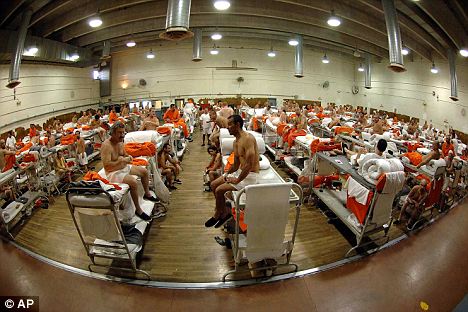 Overcrowded: Hundreds of violent criminals have been released from prison early on unsupervised parole after a computer error
The news comes after the U.S. Supreme Court ruled that California’s prisons are dangerously overcrowded, and upheld a ruling giving the state two years to slash prisoner numbers.
No attempt has since been made to return any of the offenders to prison or to put them on supervised parole schemes, inspector general spokesman Renee Hansen told the LA Times.
All of the released prisoners have been placed on so-called ‘non-revocable parole’ – meaning that they do not have to report to parole officers and can only be sent back to prison if they are caught committing another crime.
Inmates who are gang members, sex criminals or violent criminals are determined to pose a risk of re-offending and are not thought to be suitable for the scheme.
But a report by the inspector general found that the computer programme that officials Read more…
Man Arrested For Not Giving Cops His Cell Phone (Video)
Prepare for the Next Conflict: Water Wars
 Every minute, 15 children die from drinking dirty water. Every time you eat a hamburger, you consume 2400 liters of the planet’s fresh water resources — that is the amount of water needed to produce one hamburger. Today poor people are dying from lack of water, while rich people are consuming enormous amounts of water. This water paradox illustrates that we are currently looking at a global water conflict in the making.
We are terrifyingly fast consuming one of the most important and perishable resources of the planet — our water. Global water use has tripled over the last 50 years. The World Bank reports that 80 countries now have water shortages with more than 2.8 billion people living in areas of high water stress. This is expected to rise to 3.9 billion — more than half of Read more…
California Seizing Property from Safety Deposit Boxes
As reported by ABC News, what started out as a program to hold unclaimed property, such as the contents of safety deposit boxes owned by people who have moved away without a forwarding address, has gone wildly out of control. The program is now using the flimsiest of excuses to drill safe deposit boxes and sell the contents.
In a case reminiscent of the Monty Python organ donor skit (or perhaps the movie Repo Men), a San Francisco woman’s jewelry appraised at over $80,000 was sold even though she lived a few blocks from her bank, had not moved, and was current on all of her box rental feeds. In another case, a man’s retirement savings consisting of $4 million of stock certificates were sold; and “A Sacramento family lost out on railroad land rights their ancestors had owned for generations”.
The program began life as a place to hold unclaimed property for up to 5 years while the state made attempts to locate the owner. Both the holding period and the efforts to locate the owner have diminished over time. ABC news indicates that there have been internal debates within the state on these changes, with an internal memo objecting to efforts to to find the owners on the grounds that “It could well result in additional claims of monies that would otherwise flow into the general fund.”
What surprises me about these seizures is the scale and how under-reported it is. This is the first article that I have seen on this topic, compared to dozens of pieces and several books on civil asset forfeiture. This phenomenon is probably at least as large as CAF — Jarret Wollstein cites a number in the low single-digit billions for asset forfeiture (which may be an annual number) compared to the $32 billion (which may be a multi-year aggregate) cited by ABC news. In comparison, looting of safe deposit boxes requires even less due process than asset forfeiture, which at least requires that the property be accused of a crime, and can be fought in court.
Radiation in US rainwater likely from Japan
 Health officials said Sunday that one sample of Massachusetts rainwater has registered very low concentrations of radiation, most likely from the Japanese nuclear power plant damaged earlier this month by an earthquake and tsunami.
John Auerbach, the Massachusetts commissioner of public health, said that the radioactive isotope iodine-131 found in the sample – one of more than 100 that have been taken around the country – has a short life of only eight days. He said the drinking water supply in the state was unaffected and officials do not expect any health concerns.
Nevada, California, Hawaii, Colorado and Washington state have also reported tiny amounts of radiation from the Japan Read more…
Girl Scout Cookies On Their Own Front Lawn
 Once upon a time in America, if you were a couple of little girls and you wanted to sell lemonade or girl scout cookies at a little stand in front of your home nobody would give you any problems. In fact, most of the people passing by would have smiled and would have seen it as a sign of hope that the next generation was being so industrious. Well, that is not the way that it works anymore. Today, all across America nightmarish control freaks are seeking to micromanage every single aspect of our lives. That includes banning young girls from selling girl scout cookies on their own front lawns. Yes, you read that correctly. In Missouri of all places, two young girls named Abigail and Caitlin Mills were recently taught a lesson on how to be good citizens in the emerging totalitarian control grid going up all over the United States. After a complaint from a neighbor, the city of Hazelwood cracked down on the two girls and told them that they must shut down the girl scout cookie stand that they had been operating in their front yard.
So were the girls doing anything wrong? No. There are very few things that are more Read more…
Superbug spreading to Southern California hospitals
A dangerous drug-resistant bacteria has spread to patients in Southern California, according to a study by Los Angeles County public health officials.
More than 350 cases of the Carbapenem-Resistant Klebsiella pneumoniae, or CRKP, have been reported at healthcare facilities in Los Angeles County, mostly among elderly patients at skilled-nursing and long-term care facilities, according to a study by Dr. Dawn Terashita, an epidemiologist with the Los Angeles County Department of Public Health.
It was not clear from the study how many of the infections proved fatal, but other studies in the U.S. and Israel have shown that about 40% of patients with the infection die. Tereshita was Read more…
Scientists Project Path of Radiation Plume
A United Nations forecast of the possible movement of the radioactive plume coming from crippled Japanese reactors shows it churning across the Pacific, and touching the Aleutian Islands on Thursday before hitting Southern California late Friday.
March 18 2:00 AM
 The Comprehensive Nuclear Test Ban Treaty Organization shows how weather patterns this week might disperse radiation from a continuous source in Fukushima, Japan. The forecast does not show actual levels of radiation, but it does allow the organization to estimate when different monitoring stations, marked with small dots, might be able to detect extremely low levels of radiation. Read more…


![[Most Recent Quotes from www.kitco.com]](https://i0.wp.com/www.kitconet.com/charts/metals/gold/t24_au_en_usoz_2.gif)
![[Most Recent Quotes from www.kitco.com]](https://i0.wp.com/www.kitconet.com/charts/metals/silver/t24_ag_en_usoz_2.gif)

 crisisboom
 CRISISBOOM
You must be logged in to post a comment.