Archive
A New World Order Reserve Currency
 What do the riots in Egypt and a new world reserve currency have in common?
Perhaps more than we think.
Consider the following statements from George Soros in a recent interview:
Some statements of Soros (who happens to be a Fabian Socialist):
The efficient market hypothesis has failed.
Markets are not tending toward equilibrium.
There is imperfect knowledge of regulators and market participants.
He has an economic theory that is “more relevant” than the dominant one and is supporting an institute for new economic thinking….
Inflation (in the United States) is helpful because the burden of debt was getting too heavy.
The problem is you don’t have a Read more…
“War Without Borders”: Washington Intensifies Push Into Central Asia
By Rick Rozoff
A recent editorial on the website of Voice of America reflected on last year being one in which the United States solidified relations with the five former Soviet republics in Central Asia: Kazakhstan, Kyrgyzstan, Tajikistan, Turkmenistan and Uzbekistan.
 One or more of the five nations border Afghanistan, Russia, China and Iran and several more than one of the latter. Kazakhstan, for example, adjoins China and Russia.
The U.S. and Britain, with the support of the North Atlantic Treaty Organization, invaded Afghanistan and fanned out into Kyrgyzstan, Tajikistan and Uzbekistan in October of 2001, less than four months after Russia, China, Kazakhstan, Kyrgyzstan, Tajikistan and Uzbekistan founded the Shanghai Cooperation Organization (SCO) to foster expanding economic, security, transportation and energy cooperation and integration in and through Central Asia. In 2005 India, Iran and Pakistan joined the SCO as observers and Afghan President Hamid Karzai has attended its last five annual heads of state summits. [1]
Now the U.S. and the NATO have over 150,000 troops planted directly south of three Central Asian nations.
Kazakhstan and Turkmenistan are also on the Caspian Sea, a reservoir of oil and natural gas whose dimensions have only been accurately determined in the past twenty years and where American companies are active in hydrocarbon projects.
After the U.S. invasion of Afghanistan, the Pentagon and its NATO allies deployed military forces to, in addition to Soviet-constructed air bases in Afghanistan, bases in Kyrgyzstan, Tajikistan and Uzbekistan. The first two countries Read more…
WikiLeaks: tension in the Middle East and Asia has ‘direct potential’ to lead to nuclear war
Tension in the Middle East and Asia has given rise to an escalating atomic arms and missiles race which has “the direct potential to lead to nuclear war,” leaked diplomatic documents disclose.
By Heidi Blake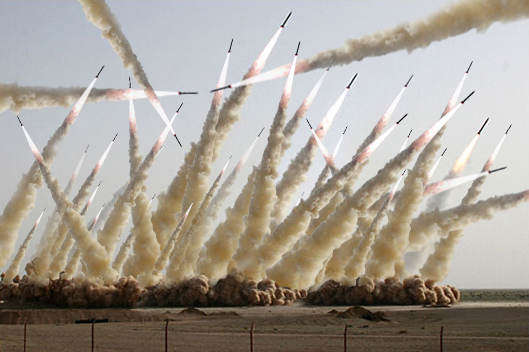 Rogue states are also increasing their efforts to secure chemical and biological weapons, and the means to deploy them, leaving billions in the world’s most densely populated area at risk of a devastating strike, the documents show.
States such as North Korea, Syria and Iran are developing long-range missiles capable of hitting targets outside the region, records of top-level security briefings obtained by WikiLeaks show.
Long-running hostilities between India and Pakistan – which both have nuclear weapons capabilities – are at the root of fears of a nuclear conflict in the region. A classified Pentagon study estimated in 2002 that a nuclear war between the two countries could result in 12 million deaths.
Secret records of a US security briefing at an international non-proliferation summit in 2008 stated that “a nuclear and missile arms race [in South Asia] has the Read more…
Something Large This Way Comes
 And so it picks up steam. What started in Iceland, instigated by Wall St, has now engulfed Tunisia, Yeman, Sudan, Egypt, Syria, Jordan and others yet to be made manifest. Saudi Prince Turki bin Abdul Aziz Al Saud has warned the country’s royal family to step down and flee before a military coup or a popular uprising overthrows the kingdom.
Julianne the Apostate can take the credit of kicking this ball down the hill as it was his release of some of those documents which demonstrated selected venality amongst certain countries’ leadership. It would have happened anyway, but the Apostate, it seems, was the spark. How this could be to Israel’s benefit is beyond me.
The control system is blowing apart at the seams. Anyone thinking the unrest across North Africa to the Middle East is part of a planned paradigm has got to be crazy. Certainly, there are organizational forces at work trying to ride on top of the chaos, but all Read more…
Small China quake forces evacuation of 65,000 people
KUNMING, China, Feb. 2 (UPI) — An earthquake that damaged nearly 700 homes forced some 65,000 people into shelters Wednesday in China’s southwestern Yunnan province.
The quake hit Yingjiang County Tuesday afternoon and had a magnitude of 4.8 on the open-ended Richter scale, county officials told the Xinhua news agency.
There was no immediate report on injuries, but officials said 229 homes had been seriously damaged and 448 others had sustained lesser damage, the report said.
The quake’s center was about 6 miles deep, geologists said.
The quake came just before Chinese New Year Thursday and county officials said they were trying to ensure a “merry and safe” celebration for evacuees by providing them with tents, blankets, coats and 10 tons of rice, Xinhua said.
China to raise interest rates within month – report
The Hong Kong-datelined story did not identify its sources, citing the sensitivity of the information.
It also cited the economists and bankers as saying China was unlikely to let the yuan currency appreciate faster anytime soon as a way to fight inflation.
Analysts polled by Reuters saw two more rate rises by the end of the first half.
The median forecast of economists polled by Reuters is for inflation to reach its fastest in more than two years at an annual pace of 5.3 percent for January.
Cheap food may be a thing of the past

U.S. grain prices should stay unrelentingly high this year, according to a Reuters poll, the latest sign that the era of cheap food has come to an end.
U.S. corn, soybeans and wheat prices — which surged by as much has 50 percent last year and hit their highest levels since mid-2008 — will dip by at most 5 percent by the end of 2011, according to the poll of 16 analysts.
The forecasts suggest no quick relief for nations bedeviled by record high food costs that have stoked civil unrest. It means any extreme weather event in a grains-producing part of the world could send prices soaring further.
The expectations may also strengthen importers’ resolve to build bigger inventories after a year in which stocks of corn and soybeans in the United States — the world’s top exporter — dwindled to their lowest level in decades.
Story: Global food chain stretched to the limit Read more…
China should increase precious metals
Sungwoo Park
SEOUL – China should increase its gold and silver reserves, the Economic Information Daily reported on Monday, citing an interview with China’s central bank adviser Xia Bin.
Increasing gold reserves at the “appropriate time” is in line with the strategy of internationalizing the yuan, the report cited Xia as saying. “Related departments” should employ a “buy in the dip” strategy over a very long period of time, Xia said.

Bullion soared nearly 30 percent in 2010, advancing for the 10th year, as the dollar dropped and investors sought a store of value amid currency debasement. China is allowing greater use of its currency for cross-border transactions, seeking to reduce reliance on the dollar.
The report is “a positive factor for gold prices in the mid-and-long term,” Hwang II Doo, a senior trader at Seoul-based Korea Exchange Bank Futures Co, said on Monday. Still “it didn’t have immediate impact on prices as gold’s gain has more to do with the unrest in Egypt at the moment.”
Total gold consumption in China, the second-largest buyer, may gain 15 percent in the first-half, fueled by growing demand for alternative investments and a hedge against inflation, the China Gold Association said last week.
Imports of gold by China jumped almost five-fold in the first 10 months of last year from the entire amount shipped in 2009, the Shanghai Gold Exchange has said. Shipments were 209 metric tons compared with 45 tons for all of 2009, said exchange Chairman Shen Xiangrong.
The country increased gold reserves by 454 tons to 1,054 tons since 2003, the State Administration of Foreign Exchange said in April 2009. The metal only accounts for 1.6 percent of the nation’s reserves held by the People’s Bank of China, according to the World Gold Council. China doesn’t regularly publish gold-trade figures and rarely comments on its reserves.
Bullion for immediate delivery gained as much as 0.7 percent to $1,346.27 an ounce, and was at $1,339.25 at 12:53 pm in Seoul. The price rose 2.5 percent on Jan 28, the biggest intra-day increase since Nov 4 as escalating tensions in Egypt fanned concern that unrest may spread to other parts of the Middle East, increasing demand for an investment haven.
Could China Be Forced To Bring A New Global Recession by 2015?
By Dian L. Chu, EconForecast
 Bloomberg on Sunday, Jan. 30 cited a 28-page report–The Financial Crisis of 2015: An Avoidable History (pdf file below)–by Barrie Wilkinson, a London-based partner at consulting firm Oliver Wyman.
The report describes a scenario–spanned 2013 to 2015–when Western QE-induced inflation brings down China, creating a debt crisis in the commodity sector–inclusive of resource-dependent countries as well as commodity producers–which eventually plunge the world into another recession, and a new world order by 2015.
“…the dramatic rises in commodities prices resulting from loose Western monetary policies eventually caused rampant inflation in China. China was forced to raise interest rates and appreciate its currency to bring inflation under control.”
Well, I think we are pretty much there already.
“Once the Chinese economy began to slow, investors quickly realized Read more…
The Internet Kill Switch
 This past week was a perfect example of how the “Internet kill switch” is rapidly becoming one of the favorite new tools of tyrannical governments all over the globe. Once upon a time, the Internet was a bastion of liberty and freedom, but now nation after nation is cracking down on it. In fact, legislation has been introduced once again in Congress that would give the president of the United States an “Internet kill switch” that he would be able to use in the event of war or emergency. Of course there would be a whole lot of wiggle room in determining what actually constitutes a true “emergency”. The members of Congress that are pushing this “Internet kill switch” bill want the U.S. to become more like China in this regard. In China, the Internet is highly controlled, highly regulated and highly censored. In fact, China has shut down the Internet in entire regions when they have felt it necessary. So what Egypt did in shutting down the Internet this past week is not unprecedented – but it was quite shocking.


![[Most Recent Quotes from www.kitco.com]](https://i0.wp.com/www.kitconet.com/charts/metals/gold/t24_au_en_usoz_2.gif)
![[Most Recent Quotes from www.kitco.com]](https://i0.wp.com/www.kitconet.com/charts/metals/silver/t24_ag_en_usoz_2.gif)

 crisisboom
 CRISISBOOM
You must be logged in to post a comment.