Archive
Wikileaks Founder: Our Enemy is China
Wikileaks may have targeted the US with its ongoing releases of sensitive State Department documents, but China is its real “technological enemy,” according to founder Julian Assange.
In an interview with the left-leaning British weekly magazine the New Statesman, Assange called China the “worst offender” for its censorship of information online.

- Associated Press
- Julian Assange, founder of Wikileaks.
“China has aggressive and sophisticated technology that places itself between every reader inside China and every information source outside China,” Assange told the magazine. “We’ve been fighting a running battle to make sure we can get information through.”
The controversial head of Wikileaks is being held in the UK and is awaiting a verdict in extradition hearings over whether he will be turned over to Swedish authorities where he is wanted for questioning over accusations of rape and sexual assault.
The Australian-born hacker has said he is worried that the US may retaliate against him for publishing a series of State Department documents on the Wikileaks site. Since late November 2010 the organization has released Read more…
WikiLeaks: China Hiding Military Build Up
 AUSTRALIA’S intelligence agencies believe China is hiding the extent of a huge military build-up that goes beyond national defence and poses a serious threat to regional stability.
A strategic assessment by the agencies found China’s military spending for 2006 was $90 billion – double the $45 billion announced publicly by Beijing.
Australia’s peak intelligence agency, the Office of National Assessments, as well as the Defence Intelligence Organisation and the Defence and Foreign Affairs departments concluded that China was building a military capability well beyond its priorities of self-defence and preventing Taiwan’s independence.
”China’s longer-term agenda is to develop ‘comprehensive national power’, including a strong military, that is in keeping with its view of itself as a great power,” says a copy of the secret assessment provided by Foreign Affairs officials to the US embassy in Canberra.
”We agree that the trend of China’s military modernisation is beyond the scope of what would be required for a conflict over Taiwan. Arguably China already poses a credible threat to modern militaries operating in the region and will present an even more formidable challenge as its modernisation continues.”
Details of the 2006 intelligence assessment are contained in a US embassy cable obtained by WikiLeaks and provided exclusively to the Herald.
The Australian document goes on to warn that the pace of China’s military build-up and ”the opacity of Beijing’s intentions and programs” was ”already altering the balance of power in Asia and could be a destabilising influence”.
”There is the potential for possible misconceptions which could lead to a serious miscalculation or crisis,” it says.
The Australian intelligence agencies suggest China could overestimate its own capabilities with a significant risk of strategic miscalculation and instability.
”The nature of the [People’s Liberation Army] and the regime means that transparency will continue to be viewed as a potential vulnerability. This contributes to the likelihood of strategic misperceptions,” the document says.
”The rapid improvements in PLA capabilities, coupled with a lack of operational experience and faith in asymmetric strategies, could lead to China overestimating its military capability. These factors, coupled with rising nationalism, heightened expectations of China’s status, China’s historical predilection for strategic deception, difficulties with Japan, and the Taiwan issue mean that miscalculations and minor events could quickly escalate.”
Although successive Australian governments have called on China to be more transparent about its military spending, ministers and diplomats have studiously avoided public reference to the scale of the discrepancy between Beijing’s published figures and the likely reality behind the scenes.
The Australian estimate of a 2006 military budget of $US70 billion ($90 billion at the September 2006 exchange rate), has not been revealed previously – though it is consistent with academic and published US government estimates of China’s growing military spending.
The secret Australian assessment is also much sharper than the language later employed in the Rudd government’s 2009 Defence white paper, which said China was on the way to becoming Asia’s strongest military power ”by a considerable margin” and warned that the pace and scope of its growth could give its neighbours cause for concern if not properly explained.
The Rudd government publicly played down reports of a hostile Chinese reaction to the white paper when it was published, but secretly briefed the US that Beijing had threatened that Australia would ”suffer the consequences” if references to China’s growing military capabilities were not watered down.
The Defence Chief, Air Chief Marshal Angus Houston, and the then defence minister, Joel Fitzgibbon, insisted that China had no problem with the white paper. But other leaked US embassy cables report that the then deputy secretary for Defence, Mike Pezzullo, briefed US diplomats that he had been ”dressed down” by Chinese officials who had a ”look of cold fury” at the references to China in the white paper.
In the September 2006 briefing of the US embassy, Foreign Affairs officials advised that Australia hoped to use its defence relationship with China to promote increased transparency in that country’s military development plans.
”We remain focused on deepening the Australia-China defence relationship in areas such as peacekeeping, counter-terrorism and junior leadership exchanges, while remaining cautious to avoid practical co-operation that might help the PLA to fill capability gaps,” the Australian paper presented to the embassy concluded.
The Royal Australian Navy and the Chinese navy held their first joint exercise involving firing of live ammunition in September last year.
Last month the Defence Department secretary, Ian Watt, and Air Chief Marshal Houston attended the 13th annual Australia-China Defence Strategic Dialogue, which was hosted in China by General Chen Bingde, the chief of the PLA General Staff.
Dr Watt said that the dialogue was ”an integral component of Australia’s defence engagement with China, and provided the opportunity to have frank and open conversations and to exchange views on areas of common interest”.
Dr Watt and Air Chief Marshal Houston also met the vice-president and deputy chairman of China’s Central Military Commission, Xi Jinping.
Air Chief Marshal Houston said: ”We committed to continuing to develop our military relationship and practical cooperation together.”
EU Debt bought up by China
Published: January 6, 2011 07:46 ET in Asia

China has been increasing its holdings of European government debt, including that issued by Spain, amid the euro-zone crisis, Chinese Vice Commerce Minister Gao Hucheng was quoted as saying on Thursday.
The Spanish daily El Pais on Thursday cited Spanish government sources as saying China has committed to buy about 6 billion euros ($7.89 billion) worth of Spanish sovereign debt.
In a statement on the ministry’s website, Gao also said that China was confident in Spanish and European financial markets and confident that they would be able to overcome Europe’s debt crisis, the Wall Street Journal reported.
“We will continue to buy debt and work together with Spain,” said Gao, who is accompanying Chinese Vice Premier Li Keqiang on a visit to Spain and other European countries.
Both officials have expressed confidence that Spain will recover from its economic crisis despite market fears of an Irish-style bailout.
El Pais published an article written by Vice Premier Li, titled, “China and Spain: A brighter future through win-win cooperation.”
Political and corporate leaders increasingly see China as a source of capital. China’s foreign-exchange reserves are by far the world’s largest, totaling $2.648 trillion at the end of September.
In the meantime, the economic mood in Europe ended 2010 on a high note, a key indicator released Thursday showed.
The European Commission’s closely watched business and consumer survey for the members of the euro currency bloc rose from 105.2 in November to a more-than-forecast 106.2 last month. The consensus among economists was that the index would nudge up to 105.5.
Ben May, European economist with the research group Capital Economics, told Monstersandcritics.com the data suggested that, “the improving global economic outlook is offsetting the ongoing troubles in the periphery.”
China J-20 STEALTH FIGHTER VIDEO FOOTAGE
Robert Gates, the US defense secretary, recently said China would be able to produce a combat jet by 2020, but if the video is genuine, it would suggest that it may be able to do so a decade or more sooner.
The photographs come amid growing fears over China’s rapidly-expanding military capabilities. Naval experts have expressed concern over the Dong Feng-21D ballistic missile, which is designed to target aircraft carriers in mid-sea – thus denying the United States its traditional military dominance of the Pacific.
Gold Reserves of the World
Bullion analyst Mark Robinson says this is the biggest and most ambitious task that China has ever announced.
“If China wants to take its gold reserves to 10,000 tonnes in 10 years, the country needs to buy or acquire the yellow metal to the quantity of nearly 1000 tonnes per year.”
Which countries own the largest quantity of gold reserves right now?
- World leader the United States has 8133 tonnes of gold reserves, accounting for 76.5% of its foreign exchange reserves;
- Germany has the second highest gold reserves at 3412.6 tonnes;
- France has 2508 tonnes of gold constituting 58.7% of its forex assets;
- Italy has 2451.8 tonnes of gold constituting 61.9% of forex reserves;
- China became the fifth biggest holder of gold reserves this April with 1054 tonnes;
- Switzerland has 1040 tonnes of gold reserves constituting 23.8% of total forex reserves;
- India which recently bought 200 tonnes of gold from IMF has 557 tonnes of gold reserves representing 3% of total forex reserves.
- The IMF, which currently holds 3,217 tonnes of gold, is the third-largest official holder of the precious metal, but is not technically a sovereign central bank. The IMF has made gold sales a key element of its new income model aimed at lowering its dependence on lending revenue to cover expenses.
China Stealth Jet Fighter J-20
 Aviation experts believe China may have started testing a new stealth aircraft – putting it well ahead of Western predictions that a revamped air force would not be ready for take-off for another decade.
Photographs of the J-20 taking high-speed taxi tests at an airfield have appeared on several websites, fueling speculation that Beijing is not particularly concerned about keeping its latest weapon under wraps – at least unofficially.
The plane photos surfaced just one week after a U.S. naval commander warned that China is stepping up testing on a space missile that could sink American aircraft carriers in the Pacific.
The Chinese prototype looks like it has “the potential to be a competitor with the F-22 and to be decisively superior to the F-35,” said Mr. Fisher. The J-20 has two engines, like the F-22, and is about the same size, while the F-35 is smaller and has only one engine.
China’s stealth-fighter program has implications also for Japan, which is considering buying F-35s, and for India, which last month firmed up a deal with Russia to jointly develop and manufacture a stealth fighter.
The Chinese military are also expected to launch their first aircraft carrier next year – a year earlier than anticipated by U.S. experts.
But China’s Foreign Ministry insists his military is one of peace, saying: ‘We pose no threat to other countries.’
According to the Aviation Week website, security at the airfield where the J-20 was photographed was slack and the prototype could be viewed from several public areas.
The ‘leak’ supports earlier claims by the Chinese military that a stealth aircraft would be airborne by 2011 and could be operational by 2017.
U.S. Defense Secretary Robert Gates dismissed that idea at the time, claiming that China would not have stealth fighters operational before 2020. “China has the money, they have the industrial expertise, they have the scientific base, the drive and motivation and of course the benefit of American research over 30 years acquired by legal or illegal means,” one anonymous observer was quoted by a Time magazine blog site. “These enablers give China wide latitude in matching or exceeding American designs that are now 20 years old.”
Stealth aircraft – which can evade detection by radar, infrared and other tracking devices – have been in development since the end of World War Two.
Experts point out that the Chinese version is larger than most observers expected – ‘pointing to long range and heavy weapon loads’.
South Africa: Another BRIC in China’s Wall
 China’s President Hu Jintao has sent an invitation to South African President Jacob Zuma to attend the third BRICs leaders’ summit to be held in China. Picture: Zuma (center) celebrates the 25th anniversary of the Congress of South African Trade Unions (COSATU) on December 4, 2010 in Johannesburg. (File Photo/CFP)
At China’s invitation, South Africa is set to join the Brazil, Russia, India and China (BRIC) group of emerging nations and will attend the first summit of the leading emerging economies in April this year. The group will thus be renamed the “BRICS,” but doubts remain over the suitability of the African nation to join the exclusive club of the fast-growing economies.
Lauding the Chinese decision to invite her country to the BRIC bloc, South Africa’s Cooperation Minister Maite Nkoana-Mashabane said the invitation was conveyed to her by China’s Foreign Minister Yang Jiechi. She said Chinese President Hu Jintao also sent an invitation to President Jacob Zuma to attend the third BRIC leaders’ summit to be held in China. Read more…
Nuclear Targets in America
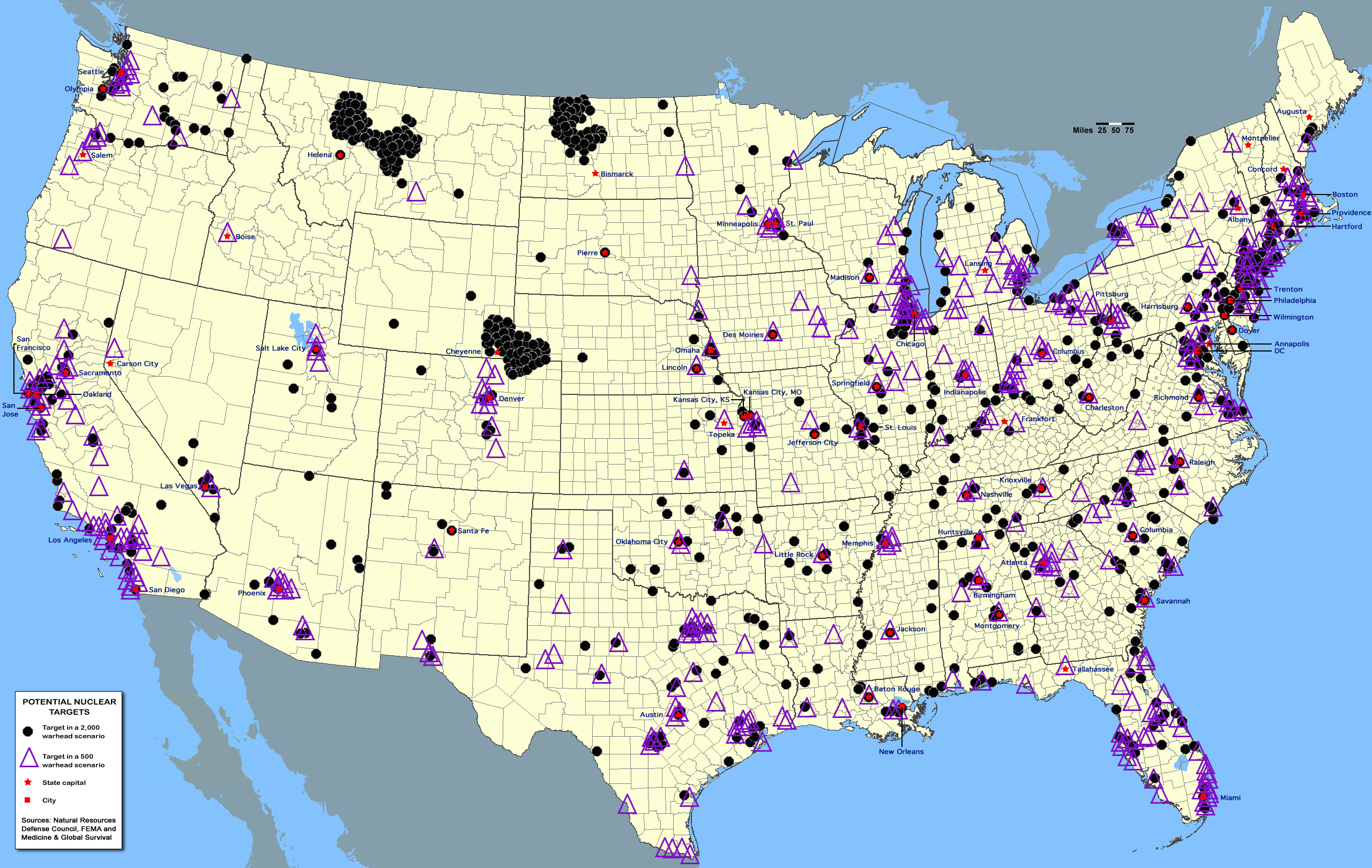
In the event of a nuclear war many of these cities have been mapped as potential Nuclear Targets due to being economic centers, tourism, military, local governments Eco hubs etc.. Click on the map to see your town enlarged. Hard to believe is it not? The town that I reside in is not that large in size however it is marked.
This information and other valuable information regarding the “Safeness” of America can be found at http://www.standeyo-cart.com/ProductDetails.asp?ProductCode=PPUSA
2010 in Review-Commodities affected by World Events
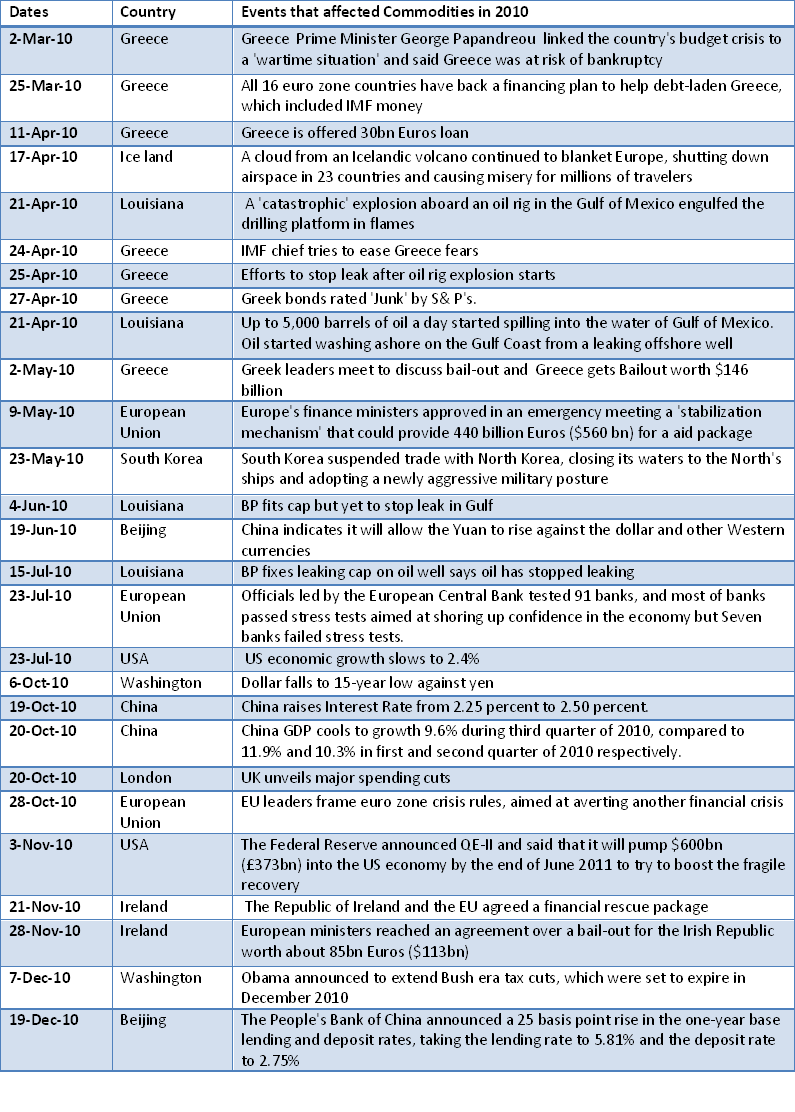 Notable events that affected commodity prices in 2010
Either America Or China Will Crash In 2011
Andy Xie’s latest sees the liquidity war getting worse in 2011.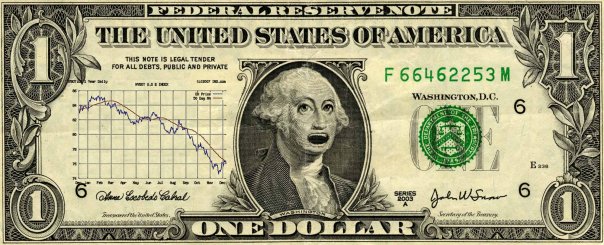
America will continue to pump the financial system with liquidity via tax cuts and quantitative easing. China will keep the yuan cheap and avoid clamping down on inflation.
The tense equilibrium can’t last for long, as either sovereign debt or inflation gets too heavy to bear. Whoever lasts longer, wins.
The most likely candidates to trigger the next global crisis are the U.S.’s sovereign debt or China’s inflation. When one goes down first, the other can prolong its economic cycle. China may have won the last race. To win the next one, China must tackle its inflation problem, which is ultimately a political and structural issue, in 2011. If China does, the U.S. will again be the cause for the next global crisis. China will suffer from declining exports but benefit from lower oil prices.
On the other hand, if China has a hard landing, the U.S.’s trade deficit can drop dramatically, maybe by 50 percent, due to lower import prices. It would boost the dollar’s value and bring down the U.S.’s treasury yield. The U.S. can have lower finacing costs and lower expenditures. The combination allows the U.S. to enjoy a period of good growth.
Xie notes that China may have the advantage here. While America has committed to a liquidity hose, Beijing still has the opportunity to crack down on inflation:
China’s inflation problem stems from the country’s rapid monetary growth in the past decade. That is due to the need to finance a vast property sector, which is, in turn, to generate fiscal revenues for local governments to finance their vast expenditure programs. Unless something is done to limit local government expenditure, China’s inflation problem is likely to get out of control…
There are two ways to limit local government expenditure. One is to cut their funding source. Their main revenue sources are land sales, property taxes, and bank loans. The last source is drying up a bit, as banks are saddled with high exposure to the sector already and are trying to decrease it. This change isn’t biting yet because local governments haven’t spent all the money they borrowed before.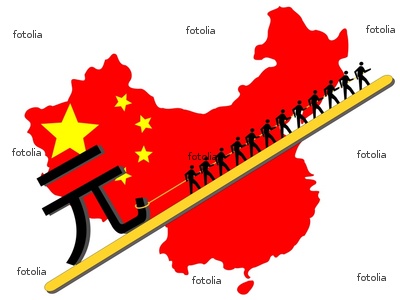
China needs America to consume their goods. This is the only way to keep its 1.3 billion people working and prevent protests and cause social instability. America has lost it manufacturing bases. They have only the printing press to print fit currency. America needs cheap imports from China to keep the illusion of high standard of living that they are used too.


![[Most Recent Quotes from www.kitco.com]](https://i0.wp.com/www.kitconet.com/charts/metals/gold/t24_au_en_usoz_2.gif)
![[Most Recent Quotes from www.kitco.com]](https://i0.wp.com/www.kitconet.com/charts/metals/silver/t24_ag_en_usoz_2.gif)

 crisisboom
 CRISISBOOM
You must be logged in to post a comment.