Archive
Major NASA Solar Flare News Conference: New Observations On Solar Storm Impact On Earth
nanopatentsandinnovations.blogspot

Credit: SOHO/NASA
Solar Storms Building Toward Peak in 2013, NASA Predicts
 |
| This image from the Solar Dynamics Observatory shows the X6.9 solar flare of Aug. 9, 2011 near the western limb (right edge) of the sun. CREDIT: NASA/SDO/Weather.com |
Solar flares like the huge one that erupted on the sun early today (Aug. 9) will only become more common as our sun nears its maximum level of activity in 2013, scientists say.
Tuesday’s flare was the most powerful sun storm since 2006, and was rated an X6.9 on the three-class scale for solar storms (X-Class is strongest, with M-Class in the middle and C-Class being the weakest).
Flares such as this one could become the norm soon, though, as our sun’s 11-year cycle of magnetic Read more…
A Strong M-class solar flare headed for Earth
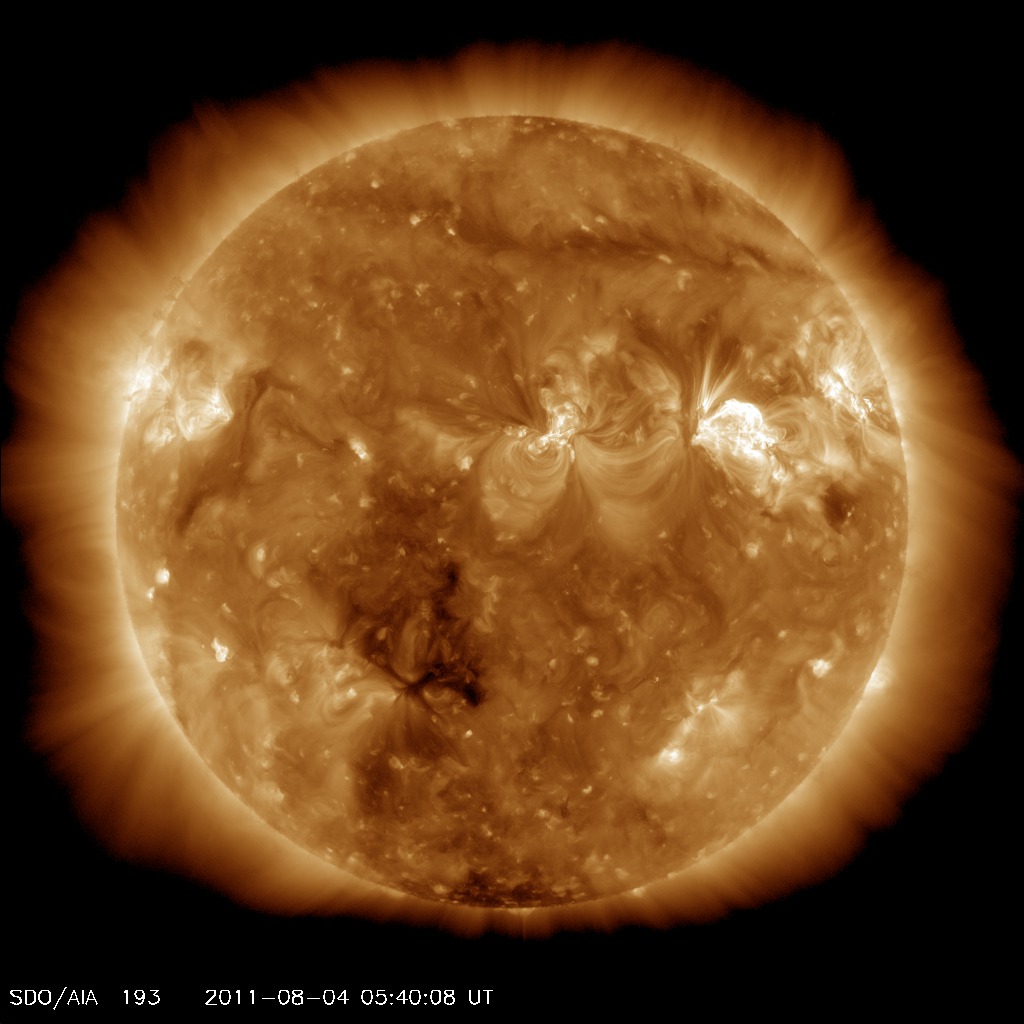
A solar wind stream flowing from the indicated coronal hole should reach Earth on Aug. 7th or 8th. Credit: SDO/AIA.
STRONG SOLAR ACTIVITY: For the third day in a row, active sunspot 1261 has unleashed a strong M-class solar flare. The latest blast at 0357 UT on August 4th registered M9.3 on the Richter Scale of Flares, almost crossing the threshold into X-territory (X-flares are the most powerful kind). The number of energetic protons around Earth has jumped nearly 100-fold as a result of this event. Stay tuned for updates.
INCOMING CLOUDS: At least two coronal mass ejections (CMEs) are now en route to Earth, propelled toward us by eruptions in the magnetic canopy of sunspot 1261 on August 2nd and 3rd. Analysts at the GSFC Space Weather Lab have just produced a new 3-D model of the advancing CMEs. Click on the image to set the clouds in motion below:
Behemoth sunspots evolve
The SDO team has just prepared a beautiful movie of the explosion that produced the CME.
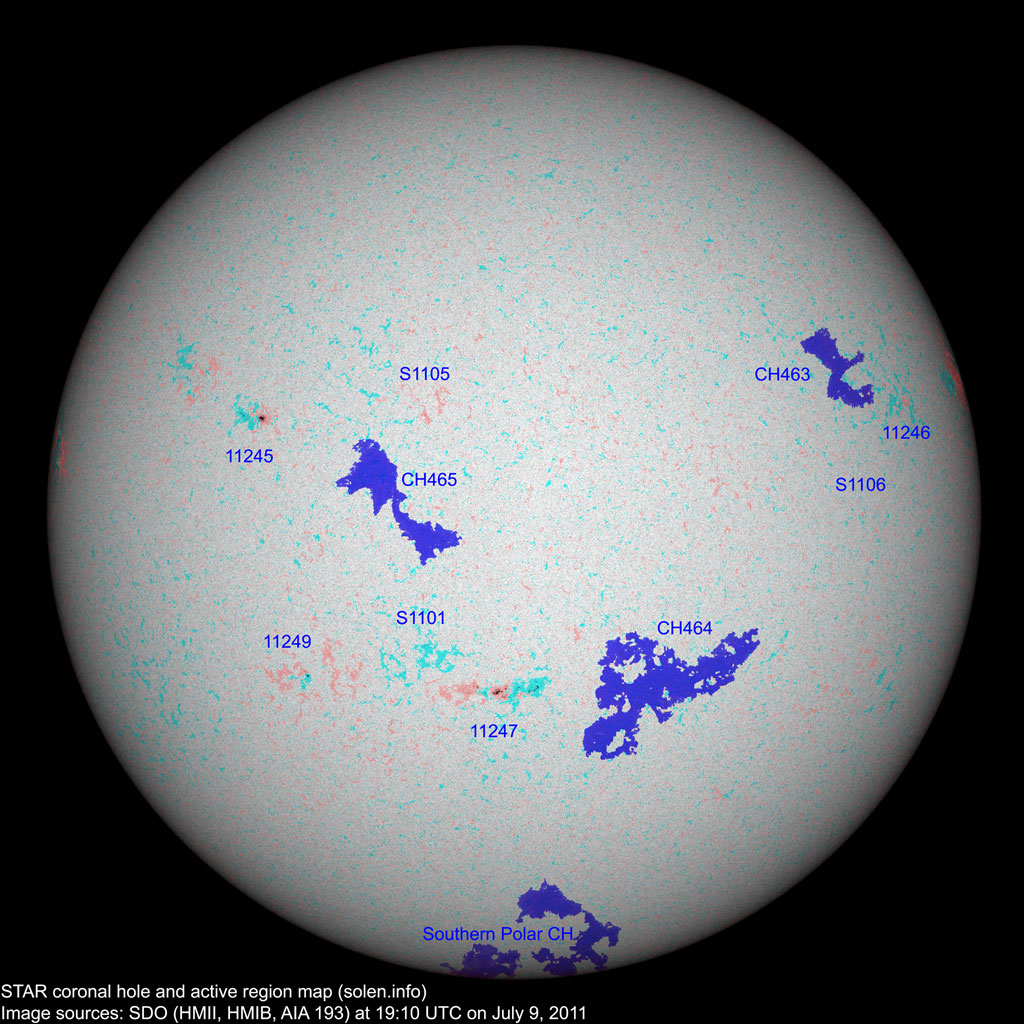
Sunspot group 1247 is expanding rapidly and in an interesting way. The active region is organizing itself as a linear Read more…
Solar Activity Intensifying
Dr. Mark Sircus, Contributing Writer
Activist Post
On June 7th, Dr. C. Alex Young from the NASA Goddard Space Flight Center woke to an email from a friend saying, “I have never seen anything like this before.” There are many things happening around us that we have not seen before, but when it happens on the sun certain people take notice. On the 7th the sun produced a prominence eruption and Dr. Young had never seen such a spectacular event, which luckily did not affect the Read more…
Incoming Geomagnetic Storm Alert:C7-Flare/CME (June 21st, 2011).
INCOMING: Magnetic fields above sunspot complex 1236 erupted during the early hours of June 21st, producing a C7-class solar flare and a full-halo CME. The expanding cloud appears to be heading almost directly toward Earth:
This does not appear to be an especially powerful CME. Nevertheless, the incoming cloud could trigger polar geomagnetic storms when it reaches Earth on or about June 23rd. The aurora outlook favors southern hemisphere observers, where solstice skies are winter-dark. Stay tuned for updates.
Solar Threat: We’ll Have Minutes to Respond; Government Plans Controlled Blackouts; Elite Contingency Plans
 While many will claim that solar storms are an unrealistic threat to our world, the governments of the United States and the United Kingdom aren’t taking any chances.
According to a report put together by Alex Thomas of The Intel Hub, the threat is not only real, but very likely, and could change the world as we know it from one day to the next:
In a stunning announcement, The United States and United Kingdom are likely set to began “controlled” power cuts in preparation of a giant solar storm.
The announcement by Thomas Bogdan, the director of the US Space Weather Prediction Centre, comes a week after a large scale solar flare released a massive amount of radiation and threatened to cause moderate disruption.
The solar flare on June 7th, 2011 was luckily pointed away from Earth but caused Read more…
Giant “Surfing” Waves Roll Through Sun’s Atmosphere
 Surfer waves — initiated in the sun, as they are in the water, by a process called a Kelvin-Helmholtz instability — have been found in the sun’s atmosphere. Credit: NASA/SDO/Astrophysical Journal Letters
Surf’s up on the Sun! Our favorite gnarly spacecraft, the Solar Dynamics Observatory (SDO) has caught conclusive evidence of classic “surfer waves” in the Sun’s atmosphere. But these waves trump ‘Hawaii Five-O’ surfing big time. These solar waves are about the same size as the continental U.S, and spotting these waves will help our understanding of how energy moves through the solar atmosphere, known as the corona.
Just like a surfing wave on Earth, the solar counterpart is formed by Read more…
‘Dramatic’ solar flare could disrupt Earth communications
Handout photo released by NASA Earth Observatory on June 7, 2011 and taken from NASA’s Solar Dynamics Observatory (SDO), sunspot complex 1226-1227, shows the Sun unleashing an M-2 (medium-sized) solar flare.
WASHINGTON – An unusual solar flare observed by a NASA space observatory on Tuesday could cause some disruptions to satellite communications and power on Earth over the next day or so, officials said.
The potent blast from the Sun unleashed a firestorm of radiation on a level not witnessed since 2006, and will likely lead to moderate geomagnetic storm activity by Wednesday, according to the National Weather Service.
“This one was rather dramatic,” said Bill Murtagh, program coordinator at the NWS’s Space Weather Prediction Center, describing the M-2 (medium-sized) solar flare that peaked at 1:41 a.m. Eastern time in North America, or 0541 GMT.
“We saw the initial flare occurring and Read more…
Solar flaring warning issued

A solar wind stream flowing from the indicated coronal hole could reach Earth on or about June 4th. . Credit: SDO/AIA.
Cape Town – The Space Weather Centre has warned that the sun is undergoing some instability, which has implications for electronic communications.
“There is a very active area on the sun as rotated onto the invisible solar disc. This active area has got the potential for more flaring for the next five to six days,” space weather forecaster Kobus Olckers of the Space Weather Warning Centre at the Hermanus Magnetic Observatory told News24.
He said that communications and electronic systems might be affected.
“The internet could be a little slower for the next week or so and especially long distance communications.”
Polar routes
Scientists recognize three major Read more…


![[Most Recent Quotes from www.kitco.com]](https://i0.wp.com/www.kitconet.com/charts/metals/gold/t24_au_en_usoz_2.gif)
![[Most Recent Quotes from www.kitco.com]](https://i0.wp.com/www.kitconet.com/charts/metals/silver/t24_ag_en_usoz_2.gif)

 crisisboom
 CRISISBOOM
You must be logged in to post a comment.