Archive
IMF Says Europe’s Debt Woes Could Spread
 The International Monetary Fund is warning that the governmental debt problems in Greece, Ireland and Portugal could spread to other European countries that employ the euro currency and also to the emerging economies in eastern Europe.
In its semi-annual report on the European economy, the IMF said Thursday that officials so far have been able to contain the continent’s debt contagion to the three countries on Europe’s geographic periphery. But the Washington-based financing agency said there “remains a tangible downside risk” of debt problems spreading. It said European nations will have to make “unrelenting” efforts to contain their financial problems.
The IMF said weak banking systems remain a threat to the financial health of the 17 nations where the euro is the common currency. It said the reduction in the number of banks in Europe is proceeding too slowly and that greater financial integration on the continent is needed.
Greece and Ireland reluctantly accepted bailouts from the IMF and their European neighbors last year and now Portugal is Read more…
Deutsche Bank Sees Gold Surging as High as $2,000 as Soros Pares His Bets
Investors including George Soros and John Paulson invested in gold as the metal surged over the past year amid a sovereign debt crisis in Europe, economic turmoil in the U.S. and civil unrest in the Middle East. Photographer: Junko Kimura/Bloomberg
May 10 (Bloomberg) — Michael Yoshikami, who oversees $1.1 billion as chief investment strategist at YCMNet Advisors in Walnut Creek, California, talks about global stocks and commodities. Yoshikami also discusses bonds, the U.S. economy, and BYD Co.’s plan to list shares on the Shenzhen exchange. He speaks from Singapore with John Dawson on Bloomberg Television’s “First Up.” (Source: Bloomberg)
Gold, which reached a record on May 2, may surge a further 30 percent by January as investors seek to protect themselves from “economic uncertainty,” according to Deutsche Bank AG.
“I’m bullish on gold despite its current levels,” Hal Lehr, Deutsche Bank’s managing director for cross-commodity trading, said in an interview in Buenos Aires. “It could reach $2,000 an ounce in the next eight months.”
Investors including George Soros and John Paulson invested in gold as the metal surged over the past year amid a sovereign debt Read more…
PBOC’s Zhou Urges Cutting China’s $3 Trillion of Foreign-Exchange Reserves
Zhou Xiaochuan, governor of the People’s Bank of China. Photographer: Qilai Shen/Bloomberg
China needs to reduce its foreign- exchange reserves as they exceed the level the nation requires, central bank Governor Zhou Xiaochuan said.
The management and diversification of the holdings, which topped $3 trillion at the end of March, should be improved, Zhou said after a speech at Tsinghua University in Beijing late yesterday. The rapid accumulation is putting pressure on the sterilization operations of the People’s Bank of China, he said.
The nation’s foreign-exchange reserves climbed $197 billion in the first quarter, reflecting global imbalances that Group of 20 finance ministers agreed last week to address through deeper scrutiny of their economic policies. China’s surging holdings are fueling inflation that accelerated last month to the highest in 32 months, prompting the government to boost banks’ reserve requirements this week for the fourth time this year.
“Foreign-exchange reserves have exceeded the reasonable levels that we actually need,” Zhou said. “The rapid increase in reserves may have led to excessive liquidity and has exerted significant sterilization pressure. If the government doesn’t strike the right balance with its policies, the build-up could cause big risks,” he said, without elaborating.
The world’s second-biggest economy grew 9.7 percent in the first quarter from a year earlier, faster than economists had forecast, and consumer prices climbed Read more…
US deficit up 15.7% in first half of fiscal 2011
AFP
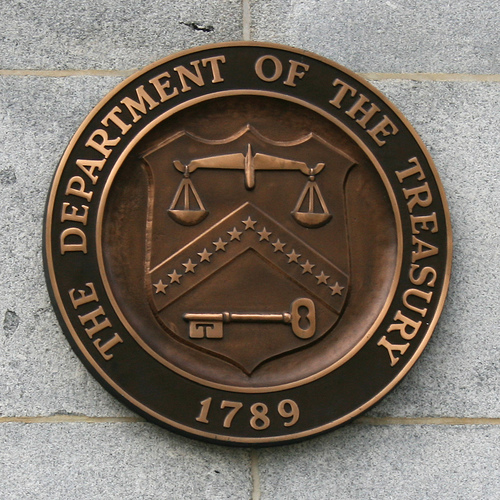 WASHINGTON — The US budget deficit shot up 15.7 percent in the first six months of fiscal 2011, the Treasury Department said Wednesday as political knives were being sharpened for a new budget battle.
The Treasury reported a deficit of $829 billion for the October-March period, compared with $717 billion a year earlier, as revenue rose a sluggish 6.9 percent as the economic recovery slowly gained pace.
The Treasury argued that the pace of increase in the deficit was deceptive because of large one-off reductions in expenditures made during the first half of fiscal 2010, compared with previous and subsequent periods.
Those included a $115 billion reduction in funds spent on the Troubled Asset Relief Program (TARP) — the financial institution bailout program — in March 2010.
But 2011 so far has also seen significant increases in spending on defense, Social Read more…
Look Out Above for Gold and Silver Prices
 By Greg Hunter’s
Gold hit another all-time high yesterday, closing well over $1,450 per ounce. Silver’s closing price of more than $39 per ounce is the highest it has been in 31 years. Why the big jump in gold and silver prices? The answer is pretty scary because there are many reasons precious metals are heading higher. Let’s start with the most obvious —inflation. Kitco.com reported yesterday, “The precious yellow metal got a fresh influx of investment buying based upon heightened inflationary expectations, safe-haven demand and a weakening U.S. dollar index.” (Click here for the complete Kitco.com story.) You can give the same reasons for rising silver prices.
In the case of silver, many experts say it is way undervalued and will outperform gold as Read more…
In Case of Govt Shutdown, IRS Would be Closed but not Federal Reserve or POMO
In order to make the biggest strawman so far in 2011 really scary and nasty, the administration just announced that as part of a government shut down, the IRS would end up being closed. While according to some this is the ulterior motive all along to avoid the premature outflow of tens of billions in cash due to federal tax refunds hitting the IRS next week, which without a debt ceiling hike would push the country into technical default possibly as soon as next week (debt subject to the limit was $14.2 trillion two days ago, just $94 billion under the ceiling and with about $74 billion in debt to be issued next week a $20 billion tax refund withdrawal would push the Treasury over the limit), what is far more amusing is that as the WSJ reminds us, the Fed would still be able to monetize debt regardless if the government was operating or not. Ergo nothing can end POMO ahead of Read more…
Seven Reasons We’re Buying a Home and Four Reasons We’re Not
Although the housing bubble and bust may have shattered notions that home prices have nowhere to go but up, Americans haven’t lost their love for owning a home. In the latest Allstate/National JournalHeartland Monitor poll, homeownership ranked second, just behind raising a family, in people’s definition of the American Dream. Despite new home sales’ drop to a record low, about four-fifths of respondents said that owning a home is still a better financial decision than renting, and nearly nine in 10 homeowners say would buy their home again.
Those results also underscore the extent to which Americans see buying a home as a deeply personal decision. It seems the decision to buy a home is made from the heart, while the decision to rent comes from the wallet.

That is a great way to look at the situation. Most people want to buy and own. Those who look rationally at the costs often chose to rent, not because it’s the most emotionally pleasing choice, but because it’s the most financially sound decision. Those who chose to rent recognize that being house poor is its own form of Read more…
Worldwide Silver Shortage?

FutureMoneyTrends.com has recently received several reports, published and non published reports about possible silver shortages. Is their a very limited supply of silver, yes, is there a worldwide shortage happening right now, well not exactly. Under the agreement that we wouldn’t reveal their name, a major bullion dealer who we are friends with, told us that their traders are not having any issues buying physical silver, and that their warehouse had a significant amount of physical silver. Now, will there one day be a shortage of silver, in our opinion at these prices, yes, the price for silver will have to move up considerably in order to come in line with the above ground available supply and ever increasing demand. Sorry to disappoint you, Read more…
True Obama debt bigger than planet’s entire GDP
 President Obama |
As the Obama administration prepares to finance a Fiscal Year 2011 budget deficit expected to top $1.6 trillion, the American public is largely unaware that the true negative net worth of the federal government reached $76.3 trillion last year.
That figure was five times the 2010 gross domestic product of the United States and exceeded the estimated gross domestic product for the world by approximately $14.4 trillion.
According to the U.S. Department of Commerce Bureau of Economic Analysis, U.S. GDP for 2010 was $14.861 trillion. World GDP in 2010, according to the International Monetary Fund, was $61.936 trillion.
“As government obligations continue to spiral out of control and the U.S. government shows no willingness to make the magnitude of spending cuts required to return to fiscal responsible, the U.S. economy is headed to a great collapse coming in the form of a hyper-inflationary great Read more…
Currency Meltdown Coming
 By Greg Hunter’s USAWatchdog.com
The situation in Japan is getting worse, not better. There are shortages in food, fuel and warm dry shelter. To make matters exponentially worse, nuclear power plants there continue to burn out of control and emit high levels of radiation. Japan is a stark reminder of how fast a modern technologically advanced society can be brought to its knees by an unforeseen calamity.
On the other side of the Pacific, the devastating pictures from that island nation are taking the attention away from our own, much more predictable, calamity coming from a tsunami of debt. As the U.S. and other world governments continue to print money to keep the banks and system solvent, a ball of debt is growing. It is on course to Read more…


![[Most Recent Quotes from www.kitco.com]](https://i0.wp.com/www.kitconet.com/charts/metals/gold/t24_au_en_usoz_2.gif)
![[Most Recent Quotes from www.kitco.com]](https://i0.wp.com/www.kitconet.com/charts/metals/silver/t24_ag_en_usoz_2.gif)

 crisisboom
 CRISISBOOM
You must be logged in to post a comment.